It’s around about this time in the season that some football managers glance over their shoulder and discover a huge black hole is in danger of swallowing them up. The gravity of the situation means some may be in danger of crossing the Premiership survival event horizon, from which there is no escape. Their best hope is the journey through the wormhole into the Championship will not stretch their credibility as managers to breaking point.
You could say managers careers are a bit like quarks – up, down, top, bottom, strange and charm[ed]. It will take the finest footballing brains to calculate the best way to achieve survival in the coming weeks – though I doubt even Stephen Hawking would be able to find the right equations to help get some clubs out of the quark-soup they find themselves in.
So Aitor Karanka has six rivals in his battle to avoid relegation – a mixture of the up-and-coming, the tried-and-tested and the unpredictable. They’ve all come to the Premier League through different journeys but one thing they have in common is they definitely don’t want to blot their copy-books with a relegation. Some are household names but others are less well known but who is best-suited to the task at hand? I’ve done a bit of research and tried to summarise their careers so far – from starting out as a player to getting on to the manager’s merry-go-round. It’s by no means a comprehensive assessment of them as managers, but it may give you a brief insight into how they got where they are now.
Eddie Howe (39) – Bournemouth
Appointed: Oct 2012 – Position: 14th – Points: 26 – Form: DLDLLL
Howe spent nearly all his career as a defender with Bournemouth until it was cut short at 29 by a knee injury – he then took on the role of the Cherries reserve team coach and eventually was given the opportunity to manage the first team in January 2009 as they struggled at the bottom of League 2. He managed to overturn a 17 point deficit and escape the relegation zone and then went on to achieved promotion to League 1 in his next season, despite a transfer embargo still in place on the club.
He was snatched by Burnley in January 2011 and took them to 8th in the Championship in his first season – though he returned to Bournemouth in autumn 2012 after failing to settle at Turf Moor. He won promotion to the Championship in his first season back and two years later he took the Cherries to the Premier League. He gained a reputation for playing attractive passing football and managed to keep Bournemouth in the top tier by finishing five points above the relegation zone on 42 points.
Paul Clement (45) – Swansea City
Appointed: Jan 2017 – Position: 15th – Points: 24 – Form: WLWWLW
His playing career never progressed beyond non-league level, though his father Dave was a right-back for QPR and his brother Neil a defender at WBA. He chose instead to concentrate on coaching from the age of 23 and obtained his UEFA ‘A’ licence in 1999. He was soon appointed a coach at Fulham’s academy and also worked with the Republic of Ireland’s U-21 squad.
He eventually joined Chelsea’s coaching set-up in 2007 and was made a first-team coach in 2009 under Gus Hiddink. He was subsequently appointed assistant manager to Carlo Ancelotti and they won the title in his first season. He continued his relationship Ancelotti and followed him to PSG, where they won the French title in their second season. Then in 2013 he became assistant manager at Real Madrid when Ancelotti became head coach and went on to win the Champions League in their first season, but a trophyless second season got the Italian the sack and Clement walked out a few days later.
In June 2015 he got his role as a number one and was appointed manager of Derby County following Steve McClaren’s dismissal, but despite being comfortably placed in 5th with only one defeat in his last 19 games he was surprisingly sacked the following February. Once again Clement joined up with Ancelotti, this time at Bayern Munich, but after six months he took up the offer in January 2017 from Swansea to become their manager and save them from relegation.
Claudio Ranieri (65) – Leicester City
Appointed: Jul 2015 – Position: 17th – Points: 21 – Form: DLLLLL
Ranieri started playing football as a defender with Roma but achieve little first-team experience there and spent most of his 12-year career with less fashionable Italian clubs such as Cantazaro and Catania where he played in the first and second tier – though he managed to achieve four promotions as a player.
He moved into management initially at amateur level in Italy and then with a small minor club before joining Cagliari in 1988 where he made his name by getting them promoted from the third tier to Serie A in successive seasons. He developed a reputation for playing in a style that allowed for a smooth switch in tactics during the game.
This success lead to a short stint as manager of Napoli during the end of Maradona’s time at the club where he achieved a fourth spot in Serie A, but was dismissed in his second season after being knocked out of the UEFA cup. He then took over a Fiorentina and gained promotion to Serie A in his first season, then flirted for a time with the possibility of winning the title in his third season before falling away into fourth spot.
In 1997, Ranieri moved to Valencia where he established them as a growing force in Spanish football but only achieved a fourth place finish in the four years he was there – he left a popular man with the supporters and was responsible for developing several promising young players including a certain Gaizka Mendieta. He then briefly managed Athletico Madrid but apparently jumped before he was pushed by notoriously impatient chairman Jesus Gil as the club struggled financially.
Then in 2000 he arrived in England to become Chelsea manager, where he was tasked with rebuilding an ageing squad. It was when he was given the nickname ‘The Tinkerman’ in 2002 for his constant use of squad rotation though arguably it eventually paid dividends as a fresh squad made a late run and qualified Chelsea in the Champions League for the first time, which was achieved despite limited signings as the club struggling financially.
The arrival of Roman Abramovich put Ranieri’s future in doubt as the Russian coveted a big name manager, after speculation linking Sven-Goran Erikisson he was finally relieved of his duties as ‘Special One’ Jose Mourinho was appointed. Though it’s worth noting that the nucleus of Jose’s title-winning squad had been assembled by Ranieri and he’d built the foundations by increasing Chelsea’s points tally in each of his four years in charge.
Next up came a return to Valencia to replace Rafa Benitez who had just won the Spanish Title and UEFA Cup and was off to Liverpool. But criticism of his rotation policy together with an autumn slump and ejection from Europe lead to his dismissal after only seven months in charge.
After a two-year absence from management Ranieri returned to Italy to take over at Parma in mid-season to help them avoid relegation – a task he succeeded in with some eye-catching results along the way. There was speculation linking him with a return to England at Manchester City and Parma decided not to extend his stay but in the end Ranieri headed to newly promoted Juventus in June 2007 on a three-year deal. It started well and he finished an impressive third in his first season and the next season also began strongly but a two-month slump in form left many criticising his team selections and despite finishing third again Ranieri was dismissed at the end of the season.
Though he was soon back in work as manager of Roma and did well in his first season and topped the table for a period but was beaten to the title by Jose Mourinho’s treble-winning Inter Milan. His second season didn’t start well and he fell out with club captain Francesco Totti and following a long bad run Ranieri resigned in February 2011. He was then installed as Inter Milan manager five games into the 2011-12 season after they’d lost 4 out 5 opening games – Ranieri got them firing again and they were soon back in the title race, but a run of only two wins in three months towards the end of the season earned him the sack.
Ranieri headed off to France and was tasked with getting Monaco promoted to Ligue 1, which he achieved in his first season as winners and then impressively finished in second spot behind title winners PSG in his second season. A brief spell in charge of Greece ended abruptly after losing at home to the Faroe Islands, before in July 2015 he was appointed manager of Leicester City and the start of one of the most amazing stories in modern footballing history as they went on to become Premier League champions.
Marco Silva (39) – Hull City
Appointed: Jan 2017 – Position: 18th – Points: 20 – Form: LWLDWL
Silva’s playing career was almost entirely in the second and third tier of the Portuguese league, where he performed as a right-back until he stopped playing at the end of the 2010-11 season whilst at Estoril. The club then made him their director of football but he soon found himself in charge after they sacked their coach. In his first season in management he won the league with Estoril to take them up into the top division and followed that up the next season by finishing 5th and qualifying for the Europa league.
He went one place better in his next season which caught the attention of Sporting Lisbon who gave him a four-year deal as their manager. In his first season at Sporting he finished third and also won the Portuguese Cup, but was incredibly sacked four days later for failing to wear the club’s official suit at a game.
Silva then moved to Greece to become manager of Olympiacos and won the title with six games to spare, including a run of 17 consecutive victories to set a new European-wide league record for this century. He then subsequently quit the club after his first season ended citing personal reasons. His success as a young manager has now brought him to the Premier League as the manager of Hull, bringing his management team with him. What appeared a lost cause as the club sold their best players now seems to be a possible chance to impress as he hit the ground running.
Sam Allardyce (62) – Crystal Palace
Appointed: Dec 2016 – Position: 19th – Points: 19 – Form: LLLWLL
Big Sam started as an apprentice at Bolton and made his Second Division debut as a centre-half in 1973 but took a couple of years to establish himself in the team. Bolton finally got promoted in 1978 and spent a couple of years in the top tier before being relegated with replacement manager Stan Anderson. Allardyce reportedly didn’t get on with Anderson and also felt underpaid so decided to move on.
He turned down Norwich and agreed to join Derby but a the last minute chose Sunderland after an offer of better money – though after two seasons at Sunderland he lost his place in the team and decided to leave. He turned down a return to Bolton because they could only pay half what he earned at Sunderland and instead made a surprise move to Third Division Millwall who not only matched his wages but gave him a £30k signing-on fee plus £10k loyalty bonus. He was actually offered the manager’s job at the Den in 1982 but turned it down as he thought at 28 was too young. Instead George Graham became manager but the two fell out after Sam refused to ‘grass’ on team-mates who broke Graham’s rules, he was subsequently frozen out and Graham agreed to pay £15k to cancel his contract.
Alladyce then ended up playing briefly in the US for Tampa Bay and it was perhaps a move that would have a lasting impression as his eyes were opened to modern practices in training and tactics that would later be a hallmark of his managerial career.
He returned to England but was a physical but limited footballer more known for his hard tackling than ability with the ball and after one season under Bobby Gould at Coventry was released and spent his subsequent playing career outside the top flight until he stopped playing first-team football.
Allardyce’s first coaching role was at WBA under Brian Talbot and it lasted two years until they were both sacked for losing to non-league Woking in the FA Cup. He then became player-manager at Limerick for one season which ended in promotion to the Irish Premier League and he returned to England to coach at Preston, including a short spell as caretaker manager – he left after two years ironically citing opposition to extreme long ball tactics.
He was appointed Blackpool manager in 1994 and it concluded by him being sacked at the end of his second season by chairman Owen Oysten from his prison cell after losing in the Division Two Play-offs. Big Sam then took on the manager’s job at Notts County but couldn’t stop them being relegated from Division Two – but the following season they won the league by 19 points and were already promoted in March. But Allardyce felt he didn’t get the financial backing required to take the club forward and resigned in October 1999 to join Bolton as manager.
After taking over at Bolton, he narrowly missed out on promotion in his debut season, losing in the 2000 Play-off final, as well as both semi-finals of the Cups incidentally – this was despite having to sell a key player in Andy Todd after he broke the jaw of assistant manager Phil Brown during a team-bonding exercise that went wrong. Bolton won promotion the following season through the Play-offs and Big Sam established them as a Premier League side over the coming seasons.
It was at the Trotters that he gained his reputation as an innovative coach using sports science and technological aids as well being open to alternative therapies like yoga and psychology – preparation and organisation were key elements to his success. After seven years at the club he eventually resigned in April 2007 with the club in 5th place, stating chairman Phil Gartside was unwilling to match his ambition and increase funding to take them to the next level and become a top four team.
Soon after he became Newcastle manager but his style didn’t go down too well with the locals and then following a bad run he was dismissed in January 2008 and replaced by Kevin Keegan. Allardyce then became Blackburn manager in the following December and kept them safely in mid-table for two seasons but when the Venky’s took over he was replaced a few months later by his coach Steve Kean. Big Sam then took over at newly relegated West Ham and achieved promotion through the Play-offs at his first attempt. Despite them finishing regularly in mid-table in the Premier League the fans didn’t warm to his style of football and many were quite vocal in wanting him out, though he remained in charge until his contract expired at the end of the 2014-15 season
Then following a bad start to the season at Sunderland he replaced Dick Advocaat as their new manager and once again successfully steered them out of the relegation zone by the end of the season – he was widely praised for his organised approach, which resulted in him being rewarded by being appointed England manager. Though his dream job didn’t last long as he was dismissed after only one game in charge following being secretly filmed explaining to fake businessmen how to circumnavigate FA rules on third-party player ownership.
Though his relegation rescue services have been called on once more, this time Crystal Palace hired him in December 2016 following the sacking of Alan Pardew.
David Moyes (53) – Sunderland
Appointed: Jul 2016 – Position: 20th – Points: 19 – Form: DLLDWL
Moyes began his senior career at Celtic and won his only major playing honour with them, a 1981-82 Scottish Championship medal. Most of his playing days were spent as a centre-back in the lower English leagues with the likes of Cambridge and Shrewsbury, then after a few years back in Scotland with Dunfermline and Hamilton he spent the last six years of his career at Preston. He combined his playing at Preston with coaching roles, working his way up to assistant manager before being offered the manager’s job in 1998 after the club sacked their manager.
Moyes had been preparing for management since his early 20’s, he was a fully qualified coach at 22 and was known to take notes on the techniques used by his managers. He avoided the drop with Preston and got to the Play-offs the following season before winning the league the year after to gain promotion to the second tier. The following year he almost won promotion to the Premier League but lost in the 2001 Play-off final.
This feat had got him noticed by bigger clubs and was appointed manager of Everton in March 2002. Moyes spent over ten years at Everton and was generally applauded for his achievements with a club who were no longer part of the ‘Big Four’, though his first four seasons were a mixed bag of good followed by bad seasons but after that he usually finished just outside the top four. Only once did he qualify for the Champions League but lost in the qualifying stages and never got beyond the last 16 of the Europa League in four attempts.
Sir Alex Ferguson saw in the disciplinarian Glaswegian a man in his own image and he became his anointed successor in July 2013 – however he had a hard act to follow and never settled quickly into the job, which left United suffering a bad start to the season. After getting knocked out of the Champions League at the quarter-final stage and only sitting in seventh spot in the league, with no chance of making the top four, Moyes was sacked after only ten months in charge.
In November 2014 Moyes returned to football at Real Sociedad in La Liga, a role that lasted almost exactly a year before he was once more sacked for a poor start to the season. Sunderland appointed him to replace the England-departing Sam Allardyce in July 2016 as their seventh manager in a little over three years.
Exmil Challenge
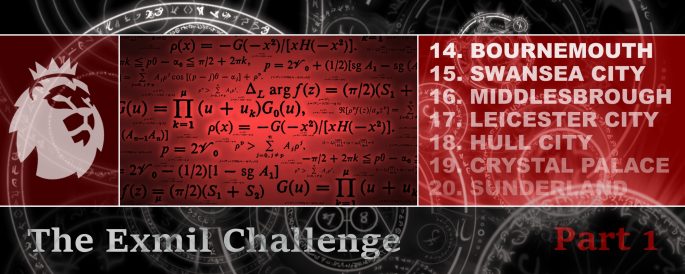
The Exmil Challenge will be starting again next week – It’s the chance to predict how you think the relegation teams will perform until the end of the season. It will be in three parts, with the first part taking us up to the International break and a chance to reflect and compare notes before part 2.
Exmil will be managing it but I will be assisting with the process by creating a form that enables you to easily select your predictions, which then get automatically submitted directly to Exmil’s mailbox – I’ll also add a few stats and tables to help you decide too.
We need to wait until after the FA Cup weekend to see which fixtures will be affected by the Quarter-final games – so it will probably be next Wednesday.