The heat is on as fired-up Boro head to the Potteries

Watching Karanka’s press conference yesterday he appeared in confident mood ahead of the trip to Stoke and there was little sign of a man under pressure – he actually made the point that he sets the example to his players by walking with his head up and showing belief in what they are doing.

His reflection on the Palace game was that it was simply an aberration brought on by the last minute news from the Team Doctor that Friend was not available and thus ruining the week’s game preparation – no doubt his mentor would have offered more severe treatment to such an oversight from a member of his medical team.

Though why Karanka thought it was better to completely change the shape of the team rather than use a makeshift full-back remains unanswered. Interesting when quizzed over why Husband didn’t get the shout his reply was basically he was not up to dealing with Townsend and it would have been an ‘excuse’ to select him – though how the player takes that damning assessment is anyone’s guess.

There is often a degree of news management with Karanka when quizzed about Boro’s current position in the table and where we may expect to finish. According to the boss “We are in the position I thought we would be” – so the bar he has set is 17th place and that is the message he wants to get across.

Though is this our realistic position and are we meeting expectations? I had a quick check yesterday on where promoted clubs finish in their first season – it’s not usually as low as 17th for two-thirds of the newly arrived teams as the average finish is actually 15th –  with many clubs finishing comfortably in mid-table and only one of the three promoted teams actually ending up being relegated. So whilst a promoted club would happily snap your hand off for 17th spot before the season started it’s not, or it should not be the measure or the target to aspire to.

Below is a table showing the finishing positions of the promoted teams in the seven seasons Boro were out of the Premier League.

Season Promoted Teams (Position finished)
2009-10 Birmingham (9) Wolves (15) Burnley (18)
2010-11 West Brom (11) Newcastle (12) Blackpool (18)
2011-12 Swansea (11) Norwich (12) QPR (17)
2012-13 West Ham (10) Southampton (14) Reading (19)
2013-14 Palace (11) Hull (16) Cardiff (20)
2014-15 Leicester (14) Burnley (19) QPR (20)
2015-16 Watford (13) Bournemouth (16) Norwich (19)

I defy any manager (even those prone to control freakery) to be able to finesse one position above the relegation zone – in fact even Karanka mentioned that Boro could have had 32 points based on performances, which could be interpreted as we’ve either under-achieved or were the victim of unforeseen bad luck – though he may be right, I can probably think of five draws that Boro could on another day quite easily have won: Stoke (H), West Brom (H), Burnley (A), Leicester (A), West Ham (A).

So in some ways he’s saying we are where he thought we would be, but at the same time countering that by claiming an extra ten points would have been a fairer reflection, which could be an attempt to move the jelly-like goalposts away from those holding the hammer as they try to nail them in place. Though this type of duality is often what you tend to get with Karanka (and perhaps he’s not alone in the art of spin among managers) – it’s painting the picture in shades of grey to avoid having his hands tied by his record, though I’ll leave it to others to determine just how many shades of grey are permissible before the relegation watershed.

The Boro boss is also good at deflecting a seemingly critical point about being overly defensive and turning it with a straight face into a compliment – “we are in this position because we have a good balance between our defence and scoring goals”. There seems to be little acknowledgement to questions posed of how Boro can change in order to improve our goals-for record and he dismisses the idea of needing to change by just reiterating “we must continue to work hard” – he’s in no doubt that he and his team are working hard (which no doubt they are) and “they will fight until the last day” – though thankfully no mention of beaches.

However, in an article in the Telegraph yesterday he is quoted on the same subject of addressing the lack of goals with “There are things we are trying to do… For two or three weeks, we’ve been training to play quicker and doing exercises on the pitch to get the ball to the box quicker and to get more players into the box. But when you change things from one day to the next, it’s difficult.”

This raises the question of why has it only occurred to the Boro boss in the last couple of weeks that something needed to be done to address the problem of our pedestrian approach to scoring goals – these points have been highlighted for months by pundits and analysts alike so it will not surely have escaped his attention. Maybe someone raised the point in Benidorm after plucking up the courage after secretly downing a Zombie cocktail before an informal pool-side meeting. Perhaps it was Negredo with his lounger 30 yards away from the others who professed to be lonely on his own, which made something twig.

He has also pointed to the improved performances going forward against West Brom and Everton as an indication of his belief that Boro will prevail against their relegation rivals. He said about the game on Saturday “We have to show from the first minute that we want to win… as three points at Stoke is really important” – and that last statement cannot be over emphasised.

To have a good chance of avoiding relegation, Boro have few realistic opportunities left to achieve the four wins that must be regarded as needed at this stage. We still have to play five of the top six in our 11 remaining games after Stoke and although we play four of our relegation rivals, three of those are away (Swansea, Hull, Bournemouth) – plus the rearranged game at home to Sunderland – that leaves two other games where we host Burnley and Southampton.

These run of fixtures are in contrast to Hull and Swansea, who both only have two of the top six to play in their run-ins – plus they have shown in recent weeks that they have found much better form. On top of that Leicester looked back to their former selves post-Ranieri, which means the task facing is Boro beginning to appear less comfortable and surely it must be time to put the emphasis on employing tactics that concentrate on winning key games rather than attempting not to lose them. In addition, the meek performance last week at Palace is even more galling given that they also must play five from the top six and up until that point had no reason to cheer.

Karanka has batted away any suggestion that he has set a target for the number of wins required and insists he only focuses on each game as it comes. But surely that is just rather damp flannel for public consumption as he must have at least privately identified games that Boro need to try and win – especially as he also stated yesterday that the difference between the Championship and the Premier League is that we were capable of beating any team in the second tier but now the gap between the top six and the rest is massive. Which means he believes five of our remaining games are unlikely to lead to three points – leaving a realistic target of winning four from seven.

The good news is that both Friend and Barragan have trained all week with the squad, which should mean Karanka can field near enough his strongest XI. I suspect Ayala will partner Gibson with the looming aerial threat of Crouch and hopefully Friend and Fabio as conventional full-backs. The next question is how many defensive midfielders Boro will deploy – if it really is crunch time then the answer must be two. It could mean 4-2-3-1 and personally I’d play Downing behind Negredo and Gaston on the left, primarily because the Uruguayan has more pace for the counter attack. We should start with Negredo up top and surely Adama on the right. Who will be the midfield two? Leadbitter would drive the team forward and perhaps Clayton will want to celebrate his new contract.

Make no mistake this is probably the most important game of the season for Karanka – if Boro fail to turn up like last week then the message to the chairman will be stark. With only two games against both Manchester clubs before the international break, the question must come to mind of whether Karanka’s Boro are capable of winning at least two of those three games in the six days that follow the fortnight off. I’m of the view that Karanka will be unlikely to hang around should we be relegated – so it may well be a short-term decision is the only decision on the table – though I suspect Steve Gibson, despite all the stodge to digest, will not want to to be rude to his regular dining partner and won’t ask the waiter for the bill until he has brought the just desserts menu.

It’s impossible to conceive that Boro won’t be fired up for their visit to the Potteries – the relegation wheel may be turning but I’m not expecting Boro to throw this one as Stoke seemingly have nothing meaningful to play for.  Come the full time whistle there will be a sigh of relief and hopefully Gibson won’t be left to ponder whether it’s Karanka who has feet of clay.

OK, as usual give your predictions of team, score and scorers – will it be victory on a fine Wedgewood plate for Boro or will Karanka be looking at a wedgie from the chairman as Boro misfire?
Where did it go wrong Aitor?

When Steve Gibson summoned Aitor Karanka to take charge of Middlesbrough FC, he was hiring more than Boro’s first foreign manager. He was hiring a symbol. Someone who would take Boro beyond their parochial shell and into the dreams, and realities, of twenty-first century top flight football while retaining the local pride that made Boro unique.

Under Tony Mowbray, Boro had restored that pride. We had at times played exciting football on an unenviable budget. But we had lost that feeling of belonging at the top.

Then Karanka, or Aitor, or AK, came along. Now, AK had won titles and European Cups. He’d worked for a manager who’d won titles and European Cups. His homeland were then World and European Champions. He clearly felt entitled to win, to succeed, to compete at the very top, and wanted everyone else to share his desire, faith and commitment to the cause in a unified atmosphere. It is the kind of arrival that, when it goes right, fuels upwardly mobile momentum – and before long, it almost certainly did.

Having taken time – albeit significantly longer than fans would have liked – to lay strong defensive foundations and steer the club clear of danger, the team were granted license to move forward, and how they responded. After just under a year in charge the confidence of a newly unified and imperious Boro backline had spread to the rest of the team. A model of stylish solidity and patient, passing probing, a commanding collective, had gradually emerged from the shambles of a sadly-never-forgotten first half at Barnsley in October 2013.

Of course it was far from all sweetness and light – there were naughty steps, costly mistakes, painful fall-outs and the most typical of Typical Boro heartaches to come on the way to the Premier League, but it was an unforgettable, remarkable and admirable journey.

So where did it go wrong?

On paper it would not appear to have gone wrong. Boro have been promoted after a seven-year absence from the top flight, are in the quarter-finals of the FA Cup, and are out of the bottom three, a situation that, at first glance, a lot of managers would gladly take.

But football is played on grass and mud, not paper, and the dour fare that the paying public have generally seen at the Riverside and on the road this season neither inspires nor motivates. There have been exceptions, but they’ve been small oases in a much larger desert.

In a way, early season contentment with a 17th place finish was a breath of rational air, which spoke to a long-term plan of establishing Boro in the Premier League. But, for Boro, it also falls into what writer Nick Miller called the who-are-you-trying-to-kid camp. A club that has invested so much money in and fan base that have waited so long for a return to the top will not, and cannot, simply be pleased with consistently and inescapably hovering above the drop zone, especially not in the manner Boro are.

There is no easy answer for this current malaise, but part of the blame has to lie with Karanka’s handling of individual skill. Despite brilliance, consistent or otherwise, from totems and wingers like Muzzy Carayol, Emmanuel Ledesma, Albert Adomah, Lee Tomlin, Diego Fabbrini, Gaston Ramirez, Adama Traore and home boy Stewart Downing, the strengths of Karanka’s Boro – AKBoro – have mainly sprung from the power of the consistent collective. Two of the most memorable AKBoro victories, at Manchester City and Brighton, sprung from a team effort focused on containment, keeping a clean sheet and sprinkles of individual class when it mattered. As perfect as those afternoons may have seemed then, is it unreasonable to suggest some may have preferred the shackles of the system to be let loose a little more?

With AKBoro, the offensive personnel have been traded over with almost alarming regularity. It is not that each set of signings, at least up until Ramirez and Jordan Rhodes, weren’t an undeniable improvement on what came before – it was more concerning that AKBoro, despite incredible statistics, struggled to find the right attacking blend. And with Boro no longer coasting on the goodwill of a title race or promotion, it is harder to attract or retain the right talent. Hence, perhaps, the underwhelming January signings and the trouble with Ramirez.

When a collective is no longer moving in the right direction, individual brilliance, more than ever, is required to raise it from stagnation and kick it into gear again. This is exactly what had to happen in January 2016, when the tide of the Karankanaut began to turn from the crest of its wave.

As talent in the squad grew, so did wages. And egos. And there can be little doubt Karanka was not wholly comfortable with this. As harsh as it may sound, we could say this arguably spoke to a relatable but unfortunate insecurity in AK’s character back then. It came to a head post-Rotherham, when an undermining of his authority in the heat of a promotion battle going wrong led to a threat to leave; theoretically, a possible psychological ploy to be reassured of his importance to the cause. It didn’t work. His bluff was called, and by the time he realised what he’d done it was too late. Of course, he came back and made up, and Boro made it up, but serious cracks had been exposed in a once imperious facade. As under Bryan Robson, we were thought of in some circles as a small club who tried to buy their way to the top and either failed, or nearly failed.

Karanka has sadly not learned his lesson over this unfortunate reverse psychology. What exactly did he hope to gain by naming Boro’s biggest win of the season as our worst performance of the season? In fairness, it was not a very good performance at all, and he may well have been reminding his players not to get carried away, but to make a public utterance like that, at Christmas, when we are so starved of wins and goals, invites fan theories that the manager is unhappy the team did things more their way than his. Sometimes you’ve got to play the game – and that time, he didn’t play it.

Patience has regularly been a virtue with AKBoro. We have seen that. But it is hard to ignore the feeling that this time, we have sailed into a storm. A manager once in control and seemingly at one with the club (remember the celebration in the stands against Derby?) looks like he is now fighting vainly to hide his desperation and edginess. We feel your pain too, Aitor, but at this time we need a positively strong figurehead to guide us to safety – and you must convince us you can be that again. We have the tools, the foundations, the goal difference and the position to build a successful end to the season, but we don’t seem to have the momentum and belief. It may still work out – but have we enough reason to believe that it will work out?

We can but wait. And hope that AK’s Boro can once again remind us why we dared to dream.

Pointless predictable passive passing paralysis at Palace

The line-up caused a few questions before hand, was Stewy playing as a wing back with Fabio on the other flank or was Ben playing as a traditional LB and Stewy playing central pulling the strings in midfield?

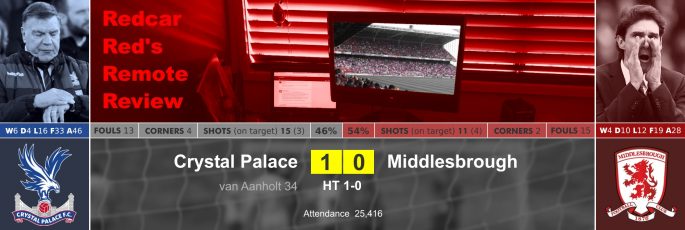
And so it was apparently three at the back which won the day as Boro lined up in their unfamiliar Yellow Championship away kit. The early action was a taste of things to come as Cabaye and Zaha took it in turns to trouble Ayala but it came to nothing fortunately. In the 5th minute Dani was lucky not to give away a penalty after a shove on Zaha which Ref Madely deemed as a shoulder “nudge” followed by a bit of a grapple. We were penned back and looking short on outlets, finally in the 11th minute Espinosa released Fabio on the flank and his cross led to a Stuani chance but de Roon eventually blazed over.

Any doubts about Gaston’s mind set was answered just after the quarter hour mark when he chased back covering for Downing, tackling a yard out from the corner flag preventing a cross. Benteke was apparently determined to moan his way through the match claiming a push, tug or shove at every opportunity. Valdes pulled off a brilliant save on 20 minutes going full stretch but the flag had gone up for a hand ball from the same moaning Benteke then Boro broke and Stuani had the ball poked away from him just as he swivelled to shoot in our only serious threat.

On the half hour Zaha was upended by Ayala again who looked to be walking a fine line before seeing a card the same shade as his shirt. Seconds later Cabaye tripped Stuani as he burst from the half way line leading to Madely producing the games first yellow.

Boro were struggling to get any type of grip on the game and in truth defensively we were hoofing and hoping and our Midfield far too deep and so inevitably van Aanholt picked up a ball in the edge of the box and drilled it home into the far corner as Boro failed to clear cleanly again after a series of desperate unconvincing headers. Stuani and Negredo were looking forlorn figures with poor to no service at best. Tactically it wasn’t working and didn’t look to be working anytime soon. Boro were pegged back and looked totally ineffective more than 20 yards out of their own goalmouth.

Breaking out we were passing about slowly easily read by Palace players and in truth a Traore type injection was needed. Any pre game thoughts I had that we would go for it was well wide of the mark with our second shot coming from a Negredo volley 30 yards out. The first half was one to forget for Boro, the back “3” was more of a back “5” with Negredo dropping deep into the middle of the park trying to service Stuani. We were far too deep and no relief from the middle as de Roon and Forshaw were deployed sweeping in front of our back five.

A disappointing and toothless first half which gave no indication from Boro whatsoever as to the importance of this game. AK certainly had to have a major rethink, what was on offer was a negative, dreary same old slow paced passing paralysis with nothing on offer from Fabio or Downing offensively and Ramirez trying to create but surrounded by Red and Blue stripes crowded out. The extra man caused by our “3” at the back stifled any hope we had of getting a grip of the game as Zaha and Townsend were simply free to rampage.

Half time changes were much needed along with a change in formation, surely the 46th minute would see the introduction of Traore with a CB being withdrawn? Well he made a change but it was Gestede for Negredo which shocked and surprised us all. The game kicked off and immediately Zaha drove into our box taking up where the Eagles had left off the first half. What Gestede was supposed to do was a mystery as thus far we had produced no service to our front two. The opening few minutes offered no solutions or any obvious tactical changes, very poor half time management it has to be said from AK. Forshaw did have a shot but as is typical it was high and wide, no change there then. The lad was running around but his lay offs and passing was far too slow and thus our creativity still floundered.

Sakho hadn’t played in months yet we put him under no defensive pressure at all. We needed a fortuitous break and it nearly came when Forshaw was upended but Gaston’s cheap dink over the wall was easily picked off by Hennesey. Gestede then attempted a cut back from the wide left and managed to hit the back of the stand somehow whilst attempting a cross. Forshaw’s dithering nearly cost us as he had his pocket picked in the middle of the pitch but fortunately Zaha fired wide.

A bit of intent led to Stuani striking a volley cleanly as the Palace box looked uncharacteristically busy but it was straight at Hennesey. A change on 60 minutes didn’t introduce some much needed pace but Guedioura on for Forshaw, not sure what that was all about as it didn’t introduce pace but he did at least look to pass forwards. This was looking extremely poor fayre and perhaps the Stanley and Oxford games had given the Players some misplaced belief.

Zaha was ripping us apart yet we had Traore sat on the bench, the irony was painful. AK’s tactics were still not working and any “tweaks” we had hoped for were moderate at best. Gibson tried a 40 yard daisy cutter which was about as good as our attacks were looking. Zaha broke again and Gaston and Fabio managed to tackle each other as we looked very edgy and slack. We tried to get forward in our ususal pedestrian manner but it was joyless to watch. The game passed 70 minutes and our tactics still failing miserably, bringing on Gestede just looked even more pointless and clueless.  AK’s inability to change a game was looking as ominous as ever, even a tame Guedioura shot couldn’t raise hopes. A full length Valdes clearance was the fastest we broke out all game but it lead to a Fabio yellow card for a challenge on Zaha yet again breaking away. Next it was Downings turn to dither and luckily Madely seen it the way of Stewy as Macarthur stubbed his toe on Stewy’s boot and collected a yellow for simulation in the box. Seconds later Stewy gave a free kick away just near the corner flag which Townsend took and fortunately Ayala’s gamesmanship took care of Benteke. Stuani was taken off on 77 minutes for Traore, again a strange shout for me considering we needed to score and almost immediately Ramirez hit the deck with cramp.

Tactics that clearly weren’t working with appallingly poor game management from AK, this was very reminiscent of our early Premiership games with incredible naivety and a lack of intelligent attacking intent. Poor substitutions with a total lack of willingness to change things, there again with 3 DM’s on the bench the options were self-restricting. It was the 86th minute before a long ball was hit up to Gestede that Fabio eventually fired wide from. Why put the big lad on if all we were going to do was conduct more passing paralysis.

Our movement off the ball was probably the worst I have witnessed, frozen and static just doesn’t cut it at this level. Incredible that as soon as we brought Traore on we then resorted to forlornly humping long balls up to Gestede. As if to rub salt into the wounds a Guedioura shot from outside the box almost hit the opposite Corner flag, it was poor fayre.

MOM there wasn’t one, I honestly struggled to rate any of them more than 4 out of 10. A more utterly hopeless, clueless and spineless performance I have yet to witness in a very long time. Abject does it credit. Put simply, not good enough and never ever looked like being good enough, no win in 9 games now and AK is now the Bookies favourite for the chop. Based on this performance it wouldn’t be a difficult decision for SG to make.

Utterly dreadful, 54% possession that was all harmless meaningless passes to nowhere in safe zones, wholly unacceptable for aside that went behind on 34 minutes. Like today’s Kit we looked like a Championship side all afternoon. When you are out of your depth against a fellow relegation struggler something needs answering and very quickly.

Boro hope to make an exhibition of Crystal Palace

So Boro are heading down to London this weekend for an appointment at the Palace where his royal high-and-mighty-ness the Duke of Lost Causes will hopefully bestow on our humble club the honour of three points for out long service in the defence of the clean sheet. Having made a right royal mess of his public duties as King of England, Big Sam abdicated his reign to allow a young former courtier at the Palace, Prince Gareth of South Gate to inherit his crown. Being caught jesting appeared not worthy of an excuse for a man who has seemingly waited longer than Prince Charles for the top job and the lords of the FA duly sent him into exile.

But the master of escapology has returned, though his hands appear still tied at Selhurst Park where the plan was to turn around a struggling team and chalk up another success. However it hasn’t gone to plan and Palace have lost six of their seven games in 2017 and have only scored in two of those. They didn’t get the bounce from Big Sam in the way Hull and Swansea did and the players confidence in the boss’s methods must now possibly be starting to come under question.

As a child, before I was into research of course, I often wondered why tomorrow’s opponents had such a seemingly odd name – Well in football terms, Crystal Palace first got an outing in 1861 as an amateur football club, which was created by the workers from the exhibition building after it was moved from its original location in Hyde Park to Sydenham Hill in south London. This amateur club only existed for around 15 years but after the stadium in the grounds of the Crystal Palace Exhibition building became the home of FA Cup final in 1895, the name was revived again ten years later by the owners of the building when they decided to form their own team as a means to attract visitors to the Palace.

During the First World War the football club were forced to relocate to Herne Hill after the Admiralty requisitioned the Exhibition building and then they subsequently took over Croydon Common Athletic Ground (known locally as the Nest) after Croydon became the only First Division team not to continue as a club after the war had ended. Finally in 1924, Palace moved to a purpose built stadium at Selhurst Park where they have resided ever since.

Well that’s enough history for today – now back to the crucial cliche-magnet relegation six-pointer on Saturday. This must be a game that Boro fancy they can get something from, though both teams seem to be struggling to score and the smart money may be on a goalless encounter and the last slot on MoTD, which has probably already been booked. Particularly as Allardyce has told his players that this is a ‘must not lose’ game for them. In his press conference, Karanka dismissed the notion that he had put a similar label on the game as he doesn’t want to place any undue pressure on his players. Though he re-iterated his belief that it was important not to lose a game if they couldn’t win it and he tries to ensure his team stays in the game as scoring in the 93rd minute is always possible (though not an often occurence to make it a game plan).

As for the team at Palace, Boro have injury problems with their full-backs – Barragan is still out and George and Chambers haven’t trained with the first team all week and are major doubts. It may mean that Gibson will play at left-back, allowing Fabio to return to his more natural right-back slot with Ayala and Bernado continuing their FA Cup partnership in the centre. The only other possibility would perhaps be a back three and some form of wing-backs – but I suspect Karanka won’t want to experiment too much on such an important game.

The Boro boss seemed to hint in his press conference that the team would continue in their more recent attacking vein, which could mean just the two defensive midfielders and possibly a start for Guedioura (the Watford lad) – though Downing has had some good games of late when he’s played and would want to impress his old gaffer. Perhaps Leadbitter and de Roon will get the nod this time but it could quite easily be any two from four.

I also expect Gaston on the left, Negredo in the middle and Adama on the right in terms of attack – so it could well be 4-3-3 or possibly even 4-2-1-3 depending on who is selected.

So will Boro leave the Palace bestowed with greatness or will Karanka fall on his sword as the team head back to Teesside with a knight to forget. OK, I know many of you have already had a busy week making predictions for the Exmil Challenge (and don’t forget the deadline if you haven’t yet submitted your entry to the Challenge closes at 14:00 on Saturday – an hour before kick-off) but perhaps you can indulge in one more – Score and Scorers, plus will Leo eat a Spanish Tortilla during the game – what are the odds on that Mr William Hill?

Time to get out the runes and make your calculations

Many of you will be familiar with the Exmil Challenge but for those who are not it has become somewhat of a tradition for fellow posters as the season reaches the sharp end. It’s a welcome chance to channel nervous energy by chewing over the possible outcomes of the upcoming games that involve Boro and our rivals.

The previous challenges involved Boro’s Championship campaigns and our rivals for promotion – but this year it’s all about staying in the Premier League and avoiding the dreaded relegation. Who will start to fade as the pressure mounts and which teams will become emboldened as they stack up the precious points.

The Challenge this year is in three parts, with the first part taking us up to the international break/borefest and a chance to reflect on how the situation is looking. By then it’s quite possible some of the teams currently involved will be waving at the relegation crowd from a safe distance, whist others will start to experience the mental strain and feel their energy being sapped by the all too real grip of relegation.

Last week I looked at the managers involved in the relegation struggle (A Brief History of Time in football management) which attempted to give an insight into how their team may fare by looking their previous experiences. Now it’s time to assess the possibilities of each team’s fixtures – for some of the teams playing below their potential a couple wins will lift the pressure and suddenly the game becomes easier. Swansea are an example of what winning games can do to a team and it would apply to most of the others too – particularly Leicester who not only can’t win but haven’t even scored in their last six games.

The difference with the predictions this time round (as opposed to promotion seasons) is that the relegation pack rarely win games. If you take a rejuvenated Swansea out of the equation (who have won four of their last six) the other six teams have only chalked up four wins between them from their combined 36 games – three of which were against fellow strugglers – twice Bournemouth and once against Palace. Basically, in the last four games, the  non-Welsh relegation teams are only averaging just over half of a point per game. So when making predictions do you play the percentages or do you take a punt on a few teams to try and gain an advantage.

Here are some words from Exmil

I thought that there would be no need for a challenge this year as I knew we would not be challenging for Europe but I was hoping we would not be involved in the relegation dogfight, I should have known that BORO do not do things the easy way. The challenge is the same as the past years, this year being in 3 parts, the first part taking us to the International break. Due to the success of Boro in the FA cup and other teams having fixtures being postponed due to their opposition being as successful as Boro, Part 1 and possibly Part 2 fixtures will be disproportionate until we know when the rearranged matches will be played, so in part 1 some teams will have 4 fixtures while others will have 3.

The format is the same as previous years, in that each entry will have to predict what each listed team will have at the end of each Part. If you predict the correct amount of points for a particular team, you will score 10 points but for every point + or -, you will lose a point. As an example if you predict Team A will have 28 points but they actually achieve 26 points you will score 8 points for that team, the same as if Team A actually achieves 30 points. Totaling the points you score for all teams will determine your position in the Exmil Challenge 2017 league and the points you score in Part 1 will carry forward into Part 2 then your total will carry forward into Part 3, at the end of which we will have our final placings and overall winner.

Werdermouth has devised an entry form to make predictions easier to submit (Is there no end to this mans talents) the form will show each teams fixtures and all you have to do is follow his simple instructions and press a button for win, draw or lose for each teams fixture and it will automatically increase that teams points total, depending whether you pressed win or draw. When you have completed the form and pressed submit, it will send an email of your entry to me.

Because the new interactive form allows us to easily record individual match predictions, these will act as a kind of ‘goal difference’ – so the tally of correct match predictions will be used to separate people on equal points. In the event of joint winners at the end of Part 3, the winner will be determined by the amount of correct match predictions throughout the challenge.

It is quite possible that other team (s) will enter the dogfight during Part 2 or 3, an example is Burnley who’s next four fixtures are away from home and since they have gained very few points (1, I think) away it is possible that they may plummet. If a team enters the fight they will be included in the next Part of the challenge. I wish everyone the best of luck in this years challenge but most of all, the best of luck to the mighty BORO.

Time to get Predicting

Thanks to Exmil for explaining the challenge and rules so now it’s time to get started. Because WordPress don’t allow programming code (such as Javascript) on their site I’ve had to place the interactive form at a different location – thankfully other hosting sites do allow code and I’ve used Neocities as it’s also ad free. Note: once all the predictions are in they will be collected into a table and placed on an Exmil Challenge Diasboro page.

You can go the form with this link: Exmil Challenge Entry Form

Boro's Oxford Circus nearly gone in 60 seconds!

As expected a much changed Boro side saw Guzan back between the posts with Ayala in for Ben, Stewy restored along with Grant in midfield and Fischer given a chance to show the longed for potential we have heard so much about with Gestede leading up front. A full away end (or corner) will have had their hopes raised as Lincoln had just toppled Burnley in the lunchtime KO. That said the very same result brought much amusement to the faces of the gathering Boro fans, a warning though if ever one was needed for Karanka’s men.

The opening minutes treated us to the latest in a growing list of clangers by Espinosa (or should that now read Oopsinosa?), the regularity of these slips is now a worry and it almost and probably should have led to an opener for the League one side. Gestede then had a great early chance with a header that he inexplicably headed down into the ground for Eastwood to collect easily. This was the first return of the talismanic ex Blackburn keeper and we were all hoping that history would not repeat itself.

Moments later Grant had a deft chip just glance of the crossbar. He was to have more opportunity later on as the game settled nicely into a steady cup tie which was surprising as Oxford clearly came to play football. We broke out of defence via Fischer who was wiped out on the half way line but Andre Marriner waved play on and the ball then broke to Stewy who charged straight into the 18 yard box and he himself was wiped out giving an easy penalty decision in our favour. Grant stepped up and even ten Simon Eastwoods couldn’t have saved it as he thunderbastarded it just under the crossbar.

Just a few minutes later as we were hoping Oxford would wilt they fired in a shot come cross that skipped across Espinosa and past Guzan into the back of the net to equalise. The ref blew for an infringement on Espinosa which was fortunate but there did appear to be “nudge” on the CB which was enough to save blushes. Questions though need to be asked how the cross was so easily delivered under no pressure with Fabio out of position.

Seconds later Fabio stormed up the left wing fired in a cross which was acrobatically brought down by Traore when it seemed lost and played in Gestede to score with a bicycle kick, 2-0 and surely game over you would have thought. Observation on the first half was that Boro were breaking out quickly, passing quickly and looking uncharacteristically very slick and composed (apart from when defending that is). At half time 13 shots with 7 on target, it’s not often this season that Boro fans have such a wealth of excitement.

Something happened at half time because the second half was from an entirely different book let alone chapter. Oxford came out, played and fought as though their very lives depended upon it, they attacked with two strikers to aim for and started to tear into us and tear our circus like defence apart, defending as though they were complete strangers. Oxford had sensed that the Boro back line was edgy, nervy and looking anything but comfortable. Chambers was having an off day, Espinosa was well Espinosa and Ayala was trying to win everything and anything and in doing so clattering into every one and looking ill disciplined. Fabio was OK but the threat was coming down our right side, centrally Ben Gibson was seriously missed.

An Oxford attack seen Adama clatter into a player on the edge of the box that looked as though it could have been a penalty. Thankfully it was outside the box but the resultant free kick from Maguire was a delicate gentle lob over the Boro wall and into the net, not the top corner just simply over the wall and past an outstretched and flailing Guzan. Seconds later Clayton not concentrating lost the ball centrally, Oxford charged forward and our generous defence just kept on giving, 2-2. What on earth happened? How can you be cruising, playing great football and then suddenly be pulled back by a side several leagues below you at home? Fair play to Oxford, as much as it hurt they certainly deserved it.

In the second half our midfield didn’t impose or create, our defence was abysmal and as a consequence there was nothing offered up front. Then came probably the most controversial moment of the match when AK made his double substitution. Despite our lack of creativity Traore was taken off (for giving away the free lick?) along with Fischer who after an optimistic first half was a shadow of himself.

Ramirez entered the fray for Fischer but Stuani came on for Traore along with groans, mumbles and some boos. For me the majority of boos and groans were for taking Traore off when chasing the game as our most creative outlet rather than for Stuani entering who has struggled out wide. It wasn’t great to hear but trying to attack and to win the game and bringing on a wide player who is a great finisher but a lousy wide player or creator just didn’t make sense.

As fate decreed it was indeed Stuani running into the box in the closing minutes chasing a Fabio cross that Negredo had miscued (or set up brilliantly) en-route that led to the Uruguayans tap in at the far post for the victory. The Stuani debate rages on. A great finisher? There is probably 99% agreement across the Riverside on that but as a wide player well that probably sees a huge drop in the ratings. The question is what did AK put him on as? The answer today is that once again he has the knack of being in the right place at the right time in the box.

The first half had some great bits of Boro play but Espinosa has struggled with decision making and today it was little different. Gestede put in a good first half shift as did Grant and Stewy but all faded in the second half. To be fair Oxford had us pinned back for large parts of the second half. Fischer has me in a quandary I can see what the Scouts seen in him but he seems incapable of that final bit of skill or magic to become a major influencer. Let’s hope it’s just a confidence thing but todays was a game you would have expected him to boss.

21 shots 8 on target is where it finished for Boro which tells the story of a very poor 2nd half embarrassingly rescued in the end by Stuani sneaking one in to spoil it for the underdogs and neutrals.

A word for Oxford, they came and played good football, no parking of buses or Burnley style hump it and hope and were almost rewarded for their efforts. They can at least go home thinking about if only Stewy hadn’t been awarded the penalty, if only Espinosa hadn’t been nudged, if only Boro hadn’t brought on two Uruguayan Internationals it might all have been very different.

A typical Cup Tie with all the magical ingredients thrown in there. As it turned out one that in the end we are thankful to be in the hat for the next round. There were however lessons to be learned and some are overwhelmingly obvious despite the calibre of opposition.

MOM for me is a difficult one, after the second half not many came out with any glory but once again at the risk of sounding like a stuck needle but whilst I like Grant and Stewy in the first half for 90 minutes it has to be Fabio again.

Karanka will be hoping that Oxford miss the boat

So this week it’s back to the distraction of the FA Cup – a chance to see Boro score goals (can they top Downing’s beauty from the last round) and do that thing which doesn’t involving losing or drawing – I think ‘win’ is the word we’re looking for.

The metaphorical hat has been kind to Boro again and we are once more at home to lower league opponents – though in my book any team that dispatches Newcastle by putting three past them should be regarded as welcome guests rather than opponents.

At yesterday’s press conference Karanka seemed relaxed but determined and won’t be taking Oxford lightly – ‘I’ll definitely be putting out my best XI’ the boss announced – though with the usual disclaimer ‘I trust all my players in my 25-man squad’ that leaves the interpretation of what ‘Best XI’ means when it comes to picking the team.

It’s a great opportunity for Boro to progress and as Karanka put it ‘If we win on Saturday then Boro are only 90 minutes away from Wembley’ – or if you’re not wanting to get too carried away then Boro are two wins away from a place in the semi-final – putting it in those terms probably just made the guy prematurely eyeing up the roof of the Boro double-decker bus with an angle-grinder in his hand stop in his tracks.

So let’s focus on the team we’re up against on Saturday – they seem to be in pretty decent form at the moment, they’ve won 8 of their last ten games in all competitions scoring 20 goals and conceding 9 – they currently sit seven points short of the play-offs in their first season in League One. Since we’re up against a distinguished academic name – and I know some of you are expecting research these days – I’ve had a quick look at the Oxford story.

Oxford United actually started out in 1893 as Headington United, which was formed for the purpose of keeping the players of Headington Cricket Club fit during the winter (possibly a fact that wouldn’t have been allowed to be mentioned in the previous blog). Though it wasn’t until 1960 that the name was changed to Oxford United as a way of raising the club’s profile, which culminated in them gaining election to the football league two years later after winning the Southern Division – which rather interestingly in some kind of neat FA Cup Symmetry they replaced our previous opponents Accrington Stanley who had gone out of business the previous season.

Incidentally, I actually wonder if the name change was undertaken with being elected to the League in mind – it may seem arcane now but there was no promotion to the football league until 1986 and clubs wanting to join had to plead their case at the League’s AGM along with the bottom four of Division Four, who had to resign and then seek re-election. The member clubs then cast their votes and the four clubs with the highest number votes were members for the next season. Critics of the system claimed it was a bit of a stitch-up as the chairmen of each club were quite pally with each other and it was notoriously difficult to become a member. (here’s a link to the history of Football League admission if you’re interested)

In 1982, Oxford United nearly went out of business and they were saved by media mogul Robert ‘Captain Bob’ Maxwell – back in the days when megalomaniacs were content to own a football club rather than run entire countries. His agenda turned out to be a merger with Reading in order to create a new club called Thames Valley Royals – this was averted thanks to protests from both sets of fans despite Maxwell threatening to fold the club if it didn’t go ahead.

After the failed merger, Jim Smith took over as manager and made excellent use of the Mirror Group pension fund by gaining promotion from the Third to the First Division in successive seasons to make Oxford a top-flight club – they even won the League Cup in their first season whilst narrowly avoiding relegation. Then in 1987 Maxwell resigned as chairman to take over at Derby County and his son Kevin took over instead. The following campaign saw the football pundit Mark Lawrenson take the manager’s job as they languished at the bottom of the table – but it was perhaps a Lawro challenge too far for him and they were duly relegated – incidentally, he was sacked three-months into the next season following a disagreement with the chairman over the sale Dean Saunders to his father’s club Derby.

Then following Captain Bob’s mysterious death after a failed attempt to swim across the Atlantic from his luxury yacht moored off the Canary Islands, the collapse of his business empire sent Oxford United into insolvency – new owners in the form of a biomass company were eventually unearthed though they were unable to sow the seeds of recovery and the club suffered a slow decline back down the divisions until in 2006 they dropped back out of the Football League. After a four-year absence they returned to League Two with former Blackburn manager Michael Appleton taking charge in July 2014 and last season saw them promoted to League One, as well as making the final of the EFL Cup.

So on to the game tomorrow, despite Karanka’s coded ‘Best XI’ remark – and that he’s said he’ll not even be thinking about Crystal Palace until Monday – I expect changes. Everyone is fit except for Barragan, including George Friend, though given that he limped off in the last round it may be tempting fate to include him tomorrow. Perhaps Ayala will get a game and maybe Gibson will be better suited to a cup-tie than Bernado.

Again, hopefully we’ll go for just the two defensive midfielders and maybe Downing will get another shot at midfield given that Guedioura is cup-tied. Bamford didn’t even make the bench last week so perhaps he’ll be rewarded with a start along with Gestede too. Ramirez hasn’t had much game-time recently so he may play an hour – but is it the kind of game where a silly challenge risks a suspension with a red?

OK, surely Boro will not slip up on Saturday – it would be a crime to waste this opportunity and one which even Oxford’s Inspector Morse will struggle to find a motive for. So will Karanka push the boat out in the Cup and leave Oxford oar-struck or will Boro make a complete cox-up and be left with the blues. As usually feel free to make your predictions, score, scorers and at what time will the crowd burst into ‘Que sera sera, whatever will be will be, we’re going to Wembley [in 90 minutes or so].

A Brief History of Time in football management

It’s around about this time in the season that some football managers glance over their shoulder and discover a huge black hole is in danger of swallowing them up. The gravity of the situation means some may be in danger of crossing the Premiership survival event horizon, from which there is no escape. Their best hope is the journey through the wormhole into the Championship will not stretch their credibility as managers to breaking point.

You could say managers careers are a bit like quarks – up, down, top, bottom, strange and charm[ed]. It will take the finest footballing brains to calculate the best way to achieve survival in the coming weeks – though I doubt even Stephen Hawking would be able to find the right equations to help get some clubs out of the quark-soup they find themselves in.

So Aitor Karanka has six rivals in his battle to avoid relegation – a mixture of the up-and-coming, the tried-and-tested and the unpredictable. They’ve all come to the Premier League through different journeys but one thing they have in common is they definitely don’t want to blot their copy-books with a relegation. Some are household names but others are less well known but who is best-suited to the task at hand? I’ve done a bit of research and tried to summarise their careers so far – from starting out as a player to getting on to the manager’s merry-go-round. It’s by no means a comprehensive assessment of them as managers, but it may give you a brief insight into how they got where they are now.

Eddie Howe (39) – Bournemouth

Appointed: Oct 2012 – Position: 14th – Points: 26 – Form: DLDLLL

Howe spent nearly all his career as a defender with Bournemouth until it was cut short at 29 by a knee injury – he then took on the role of the Cherries reserve team coach and eventually was given the opportunity to manage the first team in January 2009 as they struggled at the bottom of League 2. He managed to overturn a 17 point deficit and escape the relegation zone and then went on to achieved promotion to League 1 in his next season, despite a transfer embargo still in place on the club.

He was snatched by Burnley in January 2011 and took them to 8th in the Championship in his first season – though he returned to Bournemouth in autumn 2012 after failing to settle at Turf Moor. He won promotion to the Championship in his first season back and two years later he took the Cherries to the Premier League. He gained a reputation for playing attractive passing football and managed to keep Bournemouth in the top tier by finishing five points above the relegation zone on 42 points.

Paul Clement (45) – Swansea City

Appointed: Jan 2017 – Position: 15th – Points: 24 – Form: WLWWLW

His playing career never progressed beyond non-league level, though his father Dave was a right-back for QPR and his brother Neil a defender at WBA. He chose instead to concentrate on coaching from the age of 23 and obtained his UEFA ‘A’ licence in 1999. He was soon appointed a coach at Fulham’s academy and also worked with the Republic of Ireland’s U-21 squad.

He eventually joined Chelsea’s coaching set-up in 2007 and was made a first-team coach in 2009 under Gus Hiddink. He was subsequently appointed assistant manager to Carlo Ancelotti and they won the title in his first season. He continued his relationship Ancelotti and followed him to PSG, where they won the French title in their second season. Then in 2013 he became assistant manager at Real Madrid when Ancelotti became head coach and went on to win the Champions League in their first season, but a trophyless second season got the Italian the sack and Clement walked out a few days later.

In June 2015 he got his role as a number one and was appointed manager of Derby County following Steve McClaren’s dismissal, but despite being comfortably placed in 5th with only one defeat in his last 19 games he was surprisingly sacked the following February. Once again Clement joined up with Ancelotti, this time at Bayern Munich, but after six months he took up the offer in January 2017 from Swansea to become their manager and save them from relegation.

Claudio Ranieri (65) – Leicester City

Appointed: Jul 2015 – Position: 17th – Points: 21 – Form: DLLLLL

Ranieri started playing football as a defender with Roma but achieve little first-team experience there and spent most of his 12-year career with less fashionable Italian clubs such as Cantazaro and Catania where he played in the first and second tier – though he managed to achieve four promotions as a player.

He moved into management initially at amateur level in Italy and then with a small minor club before joining Cagliari in 1988 where he made his name by getting them promoted from the third tier to Serie A in successive seasons. He developed a reputation for playing in a style that allowed for a smooth switch in tactics during the game.

This success lead to a short stint as manager of Napoli during the end of Maradona’s time at the club where he achieved a fourth spot in Serie A, but was dismissed in his second season after being knocked out of the UEFA cup. He then took over a Fiorentina and gained promotion to Serie A in his first season, then flirted for a time with the possibility of winning the title in his third season before falling away into fourth spot.

In 1997, Ranieri moved to Valencia where he established them as a growing force in Spanish football but only achieved a fourth place finish in the four years he was there – he left a popular man with the supporters and was responsible for developing several promising young players including a certain Gaizka Mendieta. He then briefly managed Athletico Madrid but apparently jumped before he was pushed by notoriously impatient chairman Jesus Gil as the club struggled financially.

Then in 2000 he arrived in England to become Chelsea manager, where he was tasked with rebuilding an ageing squad. It was when he was given the nickname ‘The Tinkerman’ in 2002 for his constant use of squad rotation though arguably it eventually paid dividends as a fresh squad made a late run and qualified Chelsea in the Champions League for the first time, which was achieved despite limited signings as the club struggling financially.

The arrival of Roman Abramovich put Ranieri’s future in doubt as the Russian coveted a big name manager, after speculation linking Sven-Goran Erikisson he was finally relieved of his duties as ‘Special One’ Jose Mourinho was appointed. Though it’s worth noting that the nucleus of Jose’s title-winning squad had been assembled by Ranieri and he’d built the foundations by increasing Chelsea’s points tally in each of his four years in charge.

Next up came a return to Valencia to replace Rafa Benitez who had just won the Spanish Title and UEFA Cup and was off to Liverpool. But criticism of his rotation policy together with an autumn slump and ejection from Europe lead to his dismissal after only seven months in charge.

After a two-year absence from management Ranieri returned to Italy to take over at Parma in mid-season to help them avoid relegation – a task he succeeded in with some eye-catching results along the way. There was speculation linking him with a return to England at Manchester City and Parma decided not to extend his stay but in the end Ranieri headed to newly promoted Juventus in June 2007 on a three-year deal. It started well and he finished an impressive third in his first season and the next season also began strongly but a two-month slump in form left many criticising his team selections and despite finishing third again Ranieri was dismissed at the end of the season.

Though he was soon back in work as manager of Roma and did well in his first season and topped the table for a period but was beaten to the title by Jose Mourinho’s treble-winning Inter Milan. His second season didn’t start well and he fell out with club captain Francesco Totti and following a long bad run Ranieri resigned in February 2011. He was then installed as Inter Milan manager five games into the 2011-12 season after they’d lost 4 out 5 opening games – Ranieri got them firing again and they were soon back in the title race, but a run of only two wins in three months towards the end of the season earned him the sack.

Ranieri headed off to France and was tasked with getting Monaco promoted to Ligue 1, which he achieved in his first season as winners and then impressively finished in second spot behind title winners PSG in his second season. A brief spell in charge of Greece ended abruptly after losing at home to the Faroe Islands, before in July 2015 he was appointed manager of Leicester City and the start of one of the most amazing stories in modern footballing history as they went on to become Premier League champions.

Marco Silva (39) – Hull City

Appointed: Jan 2017 – Position: 18th – Points: 20 – Form: LWLDWL

Silva’s playing career was almost entirely in the second and third tier of the Portuguese league, where he performed as a right-back until he stopped playing at the end of the 2010-11 season whilst at Estoril. The club then made him their director of football but he soon found himself in charge after they sacked their coach. In his first season in management he won the league with Estoril to take them up into the top division and followed that up the next season by finishing 5th and qualifying for the Europa league.

He went one place better in his next season which caught the attention of Sporting Lisbon who gave him a four-year deal as their manager. In his first season at Sporting he finished third and also won the Portuguese Cup, but was incredibly sacked four days later for failing to wear the club’s official suit at a game.

Silva then moved to Greece to become manager of Olympiacos and won the title with six games to spare, including a run of 17 consecutive victories to set a new European-wide league record for this century. He then subsequently quit the club after his first season ended citing personal reasons. His success as a young manager has now brought him to the Premier League as the manager of Hull, bringing his management team with him. What appeared a lost cause as the club sold their best players now seems to be a possible chance to impress as he hit the ground running.

Sam Allardyce (62) – Crystal Palace

Appointed: Dec 2016 – Position: 19th – Points: 19 – Form: LLLWLL

Big Sam started as an apprentice at Bolton and made his Second Division debut as a centre-half in 1973 but took a couple of years to establish himself in the team. Bolton finally got promoted in 1978 and spent a couple of years in the top tier before being relegated with replacement manager Stan Anderson. Allardyce reportedly didn’t get on with Anderson and also felt underpaid so decided to move on.

He turned down Norwich and agreed to join Derby but a the last minute chose Sunderland after an offer of better money – though after two seasons at Sunderland he lost his place in the team and decided to leave. He turned down a return to Bolton because they could only pay half what he earned at Sunderland and instead made a surprise move to Third Division Millwall who not only matched his wages but gave him a £30k signing-on fee plus £10k loyalty bonus. He was actually offered the manager’s job at the Den in 1982 but turned it down as he thought at 28 was too young. Instead George Graham became manager but the two fell out after Sam refused to ‘grass’ on team-mates who broke Graham’s rules, he was subsequently frozen out and Graham agreed to pay £15k to cancel his contract.

Alladyce then ended up playing briefly in the US for Tampa Bay and it was perhaps a move that would have a lasting impression as his eyes were opened to modern practices in training and tactics that would later be a hallmark of his managerial career.

He returned to England but was a physical but limited footballer more known for his hard tackling than ability with the ball and after one season under Bobby Gould at Coventry was released and spent his subsequent playing career outside the top flight until he stopped playing first-team football.

Allardyce’s first coaching role was at WBA under Brian Talbot and it lasted two years until they were both sacked for losing to non-league Woking in the FA Cup. He then became player-manager at Limerick for one season which ended in promotion to the Irish Premier League and he returned to England to coach at Preston, including a short spell as caretaker manager – he left after two years ironically citing opposition to extreme long ball tactics.

He was appointed Blackpool manager in 1994 and it concluded by him being sacked at the end of his second season by chairman Owen Oysten from his prison cell after losing in the Division Two Play-offs. Big Sam then took on the manager’s job at Notts County but couldn’t stop them being relegated from Division Two – but the following season they won the league by 19 points and were already promoted in March. But Allardyce felt he didn’t get the financial backing required to take the club forward and resigned in October 1999 to join Bolton as manager.

After taking over at Bolton, he narrowly missed out on promotion in his debut season, losing in the 2000 Play-off final, as well as both semi-finals of the Cups incidentally – this was despite having to sell a key player in Andy Todd after he broke the jaw of assistant manager Phil Brown during a team-bonding exercise that went wrong. Bolton won promotion the following season through the Play-offs and Big Sam established them as a Premier League side over the coming seasons.

It was at the Trotters that he gained his reputation as an innovative coach using sports science and technological aids as well being open to alternative therapies like yoga and psychology – preparation and organisation were key elements to his success. After seven years at the club he eventually resigned in April 2007 with the club in 5th place, stating chairman Phil Gartside was unwilling to match his ambition and increase funding to take them to the next level and become a top four team.

Soon after he became Newcastle manager but his style didn’t go down too well with the locals and then following a bad run he was dismissed in January 2008 and replaced by Kevin Keegan. Allardyce then became Blackburn manager in the following December and kept them safely in mid-table for two seasons but when the Venky’s took over he was replaced a few months later by his coach Steve Kean. Big Sam then took over at newly relegated West Ham and achieved promotion through the Play-offs at his first attempt. Despite them finishing regularly in mid-table in the Premier League the fans didn’t warm to his style of football and many were quite vocal in wanting him out, though he remained in charge until his contract expired at the end of the 2014-15 season

Then following a bad start to the season at Sunderland he replaced Dick Advocaat as their new manager and once again successfully steered them out of the relegation zone by the end of the season – he was widely praised for his organised approach, which resulted in him being rewarded by being appointed England manager. Though his dream job didn’t last long as he was dismissed after only one game in charge following being secretly filmed explaining to fake businessmen how to circumnavigate FA rules on third-party player ownership.

Though his relegation rescue services have been called on once more, this time Crystal Palace hired him in December 2016 following the sacking of Alan Pardew.

David Moyes (53) – Sunderland

Appointed: Jul 2016 – Position: 20th – Points: 19 – Form: DLLDWL

Moyes began his senior career at Celtic and won his only major playing honour with them, a 1981-82 Scottish Championship medal. Most of his playing days were spent as a centre-back in the lower English leagues with the likes of Cambridge and Shrewsbury, then after a few years back in Scotland with Dunfermline and Hamilton he spent the last six years of his career at Preston. He combined his playing at Preston with coaching roles, working his way up to assistant manager before being offered the manager’s job in 1998 after the club sacked their manager.

Moyes had been preparing for management since his early 20’s, he was a fully qualified coach at 22 and was known to take notes on the techniques used by his managers. He avoided the drop with Preston and got to the Play-offs the following season before winning the league the year after to gain promotion to the second tier. The following year he almost won promotion to the Premier League but lost in the 2001 Play-off final.

This feat had got him noticed by bigger clubs and was appointed manager of Everton in March 2002. Moyes spent over ten years at Everton and was generally applauded for his achievements with a club who were no longer part of the ‘Big Four’, though his first four seasons were a mixed bag of good followed by bad seasons but after that he usually finished just outside the top four. Only once did he qualify for the Champions League but lost in the qualifying stages and never got beyond the last 16 of the Europa League in four attempts.

Sir Alex Ferguson saw in the disciplinarian Glaswegian a man in his own image and he became his anointed successor in July 2013 – however he had a hard act to follow and never settled quickly into the job, which left United suffering a bad start to the season. After getting knocked out of the Champions League at the quarter-final stage and only sitting in seventh spot in the league, with no chance of making the top four, Moyes was sacked after only ten months in charge.

In November 2014 Moyes returned to football at Real Sociedad in La Liga, a role that lasted almost exactly a year before he was once more sacked for a poor start to the season. Sunderland appointed him to replace the England-departing Sam Allardyce in July 2016 as their seventh manager in a little over three years.

Exmil Challenge

The Exmil Challenge will be starting again next week – It’s the chance to predict how you think the relegation teams will perform until the end of the season. It will be in three parts, with the first part taking us up to the International break and a chance to reflect and compare notes before part 2.

Exmil will be managing it but I will be assisting with the process by creating a form that enables you to easily select your predictions, which then get automatically submitted directly to Exmil’s mailbox – I’ll also add a few stats and tables to help you decide too.

We need to wait until after the FA Cup weekend to see which fixtures will be affected by the Quarter-final games – so it will probably be next Wednesday.

Toffees leave Boro fans with something to suck on!

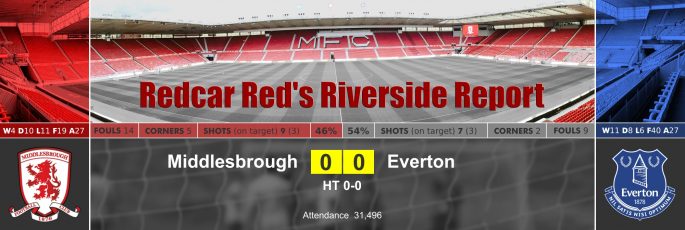
The optimism on Teesside for this game was probably only bettered by the dark depressing rain clouds that refused to clear all day. Everton were a team on the ascendancy and Boro perilously slip sliding away. Like Spurs last week it was a nothing to lose game, a draw was possibly the most the rain soaked Boro masses could hope for though for some there was that niggling “Typical Boro out of adversity moment” that just might deliver points from unexpected places. With results over the last few weeks going against us if something was going to break then today had to be the day.

Would AK stick with the predictable? Would Friend be fit and if he was would Fabio be unfairly benched for Barragan and of course would Ramirez return? So many questions for the Boro faithful and of course which Everton would turn up, the perennial top 10 side that flatters to deceive but always falters or the one on their current free scoring unbeaten run? Hopefully the Benidorm sunshine would lift the dark clouds around Teesside. Ominously though Everton were on their best winning run against Boro since December 1931 (4 wins in a row) having never beaten us 5 times consecutively.

Lukaku was looking to break Duncan Ferguson’s 60 Premiership Everton goals record and his 16 goals already this season has made him formidable enough as the Premierships leading scorer contrasting against our feeble 11 home goals all season. As we know Middlesbrough have attempted the fewest shots on target in the Premier League this season and the only side to have failed to post a shot on target in more than one PL game in 2016-17. With that backdrop the omens certainly didn’t look good. If AK continued with the same old Boro the outcome was fairly predictable before a ball was even kicked.

The Boro Team line up was less than inspirational when it was announced an hour before KO with all the predicted players in their predicted positions with the exception of the injured Friend. The opening few minutes saw Stuani put in two very weak challenges which allowed balls into the Boro box. Espinosa also looked a little nervy and so it looked like the omens where going to be proved right with yet another “Typical AK Boro” 0-0 performance at best.

As it transpired the end result was indeed 0-0 but one earned with honour, with fight, with aggression, desire and most of all we looked like we wanted to win this. After 20 minutes the realisation was dawning on both sets of fans that it looked like Boro could indeed win this with the Everton fans the quietest I’ve ever known them to be, the noise levels from the South and North stands rising steadily.

Boro were far more positive than at any game this season, closing down, snapping into tackles and not giving Everton a second to loiter on the ball. Confidence and belief levels were growing and perhaps for the first time at home we actually looked like a Premiership side playing at home rather than a promoted side hoping to hang on at home. Things weren’t perfect, we didn’t score yet again and Lukaku burst through 1 v 1 on Valdes in the first half who came out and smothered a shot when to all intents and purposes it looked like the Premiership’s top scorer couldn’t miss. After that Boro would normally be rattled, look nervous and take ten minutes to regroup but not today up the pitch they pushed, keeping a high line and putting the Toffees back in their wrappers.

Valdes came to the rescue on another couple of occasions, racing off his line and playing the sweeper keeper role to perfection. As the game progressed the Boro faithful raised the decibels and the Everton fans I suspect were waiting for what looked like the inevitable Boro goal. Unfortunately it didn’t materialise and on a couple of occasions in the first half Forshaw had an opportunity to shoot but passed into oblivion each time. Despite the vastly more offensively minded Boro the 3 DM’s still held us back. Clayton patrolled and swept up sublimely whilst de Roon looked like he had been clubbing all night and still coming down from an artificial high as he ran chased and closed down and snapped at anything in black and pink that moved. Why would a team that plays in Blue change strip against a team that plays in Red and White anyway? Did the “interesting” strip hand Boro an initiative?

Chambers picked up what looked like a game ending ankle injury just before half time and surprisingly he made it out for the second half when he looked well and truly crocked Bamford style. In fairness whatever was in the magic sponge at half time it done the trick as he nearly stole the show in the dying seconds as he crossed for Gestede to see Robles pull off a save of the season contender (OK maybe a slight exaggeration). More surprisingly though was that AK actually made a Substitution on 58 minutes taking off Forshaw who wasn’t getting up to support Negredo who himself was brilliant, battling fighting and scrapping against Funes Mori and Williams the two Everton CB’s but in vain with no support sadly.

On came Guedioura for his home debut in place of the frustrating Forshaw who has looked for weeks like he needs a break and I don’t mean 3 days in Benidorm. For me Ramirez or Downing centrally would have been a far better fit especially as we had this Everton side on the ropes at times but the ex-Watford man came on to strut his stuff and being honest I wish he hadn’t.  As at White Hart Lane when he entered the fray he gave the ball away with regular aplomb. I suppose his attempts to hand Everton what little initiative they craved took (not for the first time) some of the heat off Espinosa’s equally butt clenching distribution “skills”.

Guedioura did at least try and pass forwards and get closer to Negredo but two game winning chances fell to him on the edge of the 18 yard box and both times his efforts were more worthy of Twickenham than the Riverside. He may have a shot like a rocket but he has all the accuracy of a 90 year old on his fifteenth pint on an afternoon Sesh, the only net he hit was Temenos!

Had those chances fell to Grant, Stewy or Gaston we would have been dancing in the streets now, “high wide and handsome”, “woeful” or just plain “wayward” for a supposed Premiership professional all are apt descriptions. Our Scouting network must have been working alongside that 90 year old and drinking him under the table when they uncovered this gem!

At least AK did try and change the game with a Sub so we should be grateful but again he square pegged Traore onto the left in the second half to keep him near to the dug out and with it his effectiveness dipped compared to the first when he had Everton in a constant state of panic. Fabio already had the normally dangerous Coleman in his back pocket and the switch just made our left side messy with Stuani even more surplus wide right than wide left if that was possible. Later AK brought on Gaston for Stuani but instead of switching flanks with Traore he kept them both on their “wrong” sides to the detriment of both in my opinion.
Gaston responded to the warm reception he received by showing some forward runs and drives as well as giving away silly free kicks as is his want but how I wished AK had put Traore Right and Gaston Left (or better still Central instead of the well-meaning but limited Guedioura). Still happy though that 66 minutes in and AK had made two substitutions.

Everton were making efforts themselves to win the game especially more so in the second half as they built from their left flank with Baines now that he was free from the bane of Traore but Boro stood firm with Gibson snuffing out Lukaku in a manner that will have put another £10m on his head as he made the hitman look more like Pikachu (one for the youngsters there!). Baines even headed off the line from a Gibson header in the second half.

I enjoyed the game immensely and the crowd responded to the new attacking intent with possibly the best backing of the side all season. Hopefully not rocket science for AK to work out that playing like that had 100% support, backing and respect for his charges. More of the same please but with a few tweaks. Three DM’s are one too many, Forshaw needs a rest, Guedioura isn’t the answer and despite Gestede’s late header when he replaced Negredo with 10 to go his ball skills are Bambiesque. Traore wide right please (and leave him there) Gaston and Stewy presumably (or Grant even) in the middle instead of a DM and either Stewy or Gaston wide left. Vast improvement by the bucket load but still needs more work.

Valdes had a good game but as did Gibson who had the Cigars out but MOM for me was almost Fabio again but at the risk of going left field I’m going to give it to de Roon, that Bunny Rabbit Battery Company personified all afternoon!

After Costa Blanca, Boro now need to escape Costly Blanks

The Boro squad have been preparing for Saturday’s important game at home to Everton with a team-bonding mini-break in Benidorm – hopefully the sun, sea and setup in the micro-climate of the Costa Blanca will have our boys relaxed and ready to relaunch their season.

Though perhaps Benidorm is not usually the expected destination of millionaire footballers and maybe on hearing the news a few may have felt like X-Factor judges houses contestants chosen to go to Louis Walsh’s house in Ireland instead of The Bahamas with Simon. The local language will no doubt have been a problem for some, especially the Spanish speakers in the squad who will probably only come across retired English couples in search of two-for-one coffee and cake deals along the promenade – though perhaps several of the squad will have taken advantage of the wide selection of tattoo parlours and maybe purchased a ‘Keep calm and carry on’ T-shirt for the boss.

Anyway, the location is not so important as it’s a chance for everyone to enjoy the company of each other – especially the new arrivals. Also it’s an opportunity for Gaston Ramirez to put the machinations of January behind him and re-introduce himself to his team-mates. No doubt he’ll simply explain it was a misunderstanding from his agent who when heard the Italian manager of the current champions wanted him he had assumed it was Chelsea and not relegation rivals Leicester – Plus that ‘great deal in China’ for Stewie turned out to be 24 piece dinner service from Argos instead.

So back to the serious business of ensuring our Premier League survival – if Boro are going to pick up much needed points then it’s quite likely they will need to be garnered at home – particularly as we’ve only managed a solitary win on the road this season and that was way way back in August against neighbours Sunderland.

But Boro only have seven home games left this season, three of which are against Arsenal and both Manchester clubs, so somehow Boro will need to start making them count if they are to get some wins on the board. Though if you compare Boro’s stats at the Riverside to those on their travels there isn’t actually too much difference. Maybe we shouldn’t put too much emphasis on creating fortress Riverside and just play the team in front of us.

Here is a statistical comparison of our 12 Home and 12 Away matches – we have generally created a third less chances away from home but that has only equated to us being 25% less effective in terms of achieving points.

Possession Shots On Target F A Pts
Home  Total 128 32 11 14 12
 Average 52% 10.7 2.7 0.90 1.16 1.00
Away  Total 89 24 8 13 9
 Average 46% 7.4 2.0 0.67 1.08 0.75

The debate seems to be about how Boro should go about achieving those much needed wins – should we hold our nerve and continue to keep it tight and hope to nick a few victories – or is it now time to be more progressive in games we should be identifying as winnable. I think the best we can hope for is a return to 4-2-3-1 or 4-3-3 with a non-defensive midfielder. Though anyone expecting a few days in the sun will have relaxed Karanka’s game plan will surely be disappointed.

Though if Boro are going to start winning games then they will need to start working the opposition keeper more – the stats in the tables show we only average a measly two shots on target per game, which means if the opposition score then both have to go in to win the game. What’s apparent is that the amount of possession Boro have makes little difference in the number of chances being created. Somehow the team has to be more productive with its possession to convert it into chances created, as it doesn’t hurt the opposition to pass in front of them.

Since I know many of you like to browse the Boro stats occasionally (some more than others I believe), I’ve gone to the trouble of collating this table of our match stats for each game this season. It generally shows the picture of a team who is not creating too many clear cut chances but Boro definitely sit back and try not to be beaten against the better sides. It also doesn’t appear that possession converts into good chances to score against many of the opposition teams.

Opponents Possession Shots On Target F A Pts
A Spurs 35% 8 0 0 1 0
H WBA 62% 11 3 1 1 1
H West Ham 62% 11 2 1 3 0
A Watford 54% 5 1 0 0 1
H Leicester 62% 9 1 0 0 1
A Man Utd 34% 9 2 1 2 0
A Burnley 54% 8 2 0 1 0
H Swansea 43% 10 4 3 0 3
H Liverpool 37% 8 3 0 3 0
A Southampton 45% 6 2 0 1 0
H Hull 61% 16 4 1 0 3
A Leicester 60% 6 2 2 2 1
H Chelsea 42% 12 1 0 1 0
A Man City 29% 5 3 1 1 1
H Bournemouth 40% 11 3 2 0 3
A Arsenal 25% 11 4 0 0 1
H Watford 64% 10 3 0 1 0
A West Ham 60% 9 3 1 1 1
H Spurs 42% 6 2 1 2 0
A Everton 48% 7 0 1 3 0
H Palace 58% 12 4 1 2 0
A WBA 59% 7 2 0 0 1
A Sunderland 53% 8 3 2 1 3
H Stoke 46% 12 2 1 1 1
Total 217 56 19 27 21
Average 49% 9.0 2.3 0.79 1.12 0.88

In fact Boro have failed to score in six of their last ten Premier League games and it is these costly blanks that have left us now just two points off the bottom. More urgency on the pitch is needed – we have occasionally seen Boro are capable of an incisive counter-attacking move that gets to the opposition box before they have set themselves – this is what we need more of and not only when we’re chasing the game at the end.

So Everton arrive to the Riverside in good form at the moment and are unbeaten in their last seven, scoring 19 goals in the process – whereas Boro have not registered a win in their last seven and only managed 3 goals. The only comfort appears to be that the Toffees are not so prolific on the road in comparison to their home form – with only 6 goals in their four away trips.

No doubt Boro will be focused on the threat from Romelu Lukaku, it’s possible Karanka will be tempted to re-introduce Ayala to counter his aerial threat but a lot will depend on whether George Friend is fit to play and the knock-on effects his absence entails. If Fabio continues at left-back, Chambers will probably play right-back again – but it would be much better to have him partner Gibson and Fabio return once more to right-back. Also I wonder if we will see Gaston back on the pitch – Karanka seemed to suggest not but he’s still our best option on the left.

I’m still not convinced continuing with three defensive midfielders will lead to enough chances being created for Boro but Everton are almost a top six side and Karanka will be concerned about their threat more than re-addressing ours. What was worrying was the comment from Karanka that “We had a chance to beat Tottenham last week, and we are more mature and more experienced now than then” – unless I missed something we only had a chance to pull off an unlikely last minute draw. Positive thinking is all well and good but it needs to be also credible.

So will our nicely-bonded bunch of Boro boys stick together and arrive home ready to put three points on the board or will they come unstuck and come to a sticky end at the hands of the Toffees? As usual give your predictions of the result, score, attendance and any ideas on the new tattoos that some of the lads may be sporting.