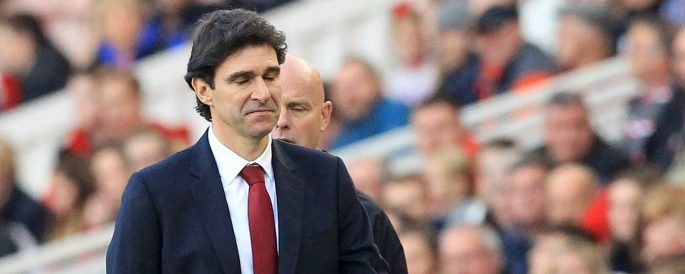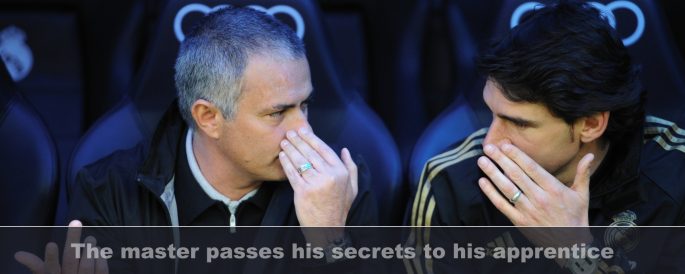

Too many players too soon, poorly thought through recruitment, and lack of integration spelt the end for Aitor Karanka after three years of steady progress, writes Simon Fallaha
In the near-immediate aftermath of Aitor Karanka’s departure as Head Coach of Middlesbrough FC (phew – long sentence!), perhaps we should take a breather and briefly review 2016-17 to date. We may well find that we should not permit ourselves too much surprise at the Boro’s failings.
Now, you can point your finger at our beleaguered ex-manager all you want, but it will not change things. For all his considerable limitations, he had a modus operandi to get us into the Premier League and he achieved this, with the added bonus, if you can call it that, of leaving us in a position where we can still escape the drop. Albeit later than many would have liked in both cases.
The reality is, man for man, the Premier League experience of this Boro squad, especially in a relegation scrap, is limited, or worse, virtually nil. Let’s look at the new arrivals from last summer in a “starting XI” kind of way.
Valdes/Guzan, Barragan, Chambers, Espinosa, Fabio, De Roon, Guedioura, Adama, Fischer, Ramirez/Gestede, Negredo/Bamford.
We have signed the effective equivalent of an entirely new side since last summer. But is it a Premier League collective? Compared to our rivals, you’d have to admit… not really.
There are players in that group that have shone at the top level, for top clubs, but their availability was another warning. You couldn’t just expect the likes of, say, Victor Valdes, Antonio Barragan, Alvaro Negredo or even Fabio da Silva to return to Premier League football and hit the ground running with a high performance level, as if they’d never been away. For those who had never played in England before, say, Bernardo Espinosa, Marten De Roon and Viktor Fischer, it was harder still. They needed to be surrounded by the right character if they were to prosper as Boro wished. And it is still open to question if Boro have found, or even can find, this character.
One club where character is not in short supply is Burnley. At least eight of their squad from their ill-fated, low-scoring return to the Premier League in 2014-15 are still on board today – Tom Heaton, Michael Keane, George Boyd, Sam Vokes, Dean Marney, Ashley Barnes, Ben Mee and Scott Arfield. Former crown jewel Danny Ings was sold at a very healthy profit, and Sean Dyche smartly and spontaneously invested the proceeds, parachute payments and later promotion money in the likes of Andre Gray, Joey Barton, Steven Defour, Jeff Hendrick and Robbie Brady. The rewards are currently there for all to see.
In praising the Clarets, I should emphasise “spontaneously”. Unlike Boro, they are not the kind to be outfoxed or destabilized by “that wasn’t in the script” moments – under Dyche they are the kings of party pooping and timely boosts. Once upon a time, they couldn’t win a game in the Championship and their front men, including one Jelle Vossen, weren’t cutting it. Before you knew it, Vossen was back in Belgium, Gray had arrived, and the victories came along. Similarly, the signings of Hendrick and Brady went through right at the end of the transfer window – the right players at the right time.
By contrast, although it was said that Boro did good business early, we concluded both transfer windows by selling Albert Adomah, Adam Reach and Jordan Rhodes. In the greater scheme of things, perhaps, whether their replacements were any better or not was irrelevant – the concern was more down to whether or not their replacements were right for Boro. Reach was a talented academy product, Adomah was a very popular player, and Rhodes was a proven goal scorer at a time when Boro needed goals.
The wrong players to sell at the wrong time, then?
It would matter less if we could say that their replacements are legitimate improvements.
But even if they are, at least on a technical level, do they connect with the area, and Boro, in quite the same way? Do they plug into the ethos of the club and what it is all about?
High-profile recruitment is, and always has been, a gamble. Arrivals like Victor Valdes and Alvaro Negredo can, in a way, be likened to Emerson and Fabrizio Ravanelli. Their ability can delight fans and inspire everyone on the pitch to play above themselves.
But their wage and status can also cause friction within the squad and resentment among the paying public, who may well perceive them as proof of the George Graham maxim that if a player doesn’t see his new club as a step up, he’ll think he’s doing you a favour by being there.
To a lesser extent, you have Scott McDonald and Nicky Bailey. Both made a positive contribution to the Moggalution in its most upwardly mobile times.
Yet you cannot quantify a signing as good or bad solely by on-the-pitch statistics.
McDonald’s tally of forty goals, beaten only in the last twenty years by Mark Viduka and Hamilton Ricard, and Bailey’s very good 2011, are fine achievements on their own terms. But those terms are sadly piddling when you consider their moodiness, a transfer fee of roughly £5 million between them (high for Boro at the time), and large wage packets. They were bought to be part of a promotion team – what they did do may have raised our hopes here and there, but ultimately amounted to nothing. In short, the ends simply didn’t justify the means.
The same certainly couldn’t be said for Rhodes, his purple patch of five in seven giving us both an invaluable lift and crucial points on the way to promotion. Far fewer goals from a more expensive signing, but a much bigger difference made by someone who truly appeared to have connected with the club.
Connection. There’s that word again. By the end of 2012-13 most of Boro’s coaching staff had a “connection” – they were locally born ex-players, along with Craig Hignett and Mark Venus. When Karanka arrived he quickly made his mark by bringing in his own men. It may have been neither parochial nor popular but there was a necessity to it, for the name of progress.
Fast forward to 2016 and Boro’s promotion heroes have overcome countless challenges to triumph as a unit. Now they, like Mogga’s backroom staff, have a feel of a family that doesn’t want to be broken up. But to build a platform for survival in the Premier League, needs have to be placed ahead of wants. Head must, reluctantly, take precedence over heart.
But a team needs heart and personality as well as brain and skill. Otherwise the club will no longer move in the right direction. And by bringing in too many players, too soon, the strength, momentum and belief of the Boro collective was irreparably damaged.
At the centre of this we have the unfortunate case of Adomah and Daniel Ayala. Their all-around development, the curbing of their erraticism and the maturity of their football brains should have been Karanka’s greatest legacy. Alas, one left the club under a cloud and the other now effectively resembles a central defensive Daniel Sturridge.
It didn’t have to be like this. It is understandable for a manager to be exceptionally frustrated at either having his authority challenged in the heat of the moment or not having their best defender available when he needs him most. But there comes a time when you must accept that nothing goes according to plan all the time. One must learn to forgive and trust, to be as patient with his players as he wants them to be with him, if not more. To guide them through the bad times. Taking pride from improving eager, willing newcomers – for example, De Roon and Espinosa – is one thing. Learning to integrate the newly high-profile talent you yourself contributed to improving is another.
This, and more, played its part in the lead up to the transfer window of discontent, the winter of very tough love that spelt the end of Aitor Karanka’s steady progress on Teesside.
Today we find ourselves picking up the pieces and scrambling for positives amidst the debris of wrecked dreams. We can admire the commitment of De Roon. We can enjoy the speed of Adama Traore. We can praise Valdes’ improvement – despite his errors, he has kept us in many games. We can take delight in the beautifully taken goals Negredo actually has scored. But has the cost been worth it?
I’m reminded of 1996-97, when it took drastic in-house divisions, freefalling to the bottom of the table and a points deduction for Bryan Robson to finally wake up and smell the coffee. The playing styles of both seasons, coincidentally twenty years apart, may seem like polar opposites, but both have been mainly dire for similar reasons – poorly thought through recruitment and lack of integration.
I guess, the more things change, the more they stay the same. Typical Boro. Or am I wrong?