| Leeds United | Middlesbrough | ||
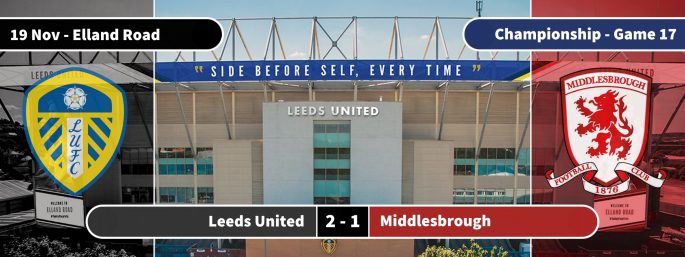
| Hernández Alioski |
24′ 54′ |
Assombalonga | 77′ (pen) |
| Possession Shots On target Corners Fouls |
43% 12 2 3 13 |
Possession Shots On target Corners Fouls |
57% 10 2 10 16 |
White heat too hot for Boro to handle
Finally what seemed like the longest build up in footballing history came around as the International snoozathon finally ended with Boro having to wait another 24 hours before attempting to build on their three game winning streak. The hype was all about Garry Monk’s return as pantomime villain to a Club that had been lifeless and listing badly but had enjoyed their best ever season in over a decade during his brief stint. Prior to the Kick off the Home fans let their thoughts be known about Boro’s Manager whilst Boro fans responded with the predictable Jimmy Saville taunts.
Initially there was a fairly frantic start to the game with both sides looking up for the challenge. Ayala and Jansson had looked a fairly physical contest in the making as Leeds settled quickest and started to pass the ball about. The Whites escaped a nailed on penalty by Berardi on Britt on 8 minutes as he was gabbed around the waist and literally bundled over in full view of Ref who presumably blinked.
Leeds were having plenty of possession with robust challenges going in and one saw with Jansson elbowing Tavernier in the forehead in a challenge again apparently unseen by the officials with 15 minutes gone. Leeds were certainly up for it whilst the Boro looked a little disarmed and unprepared for the fight ahead.
George Friend was coaching and ushering Tavernier through the opening stages which was great to see but perhaps he would have been better concentrating on his own game because he looked slow in reading the game and was having a torrid opening few minutes. By this stage the Boro plan seemed to be to sit back but we were not finding any balls up to Britt and pressure was building. Then a clearance out of our congested defence on 20 saw Britt break down the right and cross a fierce ball in only to elude the advancing Tavernier and Braithwaite. The resulting corner ironically saw Britt penalised for holding Berardi, incompetent refereeing at its best!
Braithwaite had a run checked into the Leeds box but the Referee saw nothing in it and immediately as if to contrast the pace and power difference, Leeds broke down the opposite end via a series of sharp slick passing. George then failed to cut out the resulting cross with Pablo Hernandez sneaking in at the far post ghosting past Roberts to glance a low header home. Slow starting Boro seemed to be in evidence once again, Leeds were having far too much space, possession and room with Boro merely chasing shadows unable to get out of second gear.
George was struggling, Alioski was twisting and turning him inside out and a frustrated George then gave away a free kick just up from the corner flag receiving a yellow for his troubles. The free kick worrying came in to an unmarked Saiz from a similar area where Hernandez scored previously but fortunately for Boro he scuffed his shot over the cross bar from close range. Roberts wasn’t having much joy overlapping and defensively he had been awol now on a few occasions. As if the Championship debutant RB didn’t have enough trouble Berardi then went scything through him to receive Leeds first yellow of the game as he tried forlornly to break up field.
Tempers and patience were getting frayed and another attempted Middlesbrough break saw Jansson deliberately block off Braithwaite to receive Leeds’ second yellow. A Crossfield ball from Grant to Stewy saw 60 yard back pass to Randolph who had to be quick not to emulate Jason Steele’s fate from a few seasons previously. At this point Boro were clunky again nothing was working for them and little going their way in terms of decisions. A challenge by Friend on Saiz was adjudged to have been a foul as he landed accidentally on Saiz’s ankle. It seemed very harsh although no doubt painful in fairness to Saiz but there was neither malice nor intent.
Garry Monk will have been the happier of the two managers to see the end of the first 45 minutes as his side never really got going or looked remotely likely to unlock the Leeds defence and indeed as the half ground to a close Boro looked likely to concede a second. In the last few seconds a nailed on corner for Assombalonga was denied by the assistant who bizarrely saw it as a Leeds goal kick. It wasn’t going to be an easy second 45 for Boro as the Officials had shown signs throughout the first half of being influenced by the Home support. That aside Boro bereft of any attacking fluidity were unlikely to score unless it was handed to them on a plate. For a game that meant so much to so many for different reasons the Middlesbrough side looked decidedly uninterested and well below par.
Boro were first out for the second half with neither side making any changes. I had thought that GM might have removed George and replaced him with Fabio to add more pace and energy and the fact that George was walking a tightrope. Leeds started the second half camped in Boro territory passing it around with ease and class whilst the Red shirts chased more shadows seemingly unable to read or anticipate the second phase of play. Boro looked confused, weary and pedestrian in comparison to their opponents; we were witnessing once again the pre gelling Boro from earlier in the season. For a trailing side only one attempt on target in 50 minutes told a very damning tale.
If it were possible the second half actually started even worse than the first half had ended. Whatever half time team talk had taken place it was clear that it was ineffective as there was no change in fortune from Monk’s charges, not even an increase in desire or passion. A 51st minute corner was woefully hit by Braithwaite and couldn’t clear the first man. A Downing cross on 53 saw our first opportunity of the second half fall to Tavernier on the edge of the six yard box that was skewed high and wide. Once again we immediately were made to pay for it as Roofe ran through a teflon Boro defence to set up Alioski to hit a second for Leeds.
In a bewildering attempt to address the lacklustre almost dismissive performance from Boro Monk hauled off Tavernier and brought on Johnson and Leeds immediately hit the upright with Randolph beaten. Under the circumstances Monk needed to radically alter both the shape and the tactics of his side but incredibly he just made a like for like change. Did he honestly believe that his sides’ woeful showing was because of Tavernier, seriously? If that was all that was wrong with Boro this afternoon then I must have been watching an entirely different game.
A rare Roberts rampage saw a cut back cross to Braithwaite who brought out a near goal line clearance albeit more by accident than design. The resulting corner saw Boro pass the ball straight into trouble on the edge of the Leeds 18 yard box with Howson almost tackling his own player as the misplaced ball was played into open ground setting up Leeds. The ex-Leeds favourite then took a yellow for his trouble and the resulting free kick saw Leeds miss a glaring header in on an open Boro goal. The arrival of Johnson had made absolutely no difference, the slow, predictable, poorly passed
build up continued. On 64 minutes George made way for Traore who went wide right with Downing switching flanks with Johnson dropping to LB we thought although it seemed to be Stewy after a while. My immediate thought was what was GM previously thinking with his first Substitution by replacing like for like and then taking off a struggling LB for a Right Winger? Did he have a cunning plan or was it as it appeared, just making it up as he went along.
Assombalonga had the touch of a baby Elephant all afternoon and absolutely no service to boot yet GM seemed oblivious with his revised game plan, the Championships most expensive striker isolated. On 70 minutes Britt had his first effort, a curling shot from outside the 18 yard box. The next stoppage in play saw Monk withdraw Grant and put on one of his favourites in Fletcher, presumably in a “proverbial” or bust tactic as the game now seemed totally beyond his comprehension or tactical nous.
An unexpected and undeserved lifeline was given to Boro as Ayala grabbed Ayling by the face at a Boro corner strangely unseen by the incompetent officials, stupidly Ayling reacted by grabbing Ayala’s ankle as he ran back out of the Leeds box. As play continued the Assistant informed the Ref of the incident which resulted in play being brought back and a Boro penalty awarded which Assombalonga rather too coolly for my liking converted under a barrage of redundant flag poles raining down onto the pitch.
The game then descended into a scrappy uncultured affair as Christiansen introduced Ekuban for Roofe to hang on to what he had. Although the game was petering out Leeds work rate looked 70% faster, sharper and keener as Boro just meandered through their predictable slow passing game. A late Adama cross found Braithwaite who done well to bring it down then swivel and turn to see the ball go wide. Frustrations grew as Britt for Boro then Kalvin Phillips both received the next Yellows as the game was slowly expiring. O’Kane came on for Saiz with two minutes of normal time remaining as Christiansen continued to keep what his side had deservedly earned.
Seven minutes then came up on the board as Boro pushed men up the pitch far too late in the game leaving themselves exposed to a counter on the break and but for a poor decision by Alioski it should have been ended as a contest. Hernandez then increased the card count for a mistimed tackle on Traore. Pennington then came on to further beef up the Whites rearguard for Alioski and of course to wind the clock down. An Adama won corner saw Ayala head the ball over the roof of the net in the final minute with the game concluding with a last chance Boro assault terminated as a result of a push in the Leeds box.
After so much pre-match hype and hope, a clueless, heartless and spiritless performance from Boro saw Leeds deservedly collect all three points and serious question marks raised again about an abject lack of in-game management from Garry Monk. Three games forward and one game back as it were but the nature of today was the most disappointing aspect. Boro MOM was Adama Traore, he changed the game for Boro and gave us some desperately needed impetus in a side that looked to be devoid of belief and creativity.
Today we desperately missed Cyrus Christie, George had a really poor game as did Roberts on the opposite side and apart from a few Downing passes and flashes of Braithwaite close control we were simply awful all over the pitch. Absolutely no positives to take from this afternoon, all that expensively assembled talent but zero attacking force and intent. Nowhere remotely near good enough as the fickle finger of fate now points away from Christiansen and back onto Monk.
Monk vows to silence old order on return
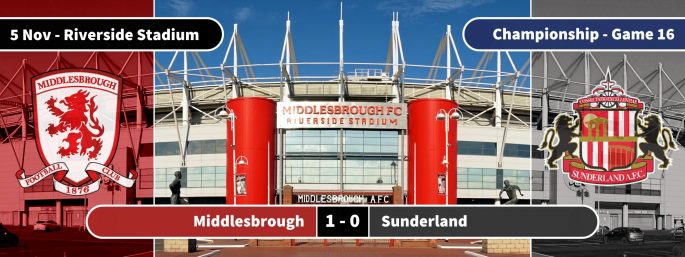
Boro head to Leeds on Sunday with renewed belief after pulling off three wins in the week before the international break that has seen Garry Monk’s team move up from bottom-half under-achievers to fifth spot promotion hopefuls in the Championship. What a week it was for the under pressure Boro manager who less than a month earlier had faced the prospect of sheepishly returning to his old stomping ground with the Elland Road fans in full gloating mode as many expected the game to be a top-six promotion-chasing Leeds against his struggling mid-table big spenders seeming less than value for money. Instead, a more settled solid-looking Boro will fancy their chances against a side that is struggling at the bottom of the form table.
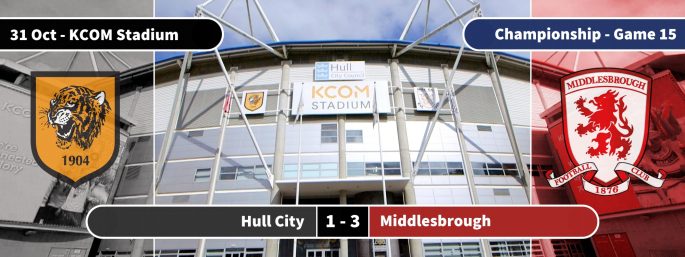
Normally when a former manager returns to his old club he’s greeted from the terraces with rows contorted animated faces as they chant “Who are you! Who are you!” though at Leeds that is usually more of a genuine question that should instead be “Who are you? Who are you?” Fans gathered in the Revie Stand often squint to see if they recognise the man in the opposition dugout as possibly being one of their plethora of former managers – some of whom lasted barely a couple of months. Sadly for Garry Monk his distinctive golfing apparel will probably jog a few memories, especially if he finds himself shouting ‘four’ as Boro improve on their goal scoring feat at Hull against an under par United. However, it’s possible the Boro manager will just be a blurry figure at Elland Road on Sunday as the Leeds Managing Director declared “With regards to Garry Monk returning, it’s not something we’ll focus on.”
There is a semantic argument of whether Monk resigned from Leeds or whether he just decided not to continue being their manager. He had a 12-month rolling contract with the West Yorkshire club but decided not to take up the option to extend the deal for a further year. There were also reports that he’d turned down a three-year contract when the new owner Andrea Radrizzani Tweeted: “Shocking news from GM. We were keen to do 3 years deal. We never receive any request from him and his agent. No regrets, we did our best.” – that only seems to imply that perhaps a long-term deal would have been offered to Monk if he’d got round to asking for one, which he didn’t.
| Leeds United | Middlesbrough | ||
| Thomas Christiansen | Garry Monk | ||
| P16 – W7 – D2 – L7 – F24 – A19 | P16 – W7 – D5 – L4 – F21 – A13 | ||
| Position Points Points per game Projected points |
10th 23 1.4 66 |
Position Points Points per game Projected points |
5th 26 1.6 75 |
| Last 6 Games Brentford (A) Derby (H) Sheff Utd (H) Bristol City (A) Reading (H) Sheff Wed (A) |
F-T (H-T) 1:3 (0:1) L 1:2 (1:0) L 1:2 (1:1) L 3:0 (2:0) W 0:1 (0:0) L 0:3 (0:2) L |
Last 6 Games Sunderland (H) Hull City (A) Reading (A) Cardiff (H) Barnsley (A) Brentford (H) |
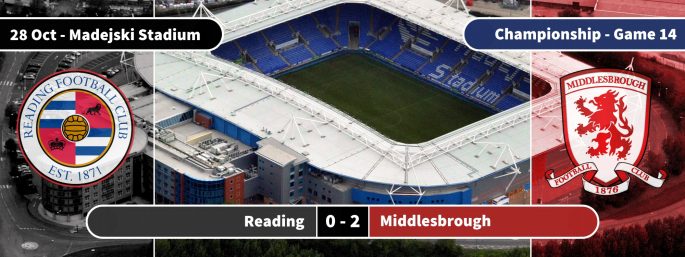
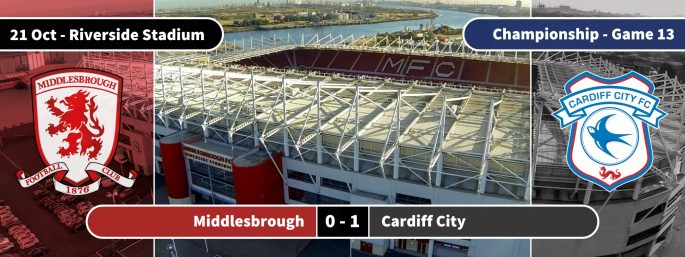
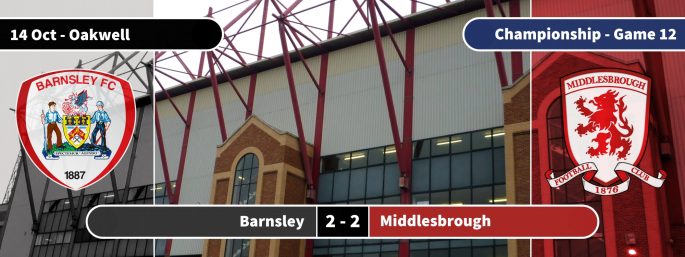
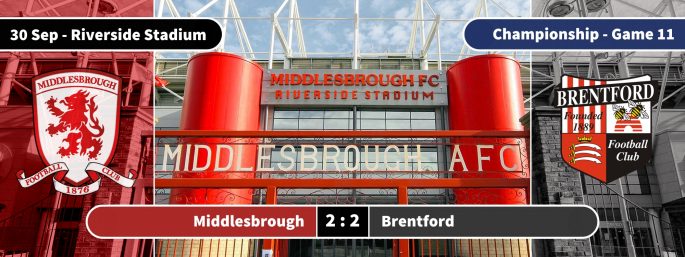
F-T (H-T) 1:0 (1:0) W 3:1 (2:0) W 2:0 (1:0) W 0:1 (0:0) L 2:2 (1:2) D 2:2 (0:1) D |
Anyway, Leeds have moved on and have drawn a line under Garry Monk by declaring “we have stopped thinking about him” – though whether they’ll soon also stop thinking about his replacement Thomas Christiansen will depend one whether he can turn around their recent run of poor form, which has seen them lose six of their last seven games. That is in stark comparison to the start of the season, when Leeds were unbeaten in their first seven games with five wins and only two goals conceded. It seems the defence of the West Yorkshire club is now struggling with 17 goals conceded during the last nine games.
Initially, it’s hard to see how a team that contains such famous names like Ronaldo and Viera is having difficulties but on closer inspection it turned out to be U20 England international Ronaldo Viera. Talking of famous names, many of the Elland Road faithful could only dream of seeing Harry Kane in a Leeds shirt, but as they glance towards the pitch their mouths may open in homage to the Spurs striker’s trademark demeanor in the disbelief that the new owner had pulled off a major coup – but instead it turned out to be just a look-alike called Samu Sáiz from Spain. Incidentally, it was revealed recently that Kane was almost sold to Leeds in January 2014 after failing to break into the team but the then Spurs boss Tim Sherwood refused to let him go.

Whilst Leeds call themselves the ‘Mighty Whites’, it’s their reputation as a hard physical team under one of Middlesbrough’s famous sons Don Revie that earned them the equally well-used nickname ‘Dirty Leeds’ or now more commonly just ‘The Dirties’. It was the superstitious Revie who was actually responsible for getting rid of their existing nickname ‘The Peacocks’ (named after the pub on the Elland Road site) as he deemed birds were unlucky, which also led to him removing the Owl from the club crest too – though given that belief it’s not entirely clear why he then went out and bought Alan Peacock from Boro in 1964.
Revie was also responsible for changing the Leeds kit to the now familiar all-white one when he became manger, from the previous blue and yellow halved shirt, which he did in an attempt to emulate the great Real Madrid. His attention to small details probably helped him become the most influential figure in the club’s history as they went on to have over a decade of success under his stewardship. Incidentally, although most managers generally have a plan he actually had a plan named after him as a player – whilst at Man City he was integral in introducing the new role of the deep-lying centre forward to English football, which became know in the game as the ‘Revie Plan’ and it was copied from the successful Hungarian national team of the time.
OK onto the game this weekend, in terms of team selection Garry Monk has to decide on who will replace the suspended Cyrus Christie – I would expect Connor Roberts to be given the opportunity to show that he can repeat the form displayed in his EFL Cup appearances, as although in theory Fabio could play there, it would send the wrong signal to a player who’s done OK with his limited chances. Whether Fabio will return at left-back is hard to say, George Friend still doesn’t look the player he was but perhaps still needs game-time like Ayala did to gain match fitness – in addition, Marcus Tavernier has played better when having the left-footed Friend behind him but competition is increasing with Marvin Johnson looking to have improved after a dip in form and may get the nod instead of the youngster. There were reports in the press that Everton and Arsenal are ready to pounce in January for Tavernier after only playing a couple of first-team games – rumours I’m sure the youngsters agent will be pleased to hear have found their way into the media as he negotiates his client’s contract extension. At least Darren Randolph got plenty of shot-stopping practice on international duty with the Republic of Ireland, which gained him much praise despite shipping five goals against Denmark.
It’s likely that Monk will continue with Leadbitter and Howson in central midfield if they’re both fit but the Boro manager has indicated Clayton still has an important role to play at the club despite his recent absence from the matchday squad. With three games in six days it may be a stretch to pick an unchanged side for these coming games – how Monk decides to manage his resources will be pivotal to the success of his team, perhaps we’ll see Leadbitter subbed around the sixty minute mark to preserve him for the midweek game. With Christie missing, Boro will miss his pace on the right side of the pitch and you wonder if Adama will be introduced at some point – though Downing appears to have made that side his own under Boro’s recent revival. I don’t think we’ll see too many shocks with the front two of Braithwaite and Assombalonga as they have started to have a productive partnership together – though one wonder if Big Rudy Gestede will get a place on the bench now that he’s back to being two-legged.
So will it be a welcome return to Elland Road for Garry Monk as his team clean-up the points at The Dirties? Or will Victor Orta demonstrate that he doesn’t have feet of clay as his latest recruits on his new patch leave Boro with mud in their eye. As usual give your predictions for score, scorers and team selection – plus will Ronaldo Viera turn out to be twice the player his name suggests?

How the mighty [whites] have fallen
Twenty years ago, Leeds supporters sensed they were about to once again become a force in English football, they had new seemingly ambitious ownership who were financing the building of a squad to challenge at the top of the Premier League. What they didn’t know at the time is that the decisions made then would have long-lasting consequence for their club and even threaten its very existence. The story of how the Mighty Whites have fallen and how Leeds United came to be owned and sold many times over would probably make a worthy degree course at the city’s university. It’s a mixture of the good, the bad and the ugly side of football ownership – at one point the club was apparently owned by the men with no name for six years.
The supporters have witnessed 21 managers under six different owners in the last 21 years – perhaps recent owner Massimo Cellino has probably best summed up their feelings with one of his random utterances when he said of the Leeds fans “they’re tired of eating shit and shutting their mouths” – in fact many aspects of the financial dealings at Leeds have left an unpleasant taste in the mouth for those involved. So here is the story of how money and power collided with the dream of wanting a successful football club. It’s about fans in the boardroom spending money that they could never pay back and how impatient businessmen arrived looking for a return or even a project to massage their egos but could never quite impose their will to satisfy their demands.
Dreams turn into nightmares
In 1996, Leeds was taken over by a small media rights company called Caspian, who paid the former owners lead by Bill Fotherby around £16m for the club. Caspian’s chairman, Chris Aker and his business partner Jeremy Fenn were traditional businessmen who planned to grow the club slowly with minimal risk by creating new revenue streams off the pitch with a stadium development plan to expand it into an entertainment and leisure complex with hotel and conference facilities. Shortly after buying the club they decided to follow the recent trend of floating clubs on the Stock Market to raise further investment, which they did under the name Leeds Sporting.
Manager Howard Wilkinson was given modest funds to improve the team for the following season but a poor start saw him dismissed and replaced by former disgraced Arsenal manager George Graham for his first job since his ban for accepting a bung. The season ended with Leeds finishing in mid-table playing boring uninspiring football that saw the club score just 28 goals – a record only recently beaten by Aitor Karanka’s Middlesbrough last season. Long-time director Peter Risdale was then appointed as Chairman with his outgoing personality seeming to have a persuasive manner on those around him. The following season saw Leeds unexpectedly play a little more adventurous under Graham and the club finished in fifth to qualify for the UEFA Cup. Caspian were beginning to anticipate a quick return on their investments on the pitch, but the 1998-99 season was suddenly disrupted in September when George Graham agreed to become manager at Spurs, leaving his assistant David O’Leary to take charge of the team. Unlike Graham, O’Leary was not afraid to blood young players and Leeds became an entertaining young side that finished 4th in the league.
It was at this point when Peter Risdale appeared to get impatient as he sensed Leeds could become a major force once more, a desire that was understandably supported by manager O’Leary. Though Caspian’s plan was meant to be based on steady growth and the cautious chief executive Jeremy Fenn took umbrage at stories leaked to the press that the club were being held back by his reluctance to open the chequebook – after which he decided the public attention was not for him and he moved on to leave Risdale free to push forward as he was also appointed CEO of the plc.
There was a problem however, a small matter of raising extra finance to buy new players as the club already were at their maximum overdraft facility of £11m from HSBC and unless a club had a rich benefactor, which Leeds hadn’t got, there was normally no other source of cash. It was at this point that Risdale had an interesting idea proposed to him by former Man City defender Ray Ranson, who had moved into insurance after his playing days had ended. Ranson idea hadn’t previously been tried before in football, if for example a club bought a player for £4m then that money would be lent to them by a financial institution and then paid back with interest over the length of the player’s contract – the investor’s risk would then be insured by a third party to protect their return. This innovation meant that a club could increase their borrowing by many times the amount which was normally possible. The theory was that it was just improving cash flow as more money was now coming into football each year, together with rising transfer fees, so the money should be easily repayable.
In the summer of 1999, Risdale sanctioned the first three deals financed by Ranson’s method and it seemed to pay dividends as Leeds finished in third to qualify for the Champions League – plus they also reached the semi-finals of the UEFA Cup. As revenues increased by £20m on the back of this success, this spurred Risdale to push even further and he then sanctioned deals totaling £18m on three more players including Mark Viduka. However, further success in qualifying for the second stage of the Champions League encouraged Risdale to go to the next level and Rio Ferdinand was purchased for a record £18m. However, all this spending had pushed Leeds to the limit of what they could actually afford to pay in the quarterly repayment fees. Risdale overcame this problem by proposing to restructure the payments by paying only half of the transfer fee over the player’s contract, with a single lump sum paid at the end of the players contract instead. While this reduced the quarterly payments to the club it basically kicked the can down the road by deferring the repayment.
A new solution to the problem of Leeds financing further player purchases came from a merchant banker called Stephen Schechter, who had come up with an idea of tapping into the income of football clubs with consistently large fan-bases. Basically, it involved having a once a year payment over a period of around 25 years that an investor would be allowed to withdraw from a ‘locked box’ account into which the club paid their season ticket receipts – the club themselves couldn’t gain access to the money in this ‘locked box’ account until after September, leaving investors to first withdraw their agreed payment. First to take up this new scheme were big spending Newcastle, who borrowed £55m and Leeds soon followed by signing up to £60m, the biggest loan ever signed up to by an English club. This debt was on top of that previously borrowed through Ranson’s earlier scheme.
Although income had risen quite considerably to over £80m as the TV money had now doubled and merchandising also increased, wages had also grown to nearly £40m. Leeds soon used up their new debt facility following three more player purchases that included the two Robbies, Keane and Fowler, which came in at nearly £30m. Everything came to a head in the 2001-02 season as rumours that O’Leary had lost the dressing-room as Leeds form slumped and they finished the season ten points adrift of 4th spot and the lucrative Champions League income that Risdale had literally been banking on. The club now had a debt of over £80m and a wage bill exceeding £50m and were losing £1m a month.
Risdale decided to sack O’Leary after he had spent £100m on players with no trophy to show for it. Terry Venables was appointed as manager but Leeds had no choice but to sell players to keep the club operating and Ferdinand left for Man Utd for £26m but with each sale the squad became weaker and the team began to slide down the table as they attempted to service the spiraling debt. Venables resigned eight months later with the club just eight points above relegation after growing tired of his chairman’s unkept promises on player sales – ten days later Risdale quit after growing pressure from the supporters. His and the club’s dream was over after pursuing it with reckless abandon – though this was just the start of the fall.
Fire-fighting to save the club
After Risdale left he was replaced by non-executive Director and major shareholder Professor John McKenzie, who was a trained economist and he was scathing of the excesses and the lack of understanding of the consequences that the club had exposed itself to. McKenzie attempted to keep the club solvent by continuing to sell players, obtaining additional funding and ultimately striking deals with creditors to defer payments to avoid Leeds being the first Premier League team to go into administration. Meanwhile, Peter Reid had taken over as manager and Leeds only just avoided relegation in the 2002-03 season. Then after a poor start to the next season Reid was dismissed in November and Eddie Gray was installed as caretaker manager at the troubled club.
Off the pitch, former Liverpool apprentice and Shrewsbury player Trevor Birch was appointed as Chief Executive of Leeds for the purpose of overseeing a takeover of the club. Birch retired from professional football at 24 and then gained a first class degree in Accountancy at Liverpool Polytechnic before qualifying as a Chartered Accountant at Ernst & Young. He left the firm in 2002 to become Chelsea’s Chief Executive in order to lead the sale of the Blues from Ken Bates to Roman Abramovich.
John McKenzie resigned from the board in an attempt lure one of China’s richest men, rumoured to be Xu Ming, a petrochemicals businessman and owner of a Chinese first division club – though sadly the Ming dynasty never materialised at Leeds. Also showing apparent interest was a Ugandan property tycoon, who claimed he had £90m of funding available to put into the club – again that never came to anything either and some even suspected that this unbelievably generous offer may have even been received as an email that required Leeds first to send their bank details.
In the end Leeds were subsequently taken over by a consortium of local businessmen, lead by insolvency specialist and Leeds fan Gerald Krasner – they embarked on the sale of the club’s playing assets, including senior and emerging youth players who had a transfer value as the club struggled to even pay the wages. With little control over which players were left at his disposal and morale pretty low as the reality of the situation started to bite, Eddie Gray’s team were unsurprisingly relegated at the end of the 2003–04 season.
Leeds had accumulated debts of over £100m and still had a wage bill that exceeded £50m – the urgent task of Krasner and his management team was to reduce this figure considerably to avoid the club going into liquidation. The consortium borrowed £15m from former Watford chairman Jack Petchey on the terms that it was to be repaid within 12 months from the sale of Elland Road. This sum would be used to reach a settlement with the two main creditors – the bondholders of the £60m borrowed on advanced season ticket sales over the next 25 years and the insurers on the players bought through the Ray Ranson scheme, which amounted to around £21m. After weeks of discussion between the various legal representatives, the bondholders received 20p in the £1 giving them £12m and the insurers had to settle for just 10p in the £1 to get around £2.1m.
In the autumn of 2004, Leeds sold both Elland Road and their Thorp Arch training ground to raise around £20m. Kevin Blackwell was appointed manager but the bulk of the players who remained were either sold or released on free transfers in order to slash the unsustainable wage bill. Blackwell was left to rebuild practically an entire squad through free transfers. Krasner had saved the club for the time being by reducing the debts to around £20m and extending the repayment periods – in addition, the directors of the consortium also loaned the club nearly £5m too to keep it operating. However, the club still needed further investment if it was to have a viable future as it was still losing over £1m each month.
The unknown owners
In January 2005, a 50% stake in Leeds was bought through a Geneva-based company the ‘Forward Sports Fund’ for an estimated £10m, it was lead by Ken Bates who declared he wanted “one last challenge”. Bates had left Chelsea 10 months earlier after selling the heavily indebted club to Roman Abramovich for a reported £140m, from which he personally pocketed £17m after having originally bought the Blues for just one pound!
The arrival of the controversial Bates (who just to clarify was the one in the hotel not the motel trade) was not greeted with much enthusiasm by the Leeds supporters as he had a less than fan-friendly reputation. He famously made the quite literally shocking decision to install an electric perimeter fence around the pitch at Stamford Bridge to prevent pitch invasions, but thankfully the local council refused him permission to turn the electricity on and it was subsequently dismantled. Bates also called the Chelsea Independent Supporters Association “parasites” in one of his often barbed program notes, which actually resulted in one fan suing him and the matter was settled out of court without Bates accepting liability – though I’m not exactly sure on what grounds he could defend calling paying supporters parasites.
His outspoken attacks were not just reserved for fans, in a Channel 5 documentary to commemorate the death of vice-chairman and club benefactor Matthew Harding in a helicopter crash, Bates declared “He [Harding] never had a chance [to take control of Chelsea] once he revealed himself in his true colours. I don’t believe evil should triumph and he was an evil man”. He added that Chelsea was a “much happier ship now that he’s not around” – though Bates had seemed more than happy to accept the £26m his late benefactor had pumped into the club. I suspect on viewing the programme many of his associates may have been tempted to hastily include a clause in their wills to ban him from offering a eulogy at their funerals – though the pair had been having a long-running feud up until Harding’s death and Bates had subsequently banned him from the boardroom.
On the pitch Kevin Blackwell’s cobbled together bunch of free transfers and loans managed to finish in mid-table respectability. The 2005-06 season saw the manager given some real money to spend with Richard Creswell and Robbie Blake arriving on fees over £1m. Also brought in was promising youngster Liam Miller from Man Utd plus the experienced Steve Stone – ten new players arrived in total with ten departing. Blackwell’s upgraded team rose to the challenge that had been set by Bates of achieving promotion – they sat in third spot in March but just one win from the last ten games meant they had to settle for the play-offs. Leeds got the final to take them on the verge of returning to the Premier League and redemption after the financial implosion – however, they lost the game 3-0 against Watford and the opportunity of a return to the big time for Ken Bates was gone.
The following season, after losing five of his first eight games Blackwell was sacked by the board and John Carver was appointed as caretaker, who lost four of his five games, before Bates appointed his former Chelsea captain Dennis Wise as manager with Gus Poyet as his assistant. Bates plan to take Leeds out of the second tier was now coming close to fruition – albeit at the wrong end of the table. As Leeds ended up in the bottom three their relegation was all but certain with one game remaining and the club was put into administration by Bates, incurring a ten point penalty that confirmed they would finish bottom.
It was suggested that if the club had not voluntarily entered administration, then they would have been forced into liquidation by the end of June by HM’s Revenue and Customs unless a £6m tax bill had been settled – though others speculated that the timing was a ploy to take the ten points deduction in a season that the club were all but relegated. KPMG Restructuring were appointed as administrators of Leeds United and within minutes of entering administration the club was sold to Leeds United Football Club Limited. This ‘new’ company had some familiar faces as the three named directors – Ken Bates, Mark Taylor (Bates’ long-time legal advisor who oversaw the sale of Chelsea to Abramovich) and Shaun Harvey (former CEO of Leeds United and for ten years managing director at Bradford City, who twice went into administration under his stewardship).
This rather expedient sale by administrators didn’t go down well in some quarters as other bidders were waiting in the wings to make alternative offers for the club. One such bidder was Don Revie’s son Duncan, who announced that he was in the process of forming a consortium to buy the club by declaring “I’ve tried to ignore my feelings for a long time as I know the aggravation needed to put things right. But when things get this bad, I can’t ignore it. My feelings run too deep. I am interested in trying to get Leeds back where they belong, which is in the top six of the Premiership.”
Though before any sale is ultimately approved, the buyer needs to issue a Company Voluntary Arrangement or CVA, which spells out to existing creditors the terms of the bid, which then requires to be approved in a vote by 75% of these creditors. When former chairman Gerald Krasner saw the terms being offered by Bates (just 1p in the £1 with a promise of a ‘substantial’ yet unspecified increase if Leeds were promoted to the Premier League within five years) he offered to represent the creditors free of charge – presumably they still included the three partners of his consortium who had loaned the club £4.5m and as the offer stood they would receive just £15 grand each. In the end Ken Bates’ offer received 75.02% approval (later revised up to 75.20% after a recount) from the creditors vote and the deal went through, which was then subject to appeal for a period of 28 days. One day before the appeal period was due to end Bates upped his offer to 8p in the £1 and offered that would rise to 30p in the £1 if Leeds were promoted to the Premier League within ten years.
However, with only a few minutes remaining before the deal could be appealed HM Revenue and Customs (HMRC), who were owed £6m, stepped in and challenged the sale. This meant KMPG had to formally put the club up for sale, which would allow other bidders a further 28 days to make offers. With several bids on the table, KPMG revealed after assessing them that once again they had chosen Ken Bates’ bid. The Football League eventually sanctioned the sale to Bates without the club needing to go through a CVA process again under the “exceptional circumstances rule”. Though they instead imposed a 15-point deduction (which applied to the new season after relegation) on the grounds that the club had not followed football league rules when entering administration. Finally, on 31 August 2007 HMRC decided not to pursue any further legal challenge and accepted Bates’ final offer, confirming him as the owner of a debt-free Leeds United.
Though this was not quite the end of the story, Phil Willis, the Liberal Democrat MP for Harrogate and Knaresborough, signed an early-day motion in the House of Commons which urged law-enforcement agencies to mount inquiries and called for greater transparency in the ownership of football clubs – plus he urged HM Revenue and Customs to challenge in court the conduct of the administrators of Leeds United.
The MP’s motion centred on the fact that three offshore companies, whose owners were unidentified and essentially had control of the club, which decisively influenced the administration process where creditors, who were in total owed £35m, were offered just 1p in the £1. The majority of the shares in Leeds before it went into administration were owned by the Forward Sports Fund, a trust registered in the Cayman Islands and administered by a company in Switzerland – the identities of the shareholders of Forward are unknown. Ken Bates declared as Leeds chairman that neither he nor any other director personally owned shares in the club.
The largest creditor to whom Leeds owed money was Astor Investment Holdings, registered in Guernsey, which claimed to have loaned the club nearly £13m. Krato Trust Limited, was registered in the West Indies island of Nevis, claimed to be owed £2.5m. Both of these creditors only supported offers made by Bates, which resulted once more in the club being owned by the Forward Sports Fund, which Bates claimed he had no financial interest in.
The administrator, Richard Fleming of the accountants KPMG, stated that neither Krato nor Astor had any connection to Forward. Since the three offshore funds’ claims amounted to nearly £18m, representing around 45% of the total owed to creditors, it meant no other deal could ever reach the required 75% approval needed if they voted as a block – even though they had offered to pay creditors a much higher amount.
However, former Leeds chairman Gerald Krasner pointed to a declaration in Leeds’ 2006 accounts that Astor investments “has an interest in Forward Sports Fund”, which meant that in fact the two entities were connected and that should then disallow them from voting on the administrator’s proposal. Mark Taylor, Bates’ co-director and solicitor, clarified that Astor and Forward had indeed been connected in June 2006 the previous year but he had ensured that they were disconnected by the end of that year. The administrator said he had been assured in writing by Astor, and in sworn declarations from Bates and Taylor, that the offshore entities were not connected. Incidentally, a quick search of the Panama Papers online database, states that the Krato Trust became a shareholder in Astor Investment Holdings in 2009.
As you might imagine, this particular episode drew the attention of several investigative journalists, including David Conn of the Guardian, who for his troubles was banned from Elland Road along with the Guardian and the BBC (with whom he also made a documentary about the issue). Bates also challenged the MP who raised the issue of Leeds ownership by saying “We challenge Phil Willis to repeat his allegations outside the House of Commons, and we will see him in court if he does.”
As for who were the identities of the shareholders behind the Forward Sports Fund? In 2010, the Football League brought in rules that required any individual who owns 10% or more of a club to be identified. When they asked Leeds to inform them of such individuals they replied that none of the shareholders of the Forward Sports Fund owned 10% of the company so their names don’t need to be declared.
In a 2011 Select Committee report that was investigating ownership in football, it stated that evidence from Leeds chief executive Shaun Harvey declared neither he or “to his knowledge” Ken Bates knew who the owners were. The Premier League chief executive, Richard Scudamore also gave evidence to the committee and stated if Leeds were promoted to the Premier League they would require them to say who the owners were. Several days after the report was published, it was announced by Leeds that Ken Bates had bought the club from Forward Sports Fund via an offshore company registered in the West Indies island of Nevis. So after six years of owning Leeds through troubled times and with a prospect of the club being promoted to the Premier League in the near future, these at least 11 unknown shareholders (given it was declared by Leeds that none held 10%) decided to sell their investment to chairman Ken Bates. It’s unlikely that anyone will now ever know who ‘they’ actually were that apparently controlled the club during the period 90% of its debts were written off.
On 21 December 2012, Bates completed a deal to sell Leeds to a Middle East-based private equity group GFH Capital – previously known as Gulf Finance House – who are an Islamic investment bank with headquarters in Bahrain. Bates remained as chairman until the end of the 2012–13 season before taking up the position of honorary president. So in what was “one last challenge” for Ken Bates, the sale of Leeds United finally boosted his personal bank balance (wherever that may be) by the less than shabby sum of £52m.
Meanwhile, on the pitch the story was one of nearly but not quite as Leeds spent three seasons in League One under Bates. Despite the 15 point penalty after relegation, Leeds went top of the league on Boxing Day under Wise before he surprisingly decided to jump ship in January and take up an offer by Mike Ashley at Newcastle to be Director of Football, with the then manager Kevin Keegan less than pleased – Gus Poyet also left to become assistant manager at Spurs. Bates installed former fans favourite Gary McAllister as manager and he ended up losing in the play-off final to Yorkshire rivals Doncaster – the following season he was sacked in December after less than one year in charge after a poor run of games. Simon Grayson then took over in the manager’s chair but again lost out in the play-offs – then Leeds got off to their best-ever start to a season in 2009-10 before stuttering and eventually getting automatic promotion by finishing in second spot.
Leeds return to the Championship saw them mount a challenge for promotion to the Premier League in their first season back, but they fell away towards the end of the season and finished seventh. The news in 2011 that Bates had bought the club brought fresh protests from Leeds supporters over lack of investment in the team – to which the new owner responded with his usual charm by calling the fans “morons”. Grayson was then sacked in February for failing to mount a promotion challenge and he was replaced by Neil Warnock who became Bates’ final managerial appointment before he sold the club. However, Bates was not quite finished yet as he had remained as chairman after selling the club to GFH but the 2012-13 season didn’t go according to plan and Warnock eventually resigned with six games left to play as Leeds hovered just above the relegation zone. In came former Reading boss Brian McDermott, who managed to win enough games to avoid the drop back to League One.
The maverick calls the tune
The Leeds supporters were generally glad to see the exit of Ken Bates from the club but they had little idea of what was to come next. Owners GFH Capital were looking to sell a 75% stake in the club with a group backed by current managing director David Haigh and the club’s main sponsors in a consortium called Sport Capital. However, some of the backers involved with Sport Capital had problems coming up with the finances required and GFH invited a rival bid from Serie A Cagliari owner Massimo Cellino. The protracted sale fell into farce when Cellino’s legal representatives summoned McDermot to inform him he had been sacked – only for him to be reinstated by the Football League as the Italian had not been yet been approved as the owner and therefore was not in a legal position to dismiss the manager.
Leeds then announced that they had exchanged contracts with Cellino’s family consortium Eleonora Sport Ltd. The deal involved 75% ownership of the club that was subject to approval from the Football League, which the Football League subsequently rejected in March 2014 after stating that Cellino failed the owner’s test due to having an Italian criminal conviction. Cellino appealed the decision and the Football League decided in his favour stating “Cellino’s recent conviction did not involve conduct that would reasonably be considered to be dishonest based on information available to him at the time” – in other words an honest mistake made in ignorance.
Leeds had just got themselves a new owner, albeit a somewhat eccentric, superstitious, impulsive chain-smoking, electric-guitar playing one with pretensions of being a rock-star. After Cellino had inheriting his father’s agricultural business, he bought his home-town club Cagliari in Sardinia just over 20 years ago and has subsequently sacked an incredible 35 managers in his time as owner. He even moved the club to a stadium 500 miles north after problems gaining a safety certificate following the electrocution of a member of staff and only returned back to Sardinia after his players threatened a boycott – but they instead returned to a stadium temporarily constructed out of metal scaffolding poles that requires a safety certificate on a match-by-match basis.
Not afraid to speak his mind, Cellino said of the former Leeds owners “You can see what’s been happening here – it’s been done by people who knew they weren’t staying. And now I have to clean up the shit…GFH made big mistakes but not on purpose. But the men who were here in GFH’s name did a really, really bad job. That’s not GFH fault. They trust people they shouldn’t.” He then tried to connect with the Leeds fans by declaring “they’re tired of eating shit and shutting their mouths” before continuing “I’m the richest man in the world with these fans and I can challenge anyone, everyone.” – something he went on to try and prove in his tenure at Leeds.
Despite McDermott being reinstated, he must have known his days were numbered – apparently his card was marked by Cellino after he failed to allow his close associate and former Middlesbrough defend Gianluca Festa to sit on the bench to observe matters before he had bought the club. He then questioned manager McDermott’s decision to take a holiday and declared that “Leeds have no manager, who’s managing this club? Brian? Where is Brian?” OK not quite as popular as ‘Where’s Wally’ but this particular game ended in May 2014 as Leeds reached a mutual agreement with manager Brian McDermott to end his spell at the club.
Cellino’s choice for his first Leeds manager was a rather surprising one in the mostly unknown Dave Hockaday, who was previously manager of Conference side Forest Green with a less than impressive track record. In his first season the team were relegated but were reinstated after Salisbury City were demoted for financial irregularities. His second season ended with Forest Green avoiding relegation on goal difference and the next two seasons saw his team finish in tenth both times, despite the club having the largest transfer and wage budget – he finally left the club by mutual consent in his fifth season after seven defeats in eight games. It’s not clear what Cellino saw in him that merited giving him a chance to manage in the Championship, though him agreeing to take charge on an annual salary of £80 grand, just a tenth of what McDermott was paid, could have been a factor. His Leeds career at just 70 days was short-lived even by Cellino’s standards with only one win in his first six games – against you’ve guessed it Middlesbrough.
Next in the hot seat hoping for a bright future was Darko Milanič, who signed a two-year deal after Leeds bought out his contract from Sturm Graz but he didn’t go down a storm at Elland Road and was dismissed after only 32 days for not winning any of his six games in charge. In November 2014, Neil Redfearn was promoted from his academy role to head coach of Leeds on an initial 12-month contract with the option of a further 12 months and a clause meaning he could return to his original role if it didn’t work out – probably a wise decision given the brevity of the previous two incumbents.
In December 2014, Cellino was disqualified by the Football League and asked to resign from the club. The Football League took the decision after obtaining documents from an Italian court, where he was found guilty of tax evasion. This spell of detention was later extended to beyond the end of the season due to Cellino’s failure to hand in his homework and present the League with the court documents himself. The controversial Italian returned as chairman in May 2015 with the apparent approval of the Football League and decided shortly afterwards to replace former hardened midfielder Redfearn, claiming in the press his head coach was “weak” and “a baby”. In came former Man City striker and former Wigan manager Uwe Rösler to take up the challenge, the German had taken up coaching after being diagnosed with lung cancer at the age of 34 whilst playing for Norwegian club Lillestrøm – following chemotherapy, he recovered successfully to return as their manager two years later. However, his time at Leeds was short-lived and he was sacked after just a dozen games and just two wins, which left Leeds in 18th place in the Championship
That day in October was quite a busy one, not only was Rösler out but Cellino was again banned by the Football League for a second time after it was discovered he was in breach of Italian tax legislation and therefore failed their suitability for club ownership test. Though before he stepped down he appointed former Rotherham manager Steve Evans as head coach. Cellino appeared to have had enough and announced he would sell the club but only to a Leeds United Fans Group – he declared “100 per cent I will sell to the fans, if they want to buy it and look after the club. The fans are the only asset the club has.” Though the Italian was not popular with elements in the crowd and soon after decided not to attend games any more due to the vocal criticism he received from the terraces.
This falling out with the Leeds fans seemed to extend to the supporters group who he planned to sell the club to after his lawyers informed them the deal was no longer on the table. The response by the group, Leeds Fans Utd was the following statement “Our insistence on him confirming his verbal offer of exclusivity in a legally binding agreement has forced transparency on his motives. It is much better that we identify this insincerity now before we spend our shareholder’s money.” Cellino’s reply was with typical bravado “They say a lot of fairytales, they really are like kids in a sweet shop. They talk too much. It is dangerous, this kind of publicity.”
Following, Cellino’s successful appeal to the Italian tax authorities on his failure to pay VAT on an imported Range Rover his ban was lifted at the end of the season. Though Cellino was not happy and revealed “he had regretted buying the club” and would sell to the right offer – he was also not happy with Steve Evans, who became his sixth sacking, though the head coach may have suspected his time was up if he had read Cellino recent remarks in the press “He [Evans] talks too much, he has to learn to shut his mouth. I’ve told him so many times to stop, you have no idea. But he doesn’t.”
Cellino problem seemed to be that his head coaches wanted to be managers and revealed “I cannot work with English managers. I never want to learn. I give up. When am I going to find a manager in England who is actually a coach? They want to control everything. But it’s wrong because when they go you have to start all over again” He may have actually had a point with that statement but in June 2016, Englishman Garry Monk was appointed as head coach by Cellino on a 12-month rolling contract – which would be his seventh and final appointment before he sold the club to Andrea Radrizzani in May 2017. His departing words to the Leeds fans were “If you can survive working with me, you can survive anything” – though only time will tell if that turns out to be true.
A chance encounter
Now Leeds find themselves with another new owner in what appears to be the consequence of a random event – not quite in the same league as a Chief Executive holding an impromptu interview of the future manager after a chance encounter in a service station toilet but definitely a bit of a butterfly wing-flap in the grand chaotic world of football. It occurred in a pre-match dinner ahead of the Champions League quarter-final game between Man City and PSG, where Italian sports media rights specialist Andrea Radrizzani found himself sitting besides football legend Kenny Daglish. After some general conversation, the subject of potentially buying an English club was raised by the Italian – to which the reply from the former Kop favourite was just two words: “Leeds United”. A few weeks later Radrizzani got hold of Cellino’s number from a business contact and pretended to be an agent representing a client from Singapore (which as it later transpires was not entirely false) interested in investing in the West Yorkshire club. A few days later Radrizzani made the suggestion of investing himself, to which the controversial FA ban-serving Leeds owner seeking an exit-strategy seemed keen and offered to sell him an initial 50 per cent stake – with the prospect of selling the other half if Leeds weren’t promoted. At the time of the deal, Leeds were sitting in third spot but thanks to a collapse in form by Garry Monk’s men they fell away and ended up finishing in seventh – which subsequently presented Radrizzani with the opportunity of full ownership.
As usual ‘ownership’ in football is never quite so simple – LUFC is registered as being 100% owned by Greenfield Investment Pte Ltd, which is an ‘acquisition vehicle’ that is 100% owned by the Singapore registered company ASER Group Holding Pte Ltd, which is in turn 100% owned by Andrea Radrizzani (The letters ‘Pte Ltd’ denotes a private limited company in Singapore). Radrizzani has made much of his wealth selling media rights of sporting events around the globe through the London-based company Media Partners & Silva Ltd, which he co-founded in 2004 with Riccardo Silva. They initially started by gaining exclusive media rights to distribute Italian Serie A games and have since expanded into other sports to become media partners to FIFA, the Premier League, Formula One and the French Tennis Open to name but a few.
It’s too early to say whether Radrizzani will be the white knight that the Mighty Whites have been searching for – though he’s gained popular support from the fans by buying back Elland Road for £20m and has claimed he has already invested £100m in the club with the aim to gain promotion to the Premier League within five years.
Epilogue
This Radrizzani deal may finally work out for Leeds supporters but football clubs have long since become the commodities of the super-rich to buy and sell on a whim or a chance business encounter in what continues to be an inflationary bubble where many will fail in their ambition to become a successful top-tier club. The danger is that they over-extend themselves and their ‘investments’ then invariably turn into debts owed by their disposable financial vehicles that have taken the supporters on a white-knuckle ride that can often risk the very existence of the club themselves.
What is clear is that those in charge of regulating football are probably incapable of ensuring that they protect the supporters from the risk of losing their clubs to the failures of judgement that wealthy risk takers are prone to making – especially when many can ring-fence their personal wealth through organising their business affairs through a whole series of offshore holding companies and investment vehicles. In a world of offshore anonymity it’s almost impossible for anyone to prove who the owners are and therefore those making accusations against the rich and powerful must tread carefully to avoid being taken to court.
As for some of the protagonists in the Leeds story – Peter Risdale went on to become vice-chairman at Cardiff City under Sam Hamman and finally chairman in 2006 when the owner stepped down. It was claimed Risdale had once again brought a club to the brink by trying to build a promotion winning team that left Cardiff fighting off four winding up orders. After stepping down in May 2010, Cardiff’s debts were nearly £70m – more than double what was estimated at the time and the club was subsequently sold to a Malaysian consortium as it faced yet another winding-up order. In 2009, Risdale’s sports consultancy business, WH Sports Group Ltd, which offered advice to football clubs failed with debts approaching £500,000 – Risdale was subsequently disqualified from being a company director until 2020 after an inquiry by the Insolvency Service discovered he had diverted payments from football clubs totaling nearly £350,000 into his personal bank account that were paid to his consultancy business.
After Ken Bates sold Chelsea he banked £17m after previously buying it for just one pound and then running up debts of £80m – he seemingly didn’t invest any of that money ten months later in the anonymously owned Forward Sport Fund consortium that was used to give him effective control over Leeds United for six years – he claims not and there is no proof to say otherwise and besides he’s not shy of taking legal action. He also maintained he didn’t know the identity of the shareholders of which none held 10% according to declarations made. Bates and his legal representative Mark Taylor also declared that the two main offshore entities that voted for his bid when the club went into administration had no connection to the club owners – despite them admitting that they were connected one year earlier and much better offers on the table were available to them than the 1p in the £1 offered by Bates.
KMPG and the Football League both accepted their explanations that they knew nothing about the people who had essentially employed them for six years – it could have been Kim Jong-un and his ten brothers for all they knew. Whoever they were, they agreed to sell him Leeds United for an undisclosed amount a few days after a Select Committee report into football ownership seemed to suggest those running the game would demand more transparency. Bates subsequently sold Leeds to an Islamic investment bank based in Bahrain. Whilst many people had lost a considerable amount of money over the years investing in the Leeds (including the tax payer and reportedly the St John’s Ambulance) it appears Bates is a man who can look after himself quite nicely – the 79-year old currently resides in tax haven Monaco, where his next project is presumably working out how to pass a camel through the eye of a needle.
You may remember earlier Shaun Harvey, who was one of the three directors of the ‘new’ company fronted by Ken Bates, who also claimed he had no idea who their shareholders were when it bought back Leeds with a controversial deal to minimally compensate creditors after it had gone into administration. In addition, he’d previously been managing director of Bradford City who had twice been in administration during his time at the club. Well it seems his talents were just what the Football League were looking for and having been elected on their board of directors he was duly appointed Chief Executive in July 2013. He is now the man ultimately in charge of ensuring clubs are owned by fit and proper people and is also responsible for growing the EFL brand by signing off deals with those looking to invest – such as a certain Mr Carabao and his invisible cup draws amongst others.
As for former manager David O’Leary who spent the £100m that ended up causing the financial meltdown – well after three years managing Villa following his departure at Elland Road, he had a brief return to football as manager of United Arab Emirates side Al-Ahli Dubai in 2010, but he was dismissed after less than a year in charge but managed to get FIFA to help him gain compensation of £3.3m for the remaining two years of his contract in 2012. It was announced this week that the now 59-year old has been invited by the new owner of Leeds to Elland Road for lunch and to take in a game – with Leeds currently dropping down the table after a good start, surely Andrea Radrizzani is not contemplating starting the whole cycle again?