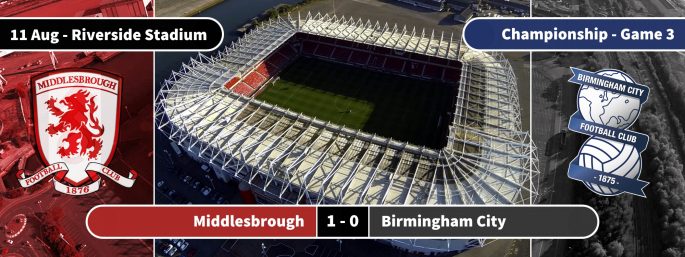
Boro 1 – 0 Birmingham

Middlesbrough Birmingham City
Assombalonga 12′  
Gardner
 
83′
Possession
Shots
On target
Corners
Fouls
52%
10
2
3
9
Possession
Shots
On target
Corners
Fouls
48%
11
4
9
11

Britt gives ex-Boss the Blues

Redcar Red reports on the victory over Monk’s Birmingham…

The “Return of the Monk” possibly didn’t have the same blockbuster ring as the “Return of the Jedi” in terms of posteriors on seats and Global awareness but nevertheless on Teesside there was an extra edge to this afternoons proceedings down at the Riverside. The Monkbot was back in town albeit showing at a Stadium near us for a couple of hours only. To some in Middlesbrough he was the scoundrel who wasted millions on mediocre to poor talent whilst to others he was unfortunate to not be given the full season to complete whatever it was he was conjuring and therein lay his problem.

One word sums up his Teesside tenure “confusion”. His Players on the pitch seemed confused, his team selections seemed at odds with one another at times and his penchant for changes which were simply coming too often just seemed to leave most of us confused and in the end losing confidence. There were doubts about whether or not he actually knew what he was doing or was just winging it, his subsequent relative success with saving the Blues from the drop would indicate that something lay deep within but far too deep to be revealed in any of his press conferences that was certain.

For Tony Pulis and Boro it was a frustrating end to the week when the window closed to put it mildly. Regardless of which side of the great Bamford divide fans sat there was mutual concern that the anticipated and arguably much needed four or five recruits did not materialise at all. The known targets seemed a few weeks short of negotiation time to have any chance of success with opposition Managers and Directors determined to have and to hold as the 5.00pm deadline came and went on Thursday. Perhaps fittingly those in charge of such things had gone from negotiators to masked Loan Arrangers to protect their identity/ies.

Ayala and Gestede were joined by new local lad Hugill on the treatment table as it was declared on Friday that our new Striker was in fact “Knacked” to use a Teesside colloquialism. Apart from that TP could muster a squad of 18 match day squad numbered players to select from or just about with maybe one sixteen year old spare plus an ancient goalkeeping relic. The good news was that Howson was fit and Tuesday night’s concern was only a kick on the knee rather than a sprain or strain. Of course we learned from last season that what TP says in these “pressers” can often be taken as mind games and or with a generous spoonful of salt.

The Gods it appeared pre kick off at least were all in our favour as TP had never lost against GM and in fact Boro were unbeaten in our last eight games against Birmingham. As the Coaches from St. Andrews parked up the travelling bluenoses were looking forward to perhaps seeing the Gardner brothers (Gary and Craig) make an appearance together along with the physically formidable Omar Bogle on loan from Cardiff to provide former Boro striker Lukas Jutkiewicz with competition.

TP went with the same again although with the limitations on his squad he doesn’t have many options to permit tinkering and so it was 3F’s at the back again with Shotton and Downing on the flanks and Howson, Clayton and Wing central and Braithwaite just behind Assombalonga. The Red Faction unfurled a new “Reservoir Dogs” banner with “Let’s go to work” underneath as the sides took to the pitch. There were a few low key boos directed at the Birmingham manager but most Boro fans like myself were kind of “Meh” towards him and not really bothered either way.

The early exchanges saw Cheikh N’Doye and Aden Flint strike up a relationship that was to last the entire afternoon. Boro had the better of then opening exchanges with Shotton looking lively in his more penetrative role on the right. Former Boro target Jota was looking lively in the opening minutes as the visitors passed the ball around posing problems but not really asking questions of the Boro defence. Neither keeper had much to do with most of the action being played outside of the 18 yard box areas until Howson played a beautiful forty five yard cross field lob to Britt just inside the Blues box who brought it down, jinked to his right and despatched an equally beautiful arced ball into the far side of Trueman’s goal putting Boro one goal up.

The goal settled Boro and stung Birmingham whose supporters had been quite vociferous up until that point. Britt nearly doubled his tally just a few minutes later but this time firing across Trueman’s goal. The signs were there that today could be a repeat of Tuesday night’s score line. This seemed to be a wakeup call as Friend had to be alert to deny Jota with a block. Adams was next to try his luck but Randolph was alert to the danger. It was clear that Birmingham still had belief and were not going to be rolled over as easily as Sheffield United had been just a few days previously.

Braithwaite was lively up front linking well with Downing and Britt and was starting to receive special treatment for his troubles with a few strong challenges coming his direction. On the half hour mark the Danish International was scythed down from behind by N’Doye who picked up a yellow card for his troubles. Downing lined up to take the free kick with the big lads all circling on the far side of the box but Stewy rolled back the years with a clever free kick that caught everyone unaware hitting the nearside upright. So close but the Blues (resplendent in Yellow) survived and regrouped to take the game to Boro again with another former Boro target Maghoma and Jota both causing problems and providing ammunition for Che Adams and inevitably ex Boro lad Jutkiewicz.

Downing again had another effort that was skyed this time as he was set up by Friend but his effort fell on his right foot much to Monk’s men’s relief. Just before the half time whistle another long ball was cleverly flicked on by Braithwaite to Britt who shot but it was now his turn to hit the post and the half finished 1-0.

Understandably there were no changes for Boro at half time as the same eleven re-entered the pitch which had now cooled a little as the Summer Sun had its West Stand shadow now covering the pitch. Birmingham seemed to enjoy the cooler climatic conditions more than Boro as they applied pressure searching for an equaliser and Randolph had to be reactive to palm away a Jutkiewicz header. Boro responded and soon had another effort which somehow stayed out of the Birmingham net when Shotton launched a throw in which was fumbled by Trueman as the trajectory confused him leaving Britt and Harlee dean contesting the ball which somehow hit the underside of the crossbar only to rebound back out with Trueman flapping at it and somehow the chance had gone with the North Stand uniformly lowering their hands from their heads in slow motion disbelief.

Garry Monk’s charges were enjoying possession and were probing and testing Boro resolve but not really looking like they were going to get past the 3F’s who were heading and clearing everything that was launched at them. On the hour mark Howson picked up on a loose ball and placed an accurate shot which beat Trueman but Morrison was on the line to head clear. Lewis Wing then played in Britt with a tempting ball across the six yard box but despite an outstretched foot his toe was just a few inches short to poke it home.

Birmingham were very much still in the game and Boro were now sitting too deep. As the game entered the last half hour we struggled to get the ball out of our own half as Gardner cracked in a long range effort forcing Randolph to dive to spare our blushes. Monk then threw on new arrival Bogle as Birmingham laid siege to the Boro 18 yard box. Solomon-Otobar and Mahoney were added to try and get something from the game for the visitors. This period was very similar to Tuesday evening except that we didn’t have the comfort of a three goal cushion.

We were camped just outside of our own box and any clearances were mostly hopeful hoofs that Britt and Braithwaite were struggling to chase after with three games in intense heat starting to sap their energy levels. In response TP freshened things up with Tavernier coming on for the equally exhausted Wing and then a few minutes later Fletcher came on for Britt and on 88 minutes McNair came on for the depleted Braithwaite whose race was run.

In between the Fletcher and McNair substitutions a frustrated Gardner picked up a straight Red for a ludicrous challenge on MOM Howson as Boro were starting to see the game out. Boro held on in a nervy final few minutes as the fourth official held up an additional four minutes. Consecutive victories in a week are not to be sniffed at but the manner of both victories had an element of hanging on desperately rather than comfortably. Three goals on Tuesday made it an insurmountable task for Tuesday’s visitors but the solitary goal today made for less comfortable viewing in the second half despite Boro having by far the better opportunities.

The lack of a Traore type outlet was noticeable as clearances were coming straight back at us for large parts of the second half. Looking at the bench TP didn’t have many options and played the hand that was dealt to him. Like on Tuesday night there were no bad performances and in fact Shotton and Howson in particular are playing their best Boro football, likewise a few others like Downing and Braithwaite are worthy of mentions. The back three are looking more solid as the games progress and Randolph never looked seriously troubled. Clayts was magnificent in shielding and protecting and we witnessed another good game from Lewis Wing who didn’t look out of place. All that said let’s be under no illusions that as good as it is to be top of the league it’s not viable to stay there unless our recruitment team unlearn the habit of a lifetime and get some credible loans in and quickly.
If you wish to leave a comment about Redcar Red’s match report please return to the Week 2 discussion page

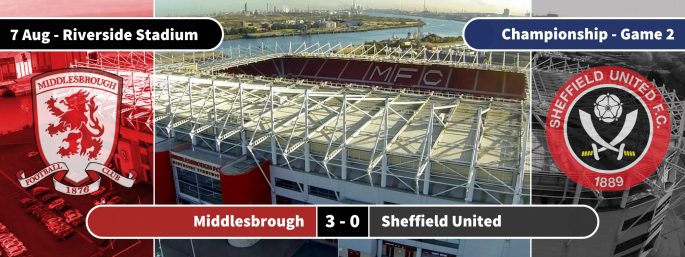
Boro 3 – 0 Sheff Utd

Middlesbrough Sheffield United
Braithwaite
Flint
Downing
7′
18′
25′
Possession
Shots
On target
Corners
Fouls
41%
13
5
7
10
Possession
Shots
On target
Corners
Fouls
59%
17
4
6
13

Swashbuckling Boro Foil Blades

Redcar Red reports on the victory over Sheffield United…

Well after a Lazarus type performance on Saturday away to Millwall and all the subsequent comings and goings Tony Pulis will have hardly had time to draw breath as he prepared his side for the visit of Sheffield United whose fans are more accurate with stones and coins than their strikers were against newly relegated Swansea on Saturday tea time. Both Managers are trying to put the finishing touches to their respective squads or perhaps more aptly in Boro’s case trying to add five or six new starters before Thursday. Both Mangers were supposedly interested in Martyn Waghorn but Sheffield couldn’t pay up front and Derby nipped in at the last minute to sign the Striker from under both our noses.

The big question for Boro fans was would TP abandon the old guard after the poor showing in the opening 70 minutes on Saturday or go with those who salvaged a seemingly unassailable point in the Lion’s Den? The manner of the change of tempo was so marked that it would be difficult to justify the inclusion of some of those Saturday starters. Additional complications however were that with an indecisive and jittery defence behind the mono paced midfield approaching this game in a cautious manner could hardly be dismissed especially when he knows that he has the potential to up the ante in the closing stages if required.

A hot and muggy Riverside played host to the first home game of the season where fans expectations were certainly a lot lower than this time last year. No talk of smashing anything other than the two outgoing transfer fees with low hopes rather than high expectations. The stats were on our side however as Boro had won our second league fixture of the season in six of the last seven seasons, (losing to Leeds in 2014-15) and of course last season our second league fixture was a 1-0 home win against Sheffield United. Searching for any optimism at all for Boro fans, United had lost their first away league match of the season in each of their last five campaigns hopefully it would be six after tonight.

On the team front Paddy McNair was fit and on the bench as Nathan Wood dropped out for the experienced Ulsterman. Lewis Wing was given the opportunity to start where he left off with Grant benched. When we lined up we surprisingly went with a 3F back three of Fry, Flint and Friend to match Sheffield. Downing was wing back on the left with Shotton operating the right flank with Howson and Wing supported by Clayton leaving Britt and Braithwaite providing the main attacking thrust.

Almost immediately Boro were on the offensive with Shotton being surprisingly sprightly setting up Howson who saw his attempt blocked. As poor as Boro were on Saturday in the opening 70 minutes the opening 7 minutes of this game saw far more endeavour as the altered Boro shape outmatched and outplayed the Blades adorned in a kit presumably borrowed from the Highways agency. That foreboding sense of Teesside inevitability which had pervaded the concourses was replaced by oohs and aaahs as Boro stroked the ball about and looked a totally different proposition to that dishevelled and aged bunch which started at the Den.

It didn’t take long for the pressure to tell and a Corner delivered from Wing via Dael Fry’s head allowed Braithwaite to somehow poke the ball over the line to put us one nil up with the Great Dane grabbing his second goal in as many games. The Riverside erupted as the evening Sun’s West Stand shadow had just covered the pitch and the warm basking glow certainly made everything feel a little more special after the net bulged. This was a great start and a well-deserved lead appropriately involving two of the best players on the pitch at that juncture. Boro never really looked back from that point. The early goal had clearly disturbed the Sheffield game plan and we started to pass the ball really well with Downing enjoying his best game for a long time in a Boro shirt as he martialled the left flank.

On 18 minutes Shotton’s cross was deflected out for a corner by Egan and another Lewis Wing corner was delivered with aplomb this time to the head of Aden Flint who powered home his header leaving Henderson in the Sheffield goal absolutely no chance to make it two nil and the away fans looking as sick as their sides’ shirts. The game looked just about over as a contest at this stage, Boro playing with total composure and not a single poor or weak performance anywhere. Clayts was scrapping, tackling and battling, protecting his backline, Howson had probably his best game to date in a Boro shirt but then so did Braithwiate who was a class above anything the United defenders had to offer. A special mention though has to go to Wing, apart from his corners leading to goals he was strong in the tackle, willing to dribble and take players on and quick to get back and defend but it was noticeable that the United players couldn’t shake him off the ball. He was standing firm and looking every inch the part and in no way looked like a reserve player taking a step up. He was head and shoulders literally over anything that United had to take him on.

As mentioned both Shotton and Downing were running the flanks and in total control and with twenty five minutes just ticking over on the scoreboard a deep Shotton cross from the right evaded everyone except Stewy homing in from the left to stick out a leg sending the ball back across the goal and past the despairing Henderson into the net. It looked a bit flukey and fortuitous in real time but who cared as we were three nil up and still had sixty five minutes to play! Downing’s celebration indicated as much and it seemed just then that everything we touched would turn to goal.

That was it really, no seriously we kind of retrenched a little knowing that the job was done and United had little option but to try and save their blushes and managed to get themselves into the game albeit too little far too late. The Police presence was a little more than the corresponding fixture last season when the event turned nasty with the South Yorkshire supporters throwing coins and stones. That increased security was perhaps just as well to prevent the 1,000 or so away fans this time throwing themselves under buses. The whistle went for half time just as a Braithwaite shot went narrowly wide of the post. The players trotted off to a well-deserved (and if truth be told unexpected) standing ovation.

The second half started with the Liverpool Welsh Whiz Kid Ben Woodburn brought on to try and work some magic. The lad did OK but as a side United just couldn’t make any build up count. At this stage Boro were happy to contain them with Randolph being called into action only twice during the evening from memory, one of which was however a full length effort to ensure a clean sheet was kept whilst the other was an up close fantastic reflex save. There were a few nervy moments with messy, scrambled defending which will need to be improved upon against better opposition than this (judging by TP’s histrionics on the touchline I suspect there is a strong possibility he agrees) but despite Sheffield trying to throw everything including the Kitchen sink at us they rarely troubled the Boro goal thanks in no small part to simply awful finishing in particular from last season’s goal machine Leon Clarke.

Wing fired in a few more corners, some of them not so good, low efforts that were either miss hit or routines that didn’t come off but another peach found Flint’s head again as he brushed aside his marker but couldn’t get the same power on it and straight at the relieved Dean Henderson. It could and probably should have been five or six but after the departures and anxieties I think all of us would have settled with three nil and as it happens that was pretty much what did happen as we seemingly settled for the three goals.

Apart from a little period of rushed clearances and nervy defending in the second half there wasn’t a single complaint to be made from the Home fans. Every single player raised their game and I can’t single out a poor performance or weak link. Britt ran himself selflessly into the ground before coming off for Fletcher with just over ten minutes remaining, Clayts came off for Grant to get a run out and shore things up and Howson eventually hobbled off after bravely attempting to carry on after a knock on his left knee which gave McNair his Boro Championship debut. The subs all did OK but the starting eleven had done themselves proud with no exceptions. As the game wore on United were losing composure with a few feisty tackles which saw three yellow cards for them and one in particular was lucky not to see a red. MOM for me was Braithwaite who simply looked a class above and like a few others possibly had his best game for Boro. I heard Radio Tees gave it to Lewis Wing and I can’t argue against that and indeed had Stewy or Fry, or Shotton, or Clayts or, or, or, or… it was just one of those nights when it all worked, well at least for the first twenty five minutes which in fairness was all that was needed.

That late, last gasp George Friend equaliser on Saturday will have had a massive psychological boost as will the manner of this victory and along with the league table who knows it may even sway the minds of a few players and their agents that perhaps the Riverside is the place to be headed over the

If you wish to leave a comment about Redcar Red’s match report please return to the Week 2 discussion page


Pulis waits patiently for news as Boro favourites swap shirts

Championship 2018-19: Week 2

Tue  7 Aug – 19:45: Boro v Sheffield Utd
Thu  9 Aug – 17:00: Transfer Window Closes
Sat 11 Aug – 15:00: Boro v Birmingham

Werdermouth looks ahead to a busy second week of the new season…

Somewhere in a small out-of-town shopping centre in Europe stands an edgy sixty-year old man increasingly distracted by the sound of a loud ticking clock reverberating in his head. The smouldering sight of his Bulkhaul diamond encrusted platinum credit card beginning to melt through the pocket of his monogrammed flame-retardant jogging trousers hasn’t prevented cries of ‘pants on fire’ when he claims he’s short of cash at the checkout. With his already healthy budget bolstered by some offers that the club couldn’t bring themself to refuse, the presence of a cash-rich man pleading he’s desperate to buy players is perhaps unlikely to encourage hard-nosed sellers with botox injected eyelids to blink anytime soon. After frequently claiming he doesn’t want to waste Steve Gibson’s money, it is perhaps the burning desire to avoid some embarrassing bank statements landing on his chairman’s desk for those impulse purchases that risk warming the already over-heated bench from Garry Monk’s trolley dash last season.

Following a disturbing dream in which a rather closely cropped geodesic-headed Rudy Gestede in 32Red branded hot-pants and stiletto heels attempts an epic strut before damaging his suspect ankles even further, the Boro manager has probably not slept well – plus it has left him feeling not so Money Supermarket as he thought he was. Although sleeping on decisions is not really an option at this late stage. Instead, he’s perhaps been laying awake at night trying to make sense of the recurring nightmare of a small furry animal with a Russian accent encouraging him to compare the market before he blows his money on cheap imitations with expensive price tags. “It’s not as ‘simples’ as you make it out” exclaims Tony before waking once more and placing his Adidas nightcap on his bedside table as he procrastinates over another purchase. The Boro manager assumed everyone knew the transfer market just doesn’t make sense any more and that most clubs pretend to be Moroccan carpet sellers with nothing better to do but offer you endless cups of over-sweet mint tea before finally agreeing to lower their prices to very expensive from extortionate. Playing the game of negotiation takes time unless you’re prepared to bid over the odds or sell on the cheap – something Boro surely would never contemplate!

Yes, spare a thought for the Boro manager as we enter the final few days of the Transfer Window – one that may well end up defining his the reign at the club. Tony Pulis appears powerless to prevent his more coveted players leaving as he shrugs off the inevitable loss of some of last season’s best performers. First, Bamford’s desire to be the main man replaced the one that thought he could one day impress his Boro manager that he had what it takes to lead the line. He retained the 32Red shirt, albeit in white, when joining Leeds for a fee that appears to have been haggled in favour of the latest carpet-baggers of West Yorkshire rather than Boro’s supposedly hard bargainers – though much will depend on the kind of season he enjoys before that particular stick can be legitimately used for punishment beatings. His first experience of being the main man at Elland Road was as an unused sub as he watched their 3-1 victory over newly relegated Stoke – so he’s already seen the benchmark.

Second out of the exit and snapped holding up his new shirt was the brick at the heart of Boro’s defence, Ben Gibson, who has headed to Sean Dyche in footballing Legoland where he’ll be hoping to rebuild his career. Burnley discovered by starting low at £11m and then raising their bid in £2m increments it broke Boro’s resolve at just half of what he was rated 12 months ago. Maybe it’s just a sign of the devaluation that comes when one of the big rich clubs are no longer interested in signing your player. Gibson spent five seasons as a Boro first-teamer, four in the Championship and one in the Premier League side that was relegated and has so far just missed out on acquiring a senior England cap since his ten appearances in the U21s. £15m from an outsider may look like quite a lot for a relatively unproven top-level player. However, if he does settle at Burnley and achieve an England call-up, then it’s likely he’ll be looked at once more by bigger clubs – hopefully Boro have a sell-on clause inserted just in case the silly money returns his way.

The hype and volatility of the inflationary transfer market means one good season has a player’s valuation going through the roof, whereas one bad season can often be explained away and damage limited. Young players in the Championship can have their valuations dramatically inflated purely on potential alone as PL clubs seek new talent to maintain their status, older players less so unless they can amaze and stand out. Ben Gibson will be 26 in January and probably can be no longer sold on potential – at least not for silly money. Perhaps in hindsight the club should have cashed in a year ago if offers closer to the rumoured £30m were possible – especially as he turned out to have had a subdued season last term and never looked close to his usual infallible best. For reasons I can’t quite seem to pin down, it felt like all our defenders and defensive midfielders looked far more impressive when the team simply concentrated on playing more defensively under Karanka – and who could have imagined that?

Looking likely to be the third key player out of the Riverside within a week is Adama Traore, after Wolves decided to meet the much maligned release clause – though it seems they’ve had to pay over £20m to avoid stumping up the whole amount up front. It always seemed the mercurial Boro favourite’s future was going to be away from the club once Pulis admitted he was powerless to stop him leaving if the release clause was met. Whether Boro have been able to insert their own sell-on clause is doubtful as it would logically follow that if Wolves met the conditions to force a sale, then they were under no obligation to add any clauses that were in Boro’s interest. Adama was a charismatic crowd favourite on Teesside and his exciting presence will be sorely missed. The player will now try to prove he can make the step up to the Premier League and continue to build his reputation.

Interestingly, Traore started only 28 of Boro’s league games last season and scored just five goals – it’s perhaps a measure of his box-office personality that, despite those modest sounding stats, he was in most supporters eyes the main player as a creative source of goals. Once he pressed the accelerator, the crowd volume noticeably increased as people excitedly rose out of their seats in anticipation. He is perhaps an example of one of those young players who is being sold on potential and Tony Pulis must take the credit for putting his faith in him and taking him from a peripheral figure under Monk to a valuable sought after asset. Whatever your view, one thing is for certain, a trip to the Riverside will be less exciting without him – especially after the loss of two other crowd favourites in Ben and Bamford.

Ahead of Saturday’s opener at Millwall, there was much talk among the Boro supporters that the current squad was nowhere near good enough to be promotion contenders. Whilst this negative feeling was frowned upon by some as defeatist talk before a ball was even kicked, similar sentiments were echoed by the man in charge at the post-match press conference. He declared of his squad: “It’s a smashing group, but it’s not good enough to get us promoted. We need to add to the group.” – before placing another tenner in the ‘Smash’ box that Steve Gibson held out to him. Pulis went on to add: “I think we’ve got to put things in perspective, if you look at the team that came here today compared to the team that finished the season we’re six players down. “When you are talking about Gibson, Ayala, Traore, Bamford, Besic, all top players, so that team was a massive change.” Although the ‘sixth’ man down was undeclared, it was widely assumed it was Rudy Gestede that was the one who narrowly missed out on the ‘top player’ accolade from the manager.

The performance itself at Millwall was so underwhelming for the first hour that the club apparently took the drastic step of cutting the live video stream to spare many overseas Boro followers from witnessing the mauling at the Den. Only those watching with smartphones were allowed to be indulged by the MFC app, safe in the knowledge they’d be busy texting, tweeting and taking selfies to notice much of the game. In fact, the away side were lucky to escape to the dressing room without any terminal scratches at 0-2 down. But it was only the introduction of youth in the second half that sparked life into the team as the ‘experienced’ Leadbitter, Clayton and Downing all got hooked to make way for Wing, Tavernier and Fletcher – which subsequently removed 32 additional years worth of tired and predictable legs from the pitch. Suddenly the team had acquired the kind of energy that Mr Caraboa could only dream of representing with a dead buffalo’s head. With the added purpose at which the youngsters ran at the opposition it started to create chances, leading to an unlikely late double that saw Boro rescue a valuable point that felt like a win.

Many are now suggesting that this is maybe the way to go and that Pulis should learn the lesson that it was time to put faith in the younger players. I suspect he won’t be so easily distracted from building a team in his image and it’s likely the youngsters place in the limelight will be short-lived if new recruits arrive on the stage. The Boro manager is probably looking at recruiting known quantities with the physicality and power he craves. The likes of Tavernier and Wing may spend much of the season adorning the bench, ready to provide cameos in the last third of games. My hunch is that given the choice, Pulis prefers hardened pros to the enthusiasm of youth – though that is not to say he couldn’t be forced to be proved wrong if their performances win points. Rumours of big full-backs with long throws and even bigger muscular forwards waiting to flex themselves for the cause will not persuade many among the Boro faithful that a change of heart is imminent. Hopefully, more than anything else, Tony Pulis will want to win games and not be stubborn in his quest to prove his methods are still valid – he’s not in Karanka’s league in that respect.

One interesting aspect to recruiting late is what then should we make of these new recruits missing the all important pre-season mountain-climbing conditioning that is supposedly so vital? If half the the eventual first team underwent less testing regimes, then does it negate the overall purpose of pre-season for the collective? Perhaps sometimes these short extreme fitness plans are over-stated or exaggerated in the grand scheme of things – they may work better for some players but it’s probably more psychological in making them think that they can push themselves further than they thought. Extensive plasma screen analysis carried out by amateur researchers at the University of Life (formed after the merger between Black Cab College and Local Pub Polytechnic) showed that during the World Cup, winning teams always look fitter than the one that has just lost and subsequently collapses on the floor exhausted and dejected. We can therefore perhaps conclude that if you want to stay fit then try to avoid losing too often and then giving yourself a mountain to climb at the end of the season – note: this study is yet to be peer reviewed.

As for how Boro will replace the key players that have just left and those now out of favour, who are waiting in the lobby for a courtesy limo to take them to the next gig – well we appear still unclear if virtual rumours and press speculation will eventual materialise into anything of substance. As we speak, apparent long-term target, Martyn Waghorn of Ipswich is rumoured to be set to snub Boro and join Derby instead – it looks like the lure of Lampard may trump the pull of Pulis – unless it’s just part of the auction game. There are some suggestions Boro are looking at Matt Richie of Newcastle to fill the void left out wide but he doesn’t sound like a box-office replacement for Adama. It’s not even clear if the money raised by the sales of the three crowd favourites (which amounts to nearly £50m) will be spent in the coming days.

Hopefully it won’t be blown on seemingly overpriced projects – Liverpool’s Sheyi Oji is apparently available for £10-15m. I think there should be a rule of thumb that a player’s valuation should be related to the shirt number a club gives them. Oji was photographed in pre-season wearing the number 54 shirt with Klopp declaring he was close to the first team – come on, if your shirt number is only normally seen on a bus then it’s unlikely you are going to be featuring in the first-team squad any time soon. It looks like any arrivals at Hurworth are being kept a closely guarded secret while Neil Bausor practises his money shot smile for the gathered media.

Anyway, if Tony Pulis wasn’t busy enough try to get shopping done he’s actually got two games to contend with this week. Thanks to Boro’s game against West Brom being selected for TV on Friday the 24 August, the planned midweek fixture before it against the Blades has been cut and spliced into this Tuesday instead. I suspect the Boro manager could have done without this extra distraction – especially as he now only has half his preferred team available. Sheffield United lost their opening fixture at home as newly relegated Swansea came from behind to snatch victory. Coincidentally, this game was also Boro’s home bow last season as Garry Monk’s team got off the mark with a 1-0 victory thanks to a Rudy Gestede looping header. The game itself was marred by crowd trouble after the final whistle with the away fans hurling bottles and coins at the departing Boro supporters. Let’s hope we get a repeat of the victory but not the behaviour of the visiting supporters.

Whilst it doesn’t seem ideal to play this fixture now, it at least give a Boro a shout at topping the table as the only other midweek Championship fixture involves Forest and West Brom – and neither of them won their opener. In fact that late rally by Boro may have given them some momentum after they escaped from languishing in second bottom just above thrashed Rotherham – though will Pulis put his faith in the youngsters who got him out of jail? He probably should given his limited options – especially since getting the crowd behind a team that is missing their departed favourites will not be easy if he opts for the mono-paced midfield trio that started Millwall.

The week ends with the return of Garry Monk and his now out-of-court settled backroom staff after Steve Gibson decided against enforcing their gardening leave after they joined Boro’s former manager at Birmingham. Indeed, welcoming former managers looks like being a regular feature at the Riverside this season as Mogga will bring his Blackburn side, McClaren returns with QPR and Agnew arrives again alongside Bruce at Villa – we just need Strachan to be given the Leeds job around Christmas and Gareth Southgate to come and check on the emerging Dael Fry to get the full set. As for the game itself against a Blues side that only just escaped relegation last season – it’s probably not the worst fixture to have as Birmingham suffered a similar fate to Millwall in that Norwich equalised with a late injury time goal. No doubt made even worse by the fact that Garry Monk’s side had just thought they’d picked up all three points with an 89th minute strike. They now have a whole week to dwell on that one and practice drills of trying not to panic at the end of games.

So time for another week on the Boro roller-coaster, I suspect many will be anticipating feeling sick and dizzy as they scream to get off – others will be looking forward to the adrenaline rush and just enjoying the ride. As for Tony Pulis? Well he may be sticking with the swings and roundabouts analogy, before hoping to avoid the big slide if his see-saw dip into the transfer market leaves him feeling he’s been given the merry-go-round by his missed targets.

Millwall 2 – 2 Boro

Millwall Middlesbrough
O’Brien
Gregory
12′
37′
Braithwaite
Friend
87′
90’+7
Possession
Shots
On target
Corners
Fouls
44%
9
2
6
13
Possession
Shots
On target
Corners
Fouls
56%
11
2
6
6

Young Guns silence Lions roar

Redcar Red reports on Boro’s last gasp draw at Millwall…

From the euphoria of an unexpected Play Off place to the disappointment of the summary Villa exodus we entered the summer months licking our wounds. With an experienced Coach on board we started looking forward to August when our quest would recommence and with hopefully a few reinforcements on board. Those Villa fans that had goaded us in our misery were getting their just rewards as their club went into freefall and everything in our Boro world was looking rosy again as optimism on Teesside was high.

Fast forward to this week which had seen bickering between fans over Bamford’s departure and our finest seemingly now fair game for being picked off by Premiership vultures. The linked replacements had been failing to stir the hearts and minds of many, not that any had actually arrived apart from veteran Keeper Andy Lonergen to compete with Dimi for the Voltarol. Apart from Flint and McNair the lack of new faces to fill identified gaps from last season hadn’t materialised and with the window slowly closing confidence was openly seeping away on Teesside.

The news on Friday hadn’t improved the mood with Ben being subject to a series of offers from Turf Moor which eventually saw a deal agreed at £15M and new recruit McNair managing to pick up yet another injury without even kicking a ball for his new club. Erstwhile gaffer Gary Monk had come in for Ashley Fletcher yesterday in an attempt to lure him to Brum potentially leaving the squad looking lighter still. With the deal for the young striker still in the discussion phase he took up a place on the bench along with the rest of the U23 squad.

TP’s match squad consisted of those who will form the core, those who didn’t want to be here, those who mightn’t be here for much longer and those who many didn’t want to be here at all along and then the youngsters including 16 year old Wood. The team pretty much picked itself with the “old guard” of Leadbitter, Friend, Downing and Clayts in place, with last season’s arrivals Randolph, Britt, Howson and Shotton complimented by Braithwaite and Fry partnering newbie Flint.

Any king of result here today would be seen as a great result under the circumstances with most hope probably placed on the creaking old guard. Looking for any reason to be cheerful Middlesbrough had faced Millwall only twice previously on the opening day. They were in the 1987-88 and 1991-92 seasons and we won promotion at the end of both of those campaigns!

Millwall got Boro’s 2018/19 season underway and an early long range attempt by Braithwaite offered some misplaced hope. The Lions built up a bit of possession with Clayts clearing and then Flint getting beat and indignant claims for a penalty from the home fans. A ball swung across the box had Shotton stretching, getting his head to the ball to concede a corner as Steve Morrison was about to strike. Another panic in the Boro defence from the resultant Williams corner fortunately saw Randolph collecting the ball from Savage to momentarily calm things in what was a lively start. That telepathic understanding between Gibson and Ayala was clearly missing and the entire back line looked very uncomfortable and then O’Brien was set up from a cut back in the box by Lee Gregory and hit an unstoppable shot past Randolph on twelve minutes to deservedly give the Lions the lead.

On a quarter of an hour Boro were looking very much second best with little evidence on show that we were going to get anything from open play. A telegraphed Shotton throw in to Flint was collected by Archer as Boro attempted a poor set piece from which Gregory broke putting Fry under pressure and winning a corner. The corner from Williams saw Jake Cooper rise above the floundering Aden Flint and the header went over much to the Travelling Army’s relief. Another tussle with Fry resulted in Millwall’s third corner and again Williams swung the ball in this time fortunately cleared by Clayton as pressure was mounting.

If there was ever any doubt that this was a patched up disconnected bunch of motley Players then the opening twenty minutes provided all the evidence that what happened in pre-season was now continuing well into the start of the actual season. All the summer planning and Austrian high tempo fitness training looked to be well short of what was required and in truth we looked far worse than those toothless two legged affairs against Villa. Boro desperately needed to get a break but a run by Britt was badly timed and flagged offside. Clayts was busy plugging defensive gaps while Grant, Howson, Downing and Assombalonga were largely anonymous.

A fourth Millwall corner saw Cooper again beat Flint who looked all at sixes and sevens. As the game progressed Meredith unexpectedly and stupidly swung an arm out at Britt and was lucky to stay on the pitch. Meanwhile Shotton had restarted the game with a throw in but had little options presented or available to him as Boro just didn’t look joined up. Frustrations and niggles were building and the game descending into a scrappy affair with Clayts picking up a yellow. Tactically Boro were looking lost and wishing for the half time whistle. The scrappy battling nature of the game suited Millwall perfectly as we couldn’t get anything moving or offer any serious threat on the Archer’s goal. Everything we tried to put together was laboured and fell apart, another Millwall break saw Clayton risk a sending off with a calculated foul which had the home fans baying for a Red and being honest Clayton was very fortunate to stay on the pitch.

Downing and Braithwaite were getting no service, Grant and Howson were ineffective in the middle and Britt cut a forlorn figure. The lack of pace and creativity was blindingly obvious as the craft and graft of Millwall was simply overpowering Boro. Boro’s first corner went over the heads of everyone including Flint and was easily collected by the Millwall defenders and the minimal threat that should have been was easily defused. As ridiculous a back header that I have ever witnessed by Aden Flint left Randolph exposed and a Jason Steele style star jump from the Irish keeper allowed Lee Gregory to take advantage of Flint’s generosity courtesy of the ball going through Randolph’s legs.

This was about as bad a defensive performance as we have seen from Boro since the confusion witnessed in the early stages of Valdes’ introduction in the Premiership. Sadly the afternoon was panning out pretty much as many expected based upon the ineptness of pre-season games and questionable transfer activity. Just before the half time whistle Howson hit a ball that was in keeping with his accuracy levels since joining last summer going well wide summing up Boro’s first half in one single moment. Millwall’s Hutchinson had gone off the pitch to receive treatment and a he re-entered the fray with a bandaged head and fresh shirt Boro tried to break through but Britt was once again caught offside with the ball was played far too late leaving him well advanced of the Lions rear-guard.

The half time whistle sounded to temporarily put us out of our misery with Millwall just picking us off as we managed to get ourselves into trouble and offered absolutely nothing in terms of creativity or quality on display. For me at this stage I would have thrown on Chapman, Wing and Tavernier because we had nothing to lose and what was on display was simply worse thanwoeful. TP sent his charges out early from the dressing room without any changes in fact nearly five minutes before the Lions entered the arena which worryingly indicated to me that there wasn’t much in terms of a tactical team talk or the air like the home sides shirts had turned blue.

Boro got us underway in the second half presumably with just an old fashioned TP rollicking to give it all they had for the first ten minutes and let’s see what happens. An over hit George Friend ball to Downing was the initial offering as Millwall once again applied pressure and added to their corner count. Without Traore there was zero outlet, threat or pressure relief, without Bamford there was no ability to collect a ball and play football in the opposition half and without Ayala and Gibson our defence was nothing short of a shambles. That’s not a reflection on Fry but on the synergy of the unit.

A golden opportunity for Morrison was missed followed by another quick chance for Gregory as Millwall sensed Boro were rocking and a third goal would kill the game off completely. Substitutions were desperately needed if only to give the young lads some experience because the eleven on the pitch were certainly not going to affect anything as it stood. Grant soon made way for Lewis Wing who hopefully would grasp the opportunity and add some creative influence for Britt. Meanwhile Tavernier was also readied as Braithwaite nearly set up Britt whose effort came off a defender in Boro’s first meaningful assault. Savile inevitably then broke and Wing registered his first involvement by picking up a Yellow in a Clayton style one for the team to cut out the threat.

A Gregory volley was cleared by Fry as Boro seemed intent on making Millwall look like Brazil as O’Brien was next to have a pop at Randolph’s goal. Tavernier came on surprisingly for Clayton who had battled and scrapped all afternoon, perhaps his Yellow card earned in the first half was playing on TP’s mind with his scant resources. Boro then switched things around, Braithwaite going more central supporting Britt and then Tavernier and Downing operating on the flanks. That left Wing and Howson in an attempt to add some outlet and abandon the safety first defensive midfield mindset.

Tavernier was quickly fouled and the resultant free kick floated in by Braithwaite was knocked down to Britt six yards out but he couldn’t make it count. Then a ball in from Shotton aimed at Flint and Wing was fumbled by Jordan Archer as Boro showed a rare bit of attacking intent. Howson was becoming more involved in the game and started to feed the wide players with Tavernier on the left creating a much needed outlet. A break in play allowed for an intake of water under the scorching Mediterranean type sun as Millwall started to run the clock down with around twenty minutes remaining.

Flint hit a wayward ball that went straight out of play with Lewis Wing screaming for it to be played to his feet. Fletcher was brought on for Downing as TP gambled his last throw of the dice. Personally I would have went for Chapman but I’m guessing TP was emphasising his Plan A “knock it up to the big lad” as Braithwaite seemingly took up yet another position on the pitch replacing Stewy. A Braithwaite corner was cleared but Wing recovered it and cleverly split the Millwall back line and as the ball came to Fletcher he fluffed his lines putting off Flint in the process. A minute later and another Flint attempt had Archer called into action as we gathered some momentum finally.

Tom Elliot came on for Lee Gregory with ten minutes remaining; presumably his height was considered an advantage in matching up the arrival of Fletcher. Britt chased a ball that was just too weighty and Archer came off his line and collected comfortably. Another opportunity for Morrison was spurned as he past Friend but was blocked by Fry conceding the corner. Tavernier was causing problems for them and won another free kick allowing an opportunity for Neil Harris to bring on new signing Skalak for the exhausted O’Brien. Braithwaite’s ball in was then cleared for a corner which Braithwaite also took but the whistle went almost immediately for a foul in the box giving Millwall the respite they wanted as they slowed things down once more.

As the game was dying in the final minutes Tavernier collected the ball after some head tennis in the Lions box poking it through to Braithwaite who despatched the ball two yards out to pull one back for Boro. Harris then brought on another defender to try and shore things up as Flint went up front with Shotton Fry and Friend forming a back three. Five minutes added time came up as Friend hit a long diagonal ball up to Fletcher which went out for a corner, Boro desperately applied pressure with Wing, Flint, Braithwaite, Assombalonga and Fletcher all desperate to nick a late equaliser. Britt was grappled and dragged back as he tried to break and then Elliot nearly had a chance immediately up the other end as the game ended in a frantic five minutes.

A tackle on Britt this time saw a last minute Boro free kick followed up immediately by another free kick with Millwall desperately trying to clear their lines. A last ditch death knell Shotton throw in ended up with Lewis Wing firing in a low speculative shot which scuffed and skidded off the hard surface in the congested Millwall box ending up with George Friend poaching in the centre of the six yard box getting on the end of it to poke home stealing the most unlikely of points. Kevin Friend immediately blew the final whistle to send the Travelling Army barmy, simultaneously with his officials heading for cover from the wrath of the snarling Dockers.

Incredibly and unbelievably Boro rescued this game against all the odds thanks to the determination and fearlessness of youthful energy. Tavernier and Wing showed their mettle and if they can do that at the Den then they can do it anywhere in this division. A rollercoaster of an afternoon which was despondency personified, rescued by the introduction of the U23’s. MOM has to be Tavernier who changed the game when he came on along with Wing. Once the shackles of the sedentary midfield was gone Howson was far more influential and Braithwaite who had got himself involved all afternoon was for me close runner up to Tav in the MOM stakes.

Phew, welcome back to the Championship in a game that highlighted so much that is currently wrong with Boro and yet against the odds offered so much unplanned hope for the future.

If you wish to leave a comment about Redcar Red’s match report please return to the Week 1 discussion page

After a gruelling pre-season are Boro fit for purpose?

Championship 2018-19: Week 1

Sat 4 Aug 2018 – 15:00: Millwall v Boro

Werdermouth looks ahead to the start of the new season…

It’s practically August and the start of the new season is almost upon us, no doubt bringing with it the anticipated feelings hope and despair in equal measures on Teesside. Well I say equal, but there are far too many fatalities of hope from seasons past that much of the Boro population now sits entrenched outside the circle of optimism in the Venn diagram of life and has long opted out of the empty set of realism. Instead, it remains in the circle of doom, predominantly huddled under the grey comfort blanket of pessimism with a lazy eye on the lookout for an unexpected pre-seasonal sunny outlook to warm their post-play-off spirits and encourage them out of their slumber of gloom. Although, I suspect few so far will have been motivated to reach for the SP Factor 50 to block out any potential harmful rays of optimism radiating from the Boro camp that may permanently damage their Teesside DNA. Many have had their fears confirmed by a string of unconvincing defeats in those all-important pre-season defining fixtures, which will soon be consigned to obscurity where only those attending even more obscure Monday evening quizzes in almost empty pubs need speak of again.

It appears the object of pre-season seems to have been defined by manager Tony Pulis as being about physically preparing his players for the long gruelling 46-game season rather than honing their footballing skills and teamwork to try and acquire that winning mentality. Ten punishing days in the Austrian mountains with triple daily sessions may have left some wondering if their Boro careers would ever make it to base camp. The gaffer’s preparations for an attempt to conquer the north-east face of the Championship this term without the need of oxygen may have had some gasping as they were run into the ground. With the opposition starting to run rings round the pre-season plodders as their creaking limbs started to seize up, desperate cries of “How do expect us to play football when we can’t move our legs?” were met with reassurance from the conditioning team that they’d feel the benefit one day – possibly April. I suspect if Pulis was asked why he likes mountains, he’ll probably just reply: “because they’re big!” Though last year’s pre-season summit fever quickly evaporated on Teesside after a less than sure-footed start to the campaign under Sherpa Monk. Boro followers will now be looking to tread more carefully before getting giddy in the rarefied atmosphere of heightened promotion expectations – indeed, most this season are preparing for a slow acclimatisation to the thin air of hope as the team sets out on the long journey ahead to scale even greater heights.

At least the World Cup under Gareth Southgate’s re-education of the English nation reminded us that we make our own history. The fear of failure shouldn’t prevent you contemplating success and achieving your personal goals – especially against average opposition or the pressure of expectations against bigger countries like Croatia and Panama with populations of 4 million and the huge nation of Belgium with its 11 million hoard of bureaucrats and purveyors of strange tasting beers. Southgate has shown that it is possible to compete with these teams and in some cases even win. Perhaps Tony Pulis has learned something from the example his Boro predecessor gave in Russia and maybe he’ll surprises us with a back three of passing defenders comfortable on the ball? Though possibly he will only seek to emulate Gareth’s style and make it his own with a matching combo of pin-striped waistcoat, baseball cap and white trainers – it could be a hard one to carry off for a mature gentleman, especially if he also opts for the beard. Whether the trend of dressing like the manager will mean we’ll also see an army of Pulis clones in the North Stand, frantically chewing gum and gesturing to hit it long remains to be seen – though it may be hard to ascertain if mature men in baseball caps and glasses have just come as themselves and that the doppelganger bandwagon has not in fact spread from Russia to Teesside – with or without love!

Indeed, anyone looking for their heart to marginally quicken, let alone skip a beat, or even contemplate salivation at the prospect of new signing will perhaps still be stuck with their bradycardia and dry mouth syndrome for a little longer. With the newly introduced smaller transfer window soon to be closed, it appears those trying to get in are being over-polite and are allowing those wanting to climb out to shuffle out first. Latest reports seem to indicate that only those fleet of foot or skilful are able to leave through the window, whereas the ones coming in need to be big and strong. It sounds not so much a window, as transfer trapdoor that is awaiting another heavy plodder to accidentally step on it and fall into the Boro camp. OK, we may have been over-sensitised by lazy press rumours linking anyone who is six feet or over to Boro. I’m not sure where this stereotyping of Tony Pulis has come from but I’m sure he’s probably just been misunderstood.

Anyway, the Boro manager appears to be quite fond of the idea of using big Rudy Gestede as the main striker this season – but perhaps the use of ‘big’ is a bit gratuitous for someone who’s only 6′ 4”. We also perhaps shouldn’t read too much into the signing of 6′ 6” Aden Flint from Bristol City – even if Ben Gibson inadvertently referred to him as a ‘man mountain’, it doesn’t necessarily mean the Boro manager is sizeist. After all, Pulis also signed the Sunderland midfield midget Paddy McNair and he’s barely over 6′ 2” in his Boro socks – plus what if Tony favours the 6′ 3” Ryan Shotton as right-back and shipped out the energetic Fabio instead. Surely the Brazilian being 5′ 8” didn’t even cross his mind when he was quite literally overlooked – in fact I believe he even called him a ‘smashing little lad’, which was also probably a little risky given that ‘smash’ has been on the club’s banned words list for some time now. The latest rumour is that the bar over the Boro changing rooms may need to be further raised as the manager targets 6′ 7” Gillingham keeper Tomas Holy. It’s all beginning to sound like a conspiracy against Pulis purely based on one or two small-minded hacks in the media simply measuring the size of players he prefers. I think we are going to need a lot more evidence before jumping to such conclusions and I shall personally remain open-minded on the issue until Boro’s bid for Peter Crouch becomes public or the club sign an unknown Croatian over 2m who lists basketball as his first love.

One of the highlights of the pre-season was the ditching of the Ramsdens Currency advertising hoarding that masqueraded as a Boro shirt last year and the introduction of the smart new kit from Hummel with the more suitably meaningless ‘Red 32’ logo instead. The ethics of promoting a online gambling outfit over a company that is essentially a pawn-broker is perhaps one for a late-night Channel Four discussion programme that few watched sober – though in the absence of being allowed alcohol or cigarette sponsorship it’s probably difficult for clubs to find suitable brands with budgets large enough to preventing them blinking at the opportunity. For the uninitiated, Red 32 is the next number on an European roulette wheel after the Green Zero, which perhaps is a wiser choice given that I suspect not many football supporters would fancy having a big fat zero on their club’s expensive replica shirt – although it could have had it’s merits as acting as long-ball target for Rudy Gestede with his back to goal.

Of course being associated with roulette is nothing new for Boro as you may recall Garry Monk’s team were quite fond of the Russian variety as they metaphorically aimed the promotion pistol at their feet before emptying the chamber. The problem for Monk was that he forgot that Russian Roulette was best survived without a fully-loaded pistol and his standing at the club became quite precarious after he ended up losing more toes than Sir Ranulph Fiennes’s ill-fated solo trek to the south pole in flip-flops. There is indeed a lesson for Tony Pulis from last season’s stuttering start and Monk’s failure to find any kind of consistency left him under pressure before ten games had passed. Any team with aspirations of automatic promotion will need to get close to that magic two points per game target – anything that falls significantly short requires the kind of runs that Fulham and Millwall managed in the second half of the campaign. However, the main impact of an indifferent start will be that the players will not play with confidence and then it becomes a much harder game – but until a ball is kicked we should remember that Boro are indeed unbeaten.

Since Boro only marginally improved their record under Pulis after Monk departed and then just edged into the play-offs, the club can’t afford to be complacent in thinking they have a squad close to one of the automatic spots. In fact as things currently stand, it is arguable that the squad is weaker and risks becoming even more so if key players like Adama, Bamford and Besic are missing. The long-running saga of ‘has he or hasn’t he?’ with regard to Traore’s exit clause has taken on almost Harmony Hairspray proportions in the Teesside psyche – have the club got a firm hold of the player or will he be one of those natural fly-away types who breeze out of the transfer window? It seems Tony Pulis has now answered that question by indicating that Adama has indeed got a release clause and there’s nothing the club can do to stop him talking to those who meet it but no club has triggered it yet. One wonders why he has publicly cleared up the mystery – is it because he’s running out of time to fund signings and is flagging it up that Traore is available at the right price? £18m is probably beyond Championship clubs, so at the moment only Huddersfield or Wolves have reportedly shown interest. Pulis will not want to be cash-rich with no time to spend it (or blow it as is often the case with panic buys) and if rumours that Britt is also available at the right price and seemingly out of favour, or Bamford can now leave as he’s not fancied either, then it could leave many of the faithful apoplectic if the manager drops the aces out of the pack while attempting a fancy squad shuffle.

Others may argue that many of our favourites have not really delivered often enough to turn down serious bids with serious money. Of course the problem is as always bringing in better quality players who have a proven record that will either accept the wages on offer or be prepared to play in the second tier. The truth is those who can play at a higher level will and that usually means there is some gamble of sorts in picking off the right players from that pool of too good for the Championship and not quite good enough for the Premier League. That is why often the loan market can be a safer option – however Boro have not looked an attractive option for loanees recently, with most barely getting a kick for their troubles last term. What seems to be left are overpriced journeymen or promising youngsters at big clubs with very little experience – the risk is that they don’t necessarily fight for place when they see the club as just part of their development. Although, Bamford was a Chelsea player when he won Championship player of the season under Karanka and Chambers a hopeful Gunner – much can depend on being part of a successful team I suspect.

It may in fact be a much better strategy to concentrate on the handful of Boro youngsters who are just on the fringes at the moment. The likes of Fry, Tavernier, Wing and Chapman are showing good form in pre-season and have the advantage of being already settled at the club and familiar with the setup. Promising youngsters from big clubs may take too long to get up to speed and as we saw from Fletcher last year – he didn’t cope well with his big money move and never looked comfortable in his new surroundings. He now perhaps looks a better prospect this season after some games under his belt at Sunderland and the pressure of making an impact removed.

As things stand less than a week before the opener at a Millwall side that just missed out last season, Boro appear to have plenty to do in order to convince the majority on Teesside that they have promotion credentials. Many of the shortcomings from the last campaign have not been addressed as yet and those players who were instrumental in getting us over the line may well exit the club too. News that Bamford is close to a £7m exit to local rivals Leeds will not sooth seething supporters feeling unimpressed with the way the squad is being reshaped. It’s basically getting our money back on a player, who when he was re-signed 18 months ago, it was claimed by some foam-fuelled journos in the local press that Boro had potentially signed a £45m player – well unless the add-ons have been under-reported (currently £3m depending no doubt on Leeds being promoted and Paddy bagging 30 goals) then he wasn’t. Having said that, in today’s market £7m looks on the bargain side when viewed relative to valuations and prices Boro get offered to purchase players.

Whether lightning-fast Adama’s shoulder dislocation in the lightning curtailed lacklustre performance against Sunderland will put off potential bids is not certain – though Pulis once again played down its significance and claimed he could be back within a week in what sounded like further sales talk. ‘First-choice’ striker, Rudy Gestede is currently nursing ankles strains, which was apparently caused by the stress of jumping and landing in what sounds a prerequisite for a target man – although some have suggested it was caused by too many sessions attempting to trap bags of cement in training. This now seems to have opened the door for Britt Assombalonga, who had appeared to have dropped down to third choice since his £15m arrival – he actually bagged a hat-trick against Hartlepool in his 56 minutes, though we know he can score against weaker opposition but has tended to struggle against better teams.

Many still remain unconvinced that Boro are ready for the new season and the First XI will more or less pick itself with some players likely to unpick themselves if their valuations are met. A back four of Shotton, Flint, Gibson and Friend looks certain – with arguably one of Boro’s best performers last term, Ayala back on the injury list and who knows when he will return. Midfield appears to be Clayton back in the holding position after a brief and surprising experiment as an attacking midfielder, which given that his one and only goal for Boro in 150 appearances makes George Friend look like a lethal finisher, then it was probably a wise decision. He’ll be joined by Howson and McNair with Downing hopefully supplying the ammunition – though it remains to be seen who replaces Adama if Pulis’s prognosis proves to be too optimistic or he indeed departs. There are strong rumours that Liverpool’s Sheyi Ojo is once again on Boro’s radar and prices seem to be quoted at £10m for a player who struggled on loan at Fulham last season and has so far managed just 6 goals in his 58 appearances – the words ‘expensive project’ spring to mind but if he arrives hopefully he’ll be the success he was sold as.

The supporters will be putting their faith in Tony Pulis and that he is experienced enough to make the right calls but there is a nagging doubt that maybe he is actually been better working with players that didn’t necessarily fit his template rather than building a stereotypical team in his image. The Championship is in some ways a brutal season of attrition where power and fitness will overcome most opponents – the risk is that Wolves and Fulham showed in the last campaign that playing football will perhaps trump mere physical strength alone. So Boro don’t just need to be fit, they also need to be fit for purpose and capable of outwitting equally stubborn opponents too. So ready or not, the season is about to get underway – there is thankfully no talk of smashing the league this time and perhaps Jonathan Woodgate’s battle cry of giving promotion ‘a real crack’ is sufficiently understated to prevent expectations exceeding potential.

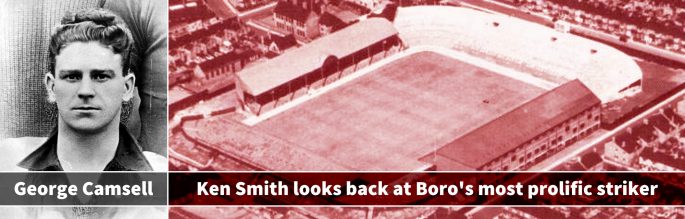
George Camsell: The story of Boro’s most prolific striker

As Tony Pulis prepares Boro for another crack at promotion to the top tier in 2018/19, many supporters will be hoping he unearths a striker who can knock in the required goals needed to achieve this ambition. Looking back at the club’s history, we can discover that Boro thankfully had found such a player and he was instrumental in firing the club to promotion in the 1926/27 season. Indeed, the player in question, George Camsell, went on to become Boro’s most prolific striker in their history. Diasboro’s resident historian, Ken Smith, tells the story…

A year ago I visited Dorman’s Museum to view an exhibition entitled “From the Bob End”. As most of you will know the Bob End was the name affectionately given to the uncovered East End of Ayresome Park where the admission cost a bob or a shilling (10 pence in today’s currency) prior to the Second World War and well into the 1950’s. This exhibition ran for about ten weeks leading up to Christmas and was sub-titled “The Camsell Years”. It was packed with features of the Boro’s history including three football shirts given to Camsell, a red Wales shirt given to him by Welsh international Tom Griffiths, a white international one worn by Camsell, and a rare blue one worn by him in the controversial international against Germany in 1935 when the home team gave the Nazi salute, a game which many people wanted stopped. However, it passed without any further incident and England won 3-0 with Camsell scoring twice and thus maintaining his amazing record of 18 goals for England in 9 matches.

George Camsell 1 - CropGeorge Camsell signed for Boro on 6 October 1925 from Durham City
for £500 and made his debut against Nottingham Forest 3 weeks later

Of course the main feature was the 1926/27 season when Camsell scored 59 league goals in 37 matches and the lead up to that amazing season when he had been greatly helped by an alteration in the offside law which suited his quick acceleration and brilliant opportunism. The George Camsell actually began in the previous season when Boro, having made a good start and being top of the Second Division table after the first 13 matches with 20 points and with centre-forward Jimmy McClelland having scored 14 goals. Herbert Bamlett, the manager, decided to supplement the attack by signing George Camsell for £600 from Third Division Durham City.

Suddenly McClelland hit a barren goal scoring spell, which sometimes happens to the best of strikers, and Boro lost 6 successive matches, although he recovered towards the end of the season finishing with 32 goals in 38 league appearances, but Boro still dropped down the league and only finished 9th, yet Camsell only played in 4 matches when McClelland was injured and never in the same team as him. Strangely, because Camsell hadn’t been able to usurp McClelland, Boro decided to place him on the transfer list for a cut price fee of £200. Barnsley appeared to be the only club interested in signing him but were unable to raise the finance, so when the retained list was compiled at the end of the season, Camsell’s name was on it.

Boro started the 1926/27 season badly, losing the first 3 matches and drawing the next one, what’s more McClelland didn’t score in any of them, so Camsell was selected for the 5th match which Boro won, although Camsell didn’t score. However, Boro then went on a winning streak of 9 of the next 10 matches with Camsell scoring 14 goals. After losing to Oldham Athletic in mid-November, Boro then went unbeaten for 21 matches (although typically, they lost away to Third Division Millwall in the 5th round of the FA Cup), and eventually accumulated 62 points, 8 more than runners-up Portsmouth, and scored 122 goals (still a record for the Second Division), Camsell scoring 59 of them in only 37 matches, including 4 against Swansea on 18th December and all 5 away to Manchester City on Christmas Day. The return fixture against City on Boxing Day saw Boro win 2-1 before a then record crowd of 43,754. Boro scored 5 or more goals in 10 league matches during that season and expectations were high for a good season back in the First Division.

1927/28 was the tightest season of all time; Everton were Champions with 53 points, Derby County finished 4th on 46 points, but Tottenham and Boro were both relegated with 38 and 37 points respectively. Boro went into the last match of the season at home to Sunderland who were bottom, needing a draw to avoid relegation – incidentally, a draw would also relegate Sunderland for the first time in their history. Boro had never been in the bottom two all season, but lost 0-3, went down, and Sunderland were safe. Camsell had scored 33 of Boro’s 81 goals.

Boro started the 1928/29 fairly well, winning the first 2 matches but had dropped to 7th place by early December, before losing only one of their next 13 matches which took them top, and that’s where they stayed. Going into the last match of the season and already assured of promotion, they were on equal points with Grimsby Town but had a superior goal average, so again a draw was needed to win the League. This time there was to be no mistake; Boro won 3-0 and Camsell scored twice bringing his league total to 30. Billy Pease scored 27 goals out of Boro’s total of 92.

George Camsell 2 - CropThe prolific George Camsell scored a total of 325 goals for Boro in his 418 appearances, as well as 18 goals for England in just 9 international games


Back in the First Division, Boro finished 16th in 1929/30, but the were never in danger of relegation. Camsell retired at the end of the 1938/39 season having lost his place to Mickey Fenton, with a total of 325 goals in 418 league appearances, and after missing his first penalty, never took one again. He later worked on the coaching and administration staff until retiring in 1963. He died three years later.

It’s amazing to think he might have been transferred less than a year after first signing for Boro, and at a third of the sum paid for him. It would seem that the then manager, having bought him, then decided he wasn’t going to make it, and that, after only 4 appearances. Shades of Karanka’s treatment of Jordan Rhodes perhaps? Or even Garry Monk’s of Patrick Bamford? Obviously nobody today has ever seen George Camsell play, but having heard so much about him from my grandfather, and also after visiting the “From the Bob End” exhibition last year, I am a great fan of his, and as November was the month of his birth, I felt obligated to share some of my thoughts of him on this forum during this international break.

As a final thought about George Camsell’s career let me unearth his achievements. We all know that he scored 59 league goals during the 1926/27 season, but that included 9 hat-tricks, a record that has never been equalled in English football, and is never likely to be either.

Much was made of Jamie Vardy’s record of scoring in 11 Premier League matches two seasons ago, but George Camsell scored in 12 consecutive matches in the 1926/27 season only to be beaten by Tom Phillipson for Wolves later that same season with 13. Camsell actually scored 82 goals in all matches in that record breaking season, which unfortunately was broken by Dixie Dean the following season with a total of 95 including 60 in league matches.

In total Camsell scored 348 league goals in his career (22 for Durham City, 326 for Boro), just behind Boro’s Steve Bloomer (1892 to 1914) with 352 (291 in two spells with Derby County, 61 for Boro), although a long way behind Arthur Rowley’s record of 434 league goals from 1947 to 1965.

I should add that George Camsell as well as holding the Boro record of scoring 59 league goals in only 37 matches in 1926/27, also has the highest scoring ratio for England, his 18 goals coming in only 9 appearances.

Boro’s Leading Scorers

Some readers might find this list of Boro’s leading scorers in league matches a little interesting? Note all players positions are centre forward unless indicated.

George Camsell ... ........................... 1925-39 .............. 325/418
George Elliott ... ........................... 1909-25 .............. 203/344
Brian Clough ..... ........................... 1955-61 .............. 197/213
John Hickton ..... ........................... 1966-78 .............. 159/415
Mickey Fenton .... ........................... 1932-50 .............. 147/240
Alan Peacock * ... ........................... 1954-64 .............. 125/218
Bernie Slaven * .. ........................... 1985-93 .............. 118/307
Wilf Mannion ..... inside forward ............ 1938-54 .............. 100/350+
Billy Pease ...... inside forward ............ 1926-33 .............. 99/249
Lindy Delapenha .. inside forward/winger ..... 1950-58 .............. 90/260
David Mills ...... inside forward ............ 1968-79 & 1984-85 .... 90/296
Jackie Carr ...... inside forward ............ 1911-30 .............. 75/449
Bill Harris ...... wing half/inside forward .. 1954-65 .............. 72/378
Johnny Spuhler ... winger/centre forward.. ... 1946-54 .............. 69/223
Bobby Bruce ...... inside forward.. .......... 1927-35 .............. 65/237
Steve Bloomer .... ........................... 1906-10 .............. 59/125
Billy Birrell .... winger/inside forward ..... 1920-27 .............. 59/218
David Armstrong .. midfielder/winger ......... 1971-81 .............. 59/359
Alf Common ....... ........................... 1905-10 .............. 58/168
Andy Wilson ...... ........................... 1914-15 & 1921-23 .... 56/73
Benny Yorston .... all forward positions ..... 1933-39 .............. 54/152
S.G. Cail ........ ........................... 1907-13 .............. 52/135
Arthur Horsfield . ........................... 1963-69 .............. 51/111
Paul Wilkinson ... ........................... 1991-96 .............. 50/161
Geoff Walker ..... winger .................... 1946-55 .............. 50/240
F.W. Warren ...... winger .................... 1929-35 .............. 49/160
Alex McCrae ...... inside forward ............ 1948-53 .............. 47/122
Alan Foggon ...... ........................... 1972-76 .............. 45/115
Ian Gibson ....... inside forward ............ 1962-66 .............. 44/168
John Hendrie ..... ........................... 1990-96 .............. 44/192
Derrick Downing .. winger .................... 1965-72 .............. 39/182
Jimmy McClelland . ........................... 1925-27 .............. 38/62
John O’Rourke .... ........................... 1966-68 .............. 38/64
Arthur Kaye ...... winger .................... 1960-65 .............. 38/164
Jim Irvine ....... ........................... 1964-67 .............. 37/91
Scott McDonald ... ........................... 2010-13 .............. 37/116
Hamilton Ricard .. ........................... 1998-2001 ............ 33/115
Craig Hignett .... midfielder/forward ........ 1992-98 .............. 33/155
Charlie Wayman ... ........................... 1954-55 .............. 31/55
Juninho .......... ........................... 1995-97, 99, 2002-04 . 29/120

* possibly deemed natural goal scorer in post Clough era?

Interestingly, Mark Viduka scored 26 league goals in 72 appearances, Yakubu 25 in 73, Jimmy Floyd Hasselbaink 23 in 58 and Massimo Maccarone 24 in 80 – but all in the 21st century.

Ken Smith Banner

Since Diasboro was formed, Ken has been posting his recollections and thoughts on Boro’s history and sharing his statistical records. I’ve now collated some of these posts, particularly those over the summer break, to make them into standalone articles. Some articles are as he has posted them with just the general blog chat removed, whereas others have been carefully spliced together from several posts and edited to remove duplicated content or slightly rejigged to maintain the chronology.

I’m sure many Diasboro readers, especially those who may have missed them first time round, will find them interesting reading and a valuable easy-to-access resource for future reference. You can now find these articles on a dedicated page, which you can access by clicking on the banner above, which can also be found at the top of the right-hand column under ‘DIASBORO LINKS’ – Werdermouth.

In2views: Jeff Winter

The latest in a series of profiles and interviews, Orginal Fat Bob gives his personal view on the life and career of a footballing guest, before sitting down for a chat and asking a few questions. Our Diasboro special guest this week is Jeff Winter.

1. The Overview – the man and his career

I have known Jeff since at least 1984 (or even before that date), when we used to be refereeing colleagues. I know it was at least 1984 because a group of fellow referees including Jeff and I, went to Wembley to see one of our colleagues who had been appointed as an Assistant Referee for the FA Charity Shield in that year. For those who require the full facts, it was won by Everton 1-0 against Liverpool and our colleague had a great game. It was a memorable occasion and all eight of us travelled down to London in two cars, one of which being my own. A subsequent multi-car bump just outside London resulted in my car sustaining damage, so I do remember it well! I sold the car three weeks later, so it was quite an expensive trip.

Jeff Winter 2004 Cup FinalMiddlesbrough born Jeff Winter started refereeing at 23 and reached the top of the game before retiring as a professional after the 2004 FA Cup Final
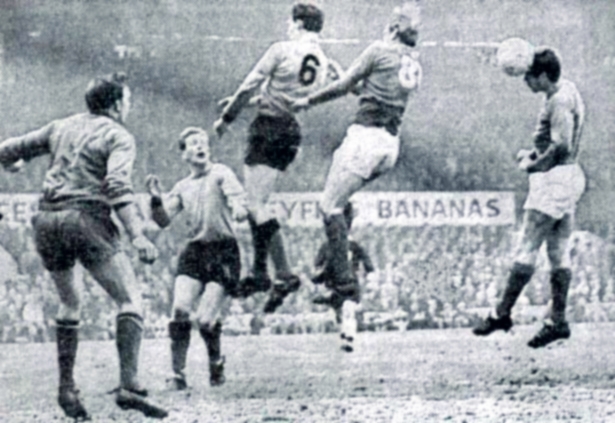
I also seem to remember Jeff acting as an assistant to me for a local league cup final, when I was in the middle of the pitch as the referee. I may of course be wrong, but then my memory is a bit hazy to say the least these days. Let’s not forget, we are talking about a time nearly 35 years ago.

Jeff and I still see each other regularly down at the Riverside on match days and at social evenings. I was at the Riverside recently, when he hosted a football quiz on refereeing decisions, based on various incidents that can occur during a game. The room went unusually quiet and various theories about what should be the correct conclusion to questions were put forward. He told me not to say anything, then when no one knew the answers, he swooped on… me! Fortunately I could still remember enough about the laws of the game to give the right answers (phew!)

We also communicate and tweet on Twitter, so we keep in touch at least every week. Hopefully our love of football will shine through with our In2View and show that referees are human!

A man of many talents he was a bank manager, then a financial advisor before becoming a full-time referee. Jeff took charge of the 2004 FA Cup Final between Manchester United and Millwall, his final game as a professional referee before retirement. He supports Middlesbrough and Rangers. It is rumoured he was due to officiate in the 2004 Football League Cup Final, only to be ruled out due to Middlesbrough appearing in the final against Bolton Wanderers, so was there instead as a fan. He has also appeared as an official on the BBC TV programme Superstars.

Since 2006, he officiated in the annual series of national six-a-side tournaments called Masters Football, referees for which are FA endorsed. This competition features ex-professional footballers chosen by the PFA.

He also worked for TFM Radio on Teesside until June 2008 and currently writes many columns for local and national media, all of which can be found on his official site. He tours the country acting as an M.C. and host with other football personalities and can certainly control a crowd. He also has his own web site “JEFF WINTER The ref fights back.”

2. The Interview – a quick chat

OFB: What year did you start refereeing and did you always set out as your target, to be at the top of the profession?

JW: I started refereeing in 1979 at the age of 23, nowadays if you want to get to the very top starting at that age would make it very difficult. When I first started, I had absolutely no ambition to get to the top, it was merely a way of getting fit and being involved in football.

OFB: What made you decide to be a referee, were you any good at football?

JW: There was only one thing that prevented me getting to the top as a footballer, that was a distinct lack of ability! I’m better nowadays at Walking Football, but I would never had made it as a footballer, at any decent level back in the day. I fell into refereeing almost by accident. A customer at the bank where I was working, was the North Riding County Football Association secretary and he talked me into taking the course. Boro were having a poor time and he suggested that instead of going to the away games at the end of the season, that I reffed a few local games. I enjoyed it and at the start of the following season, I decided to commit fully. It was a very strange feeling, driving to ICI Wilton football ground on a Saturday afternoon, with the crowds heading the other way towards Ayresome Park. I almost turned the car around, but fortunately I didn’t.

John O'RourkeOne of Jeff’s early Boro favourites was John O’Rourke, who is pictured here
scoring against Oxford in the final game of the 1967 promotion campaign

OFB: Who was your favourite Boro player at that time, when you were just a spectator and others that you have refereed in friendlies?

JW: I had started going to Ayresome in the “Bob-end” around the early sixties. My first real memories were of the promotion winning side in 1967, John Hickton and John O’Rourke were amongst the stars of the time. Probably the best time for me as a supporter was watching when Jack Charlton was in charge. What a side we had back then, Graeme Souness was clearly destined for great things in the game.

The days under Bryan Robson were also very special and whilst we had a fair few top players none could match the one and only Juninhio.

OFB: Who is your current favourite Boro player and why?

JW: I love to see local lads do well for their hometown club, so Ben Gibson, Dael Fry and Stewie Downing are clear favourites in my book.

OFB: As well as being a Boro fan, you are also a keen Rangers fan and travel a lot to see them home and way. I know that it was because of the legendary Jim Baxter, but how did you come to support them?

JW: You are correct that as a youngster, Slim Jim was one of my favourite footballers. When I discovered Rangers history and what the club and its supporters stand for, it was an easy decision. They are a “British club” and their loyalty to the Crown and support for the Armed Forces, fit in with so many English supporters.

OFB: How many miles do you rack up going to watch football these days?

JW: I’ve never really thought of counting them to be honest, but last season I went to 119 games. I’m not a ground hopper type, I just go to watch games I want to. I saw Boro play 49 times last season, pity it couldn’t have been 50 with the last one being the Play-off final! I usually manage circa 25 Rangers games a season. When Boro or Rangers aren’t playing, I get to a fair few Hartlepool games and quite a lot of local non-league matches too.

OFB: Who are your current favourite Rangers players and why?

JW: After having to completely rebuild the team after being demoted to the bottom tier of Scottish football, there have been many players who have had the honour of wearing the shirt, that in better times would never had enjoyed that opportunity. At present, we are at the start of a new era with many new faces heading into Ibrox. I am excited that Steven Gerrard is at the club. He made his senior debut for Liverpool when I was the referee. He also made his senior debut for England at Wembley, when I was the Fourth Official. Obviously, he is not coming to the club as a player, but he has the ability to attract some good players to the club. I will always support every player who wears the shirt, for any side I am supporting.

OFB: When you and I were colleagues, we often talked about the actions of the late great Ray Dowle a revered local referee. Can you tell us any of the amusing anecdotes or pranks that happened to him?

JW: How long have you got? I was asked to do a piece for the Gazette when he sadly passed away, it was difficult to keep it clean. I stated at the time that despite what I achieved in the game nationally, I wasn’t even the best-known referee on Teesside, that honor was certainly well and truly deserved by Ray. He was a legend, his one liners were often imitated badly by many referees, myself included!! I was a poor imitation, but I must admit I tried to copy his sense of humour, to try and de-fuse situations on the pitch.

OFB: Did you try and emulate your style of refereeing, on any individual referee and did you always watch televised games for pointers?

JW: I was very lucky that many senior referees locally, offered help and guidance. We had a few colleagues who were assistant referees on The Football League, the likes of Stuart Louden, Bernard Elland, Ray Pallister and Fred Bond who helped Myself, Terry Lynch and Paul Henderson, when we made the jump to that level. I was very fortunate to meet George Courtney early in my career and his charisma and dedication helped me no end. I also had great respect for Keith Hackett. He used his physical presence to impose his authority on games, in much the same manner as the great Jack Taylor had done many years earlier. Sharing their build (it’s also very similar to mine OFB!) I tried to copy their style.

Whilst I did watch football on TV, I felt I learnt a lot more from being at games and I travelled with senior colleagues when I wasn’t officiating myself. That showed me a lot about their attitudes and performances both on and off the field.

OFB: In your opinion, who was the greatest referee you have seen in recent years and why?

JW: When he was first promoted onto the Premier League list, my bosses asked me to room with Howard Webb and get him used to life in the Premiership. It was very clear from the outset that he had everything to get to the very top. He was a class act and a great guy as well. In return for me being his agony aunt, he had to listen to me, fine tuning my fledgling After-Dinner Act, as I was due to retire at the end of his first season. It has always filled me with pride when he reffed a major game and Howard never forgets those nights when we shared thoughts and experiences. He should oversee the Referees in this country, be his own man and use his experience to help the next generation.

OFB: When it came to the time to become a full time official, was it an easy decision?

JW: It was brilliant! I never have regrets in life, so was happy to be in the first group of full time officials in this country. It’s easy to say now that I wish they had been introduced earlier, but at least I was there from the outset. To be paid to train each day and referee at the highest domestic level was absolute heaven.

OFB: What was your most memorable game, your own individual performance and best experience?

JW: Believe it or not I just loved refereeing, even whilst officiating on the Premier League I still refereed locally. At the highest level obviously, doing the FA Cup Final in 2004 was the most important game, but my career was littered with many important fixtures. At my time of refereeing, Leeds United against Chelsea was always a tasty encounter, I did it seven times during my time on the Premier League list. Probably one of the stand out games, was an afternoon at White Hart Lane when Spurs were 3-0 up at half time but contrived to lose 5-3 against Manchester United. At the same ground, the first time Sol Campbell returned to play for Arsenal against his former side, it was a game played in one of the most venomous atmospheres I ever encountered.

OFB: What was your worst game or experience and why?

JW: To be honest I was lucky. I had bad games but was fortunate not to have a career defining incident that is remembered to this day, unlike some of my former colleagues. Probably my worst incidents were nothing to do with my refereeing, a few were linked to the Hillsborough disaster. I refereed an anniversary game at Anfield against Aston Villa and it was very emotional for everyone before the game.

OFB: Is there a game that you wished you had refereed?

JW: Like I said earlier, no regrets. But, I thought that I had the mental strength and courage to officiate in the most hostile of atmospheres, so some of the games played in the cauldrons of European football would have been a challenge that I would have relished. Perhaps an Old Firm game would have been good as well!

Gordon Strachan - cropJeff’s least favourite manager to referee was Gordon Strachan, who he regarded as an absolute nuisance and has had to send off in his time
OFB: Who was in your opinion the manager or manager that you just couldn’t get on with?

JW: The names left off this list will surprise as much as those on it. I didn’t get on with Laurie Sanchez or David O’Leary and always found Arsene Wenger to be sullen and unapproachable. This was even though I must be one of the very few referees of my generation, that never sent off an Arsenal player. My all-time nemesis though was Gordon Strachan, a decent man away from the cameras, but an absolute nuisance when in front of them.

I prefer to speak of the gentlemen that graced the technical areas, Sir Bobby Robson was the best, a lovely man and sadly missed. I also had a lot of respect for Joe Royle and Gareth Southgate was always a pleasure to be involved with. He was only ever dismissed once in his career and guess which prat did that?

OFB: Which opposing team and which player did you not like refereeing?

JW: Refereeing is about man management and with most players you could engage and enjoy a bit of banter. A few though I just didn’t get on with, West Ham’s Igor Stimac was always difficult, as were Steve Staunton and Danny Mills. Craig Bellamy always liked to have his say, I did get on with him though and he is a totally different person when he’s off the pitch. Much the same could be said about Alan Smith, at Leeds, he was a nightmare to Ref, always full of aggression and nastiness.

The worst teams were always the best teams football wise, they were that used to winning that they expected everything to go their way. When they didn’t, they were a handful. During my time, Fergie’s Manchester United always proved difficult, they thought that they were beyond reproach. I probably cautioned more of their players for dissent than any other side.

I don’t think I ever had a good game at Rochdale or Hull City’s Boothferry Park!! I am sure that a few supporters will be keen to add a few other grounds to that list though!!

OFB: Which opposing team and which player did you personally like refereeing?

JW: My favourite grounds were White Hart Lane, Anfield and Goodison Park. My favourite players were Gianfranco Zola, a real gent on the pitch and ironically some of the characters in the game such as Paul Ince and Alex Rae were great, and I always found it easy to enjoy some banter with them.

OFB: There was controversy this season, when a referee who was a self-confessed Sunderland fan, awarded a penalty against Boro in extra time. You quite rightly said, that it made no difference to a referee and that you had officiated at all the senior clubs in the North East. Do you think that referee will be seen at the Riverside next season, or will the FA discreetly keep him away from the fans?

JW: No one complained on the many occasions that he refereed Boro in the past, including last season when he was in the middle, in our victory at Bolton and when he substituted for an injured referee in the second half of a victory at The Riverside. Boro fans didn’t like Newcastle supporter Mark Clattenburg either and he didn’t end up having a bad career, did he? There was never a more self-confessed Boro fan than yours truly and that didn’t stop me refereeing many Sunderland and Newcastle games, including the last ever Wear/Tyne derby at Roker Park. Sunderland also asked me to take charge of the their first ever game at The Stadium of Light against Ajax. I also refereed Dickie Ord’s testimonial game for Sunderland against Steaua Bucharest.

No club or indeed its supporters should be able to dictate who the referee is, when you go out there you do your job and the conspiracy theories are just sheer stupidity.

OFB: As a self-confessed Boro supporter, who was in your opinion the best manager that Boro have ever had and why?

JW: Jack Charlton, it was a magic time for the club and their supporters.

Juninho 2 - cropJeff’s favourite Boro player of all time is the Brazilian Juninho,
who he described as a magician who became one of us


OFB: Who was your favourite Boro player of all time and why?

JW: Juninho, a magician and a man who became one of us.

OFB: How do you think the match day has changed from the time that you were involved with professional football to the present day?

JW: It has changed drastically mostly due to the money now involved. At times it’s more like a business than a sport. Players are very clever and their ability to draw contact from opponents is almost un-detectable.

OFB: What do you think about the latest technology to aid referees decisions?

JW: Goal line technology is brilliant, it proves how virtually impossible it was for officials to get it right with only the naked eye. Regarding VAR, I am afraid, the jury is still out. I am not a fan, but it’s here to stay, so we’ll have to get used to it.

OFB: If you could be a fly on the wall, is there any dressing room you would wish to eavesdrop on?

JW: Any team managed by the so called “Special One”, I don’t like him. and it would be interesting to listen to what he has to say.

OFB: Do you have any regrets in your career, or missed opportunities?

JW: NO! No regrets!

OFB: Whom have you made a lifelong friend through football?

JW: Sadly, we lost Terry Lynch just over a year ago, a real character and a great friend during our time refereeing. My first roommate after the advent of Full time refereeing was Eddie Wolstenholme, I went to see him last weekend, he’s had a few health problems recently and my thoughts are with him.

OFB: A huge thank you to Jeff, for taking the time to talk to Diasboro readers and hopefully they will understand how referees think and act in the modern game. They should also appreciate that we start and then carry on officiating and talking at length because we love the game!

Doug’s Diaries: Colin Todd

Following on from our In2views article with award winning columnist, broadcaster and journalist Doug Weatherall, Original Fat Bob has once again met up with him, as Doug recalls his days involved with football and sportsmen at the highest level. We delve into his diaries to reveal never previously told facts and intimate stories, which helps to bring back to life, what it was like to meet the footballing heroes and be part of the footballing community. Doug was lucky enough to be able to share moments in those great and heady days, or commiserate at the dark times that often everyone in the football world endures. This Diary posted on our blog, is a view on the life and career of Colin Todd.

Colin Todd - Crop After being assistant to Bruce Rioch, Colin Todd became Boro manager in 1990 and took the club to the play-offs the following season before quitting

Colin Todd was born in December 1948 and became a tremendous player for England, Sunderland and Derby County. Most notably for the Boro fans, he was also once their Football Manager and Coach. He was memorably Bruce Rioch’s, right hand man during the dark days of the Boro liquidation, before taking up the reins himself in March 1990 with Middlesbrough, succeeding Bruce who had been sacked. He had coached the club from the Third Division to First Division in successive seasons, but Middlesbrough were struggling in the Second Division and we were facing the real threat of moving from the Third to First Division and back again in successive seasons. Todd kept the club in the Second Division and they qualified for the play-offs a year later, although they were denied the chance of promotion after losing to eventual winners Notts County in the semi-finals and Todd quit soon afterwards. He was most recently the manager of Esbjerg fB.

Todd had opportunities to sign for Newcastle United and the Boro, but, chose Sunderland “because of their tradition for youth”. He played a major part in the Sunderland youth team’s 1967 victory in the FA Youth Cup, led by their coach Brian Clough. By then, Todd was already a first-team regular. He made his debut as substitute for Charlie Hurley in a 1–1 draw away against Chelsea in the First Division on 10 September 1966 and by mid-season had established himself in the starting eleven. He missed only three league games in the next three seasons, at the end of which Sunderland were relegated from the top flight. After 191 appearances and three goals in all competitions for Sunderland, Todd re-joined Clough at Derby County in February 1971.

On joining Derby, he had cost them a British record transfer fee for a defender of £175,000. When linked with Derby, Brian Clough famously remarked “We’re not signing Colin Todd, we can’t afford him”, he then signed him that same day. Clough sent the chairman Sam Longson a telegram informing him of the signing and the size of the fee: £175,000. He formed a formidable partnership with Roy McFarland at club and country level. Under Clough, he helped Derby win the First Division title in his first full season at the Baseball Ground and collected a second title winner’s medal under Clough’s successor Dave Mackay in 1975.

As a player, he made more than 600 appearances in the Football League, also playing for; Everton, Birmingham City, Nottingham Forest, Oxford United and Luton Town. He ended his footballing playing career when he played in the North American Soccer League for the Vancouver Whitecaps. He won two Football League titles with Derby County during the 1970s and won the PFA Players’ Player of the Year award in 1975. He was capped by England on 27 occasions.

He has managed other English league clubs including; Bolton Wanderers, first, as the assistant to Bruce Rioch, then moving up to manager, when Rioch left to manage Arsenal, having achieved promotion in the 1994–95 season,

Todd was also caricatured in the 2009 movie about Brian Clough’s days at Leeds; “The Damned United.”

Diary Extracts:

OFB: When did you first hear of Colin Todd, was it when he was playing for the junior team at Sunderland?

DW: No. It was when he played for Chester-le-Street and District Boys in the 1963-64 season. In relative terms, they were a tiny association with few schools from whom to choose players. But, remarkably, they reached the final of the English Schools Trophy, even though in every previous round they were drawn away from home.

Nine of the regular members of the Chester team were from one school, Washington Grammar. The most notable being their skipper, inside-forward Colin Suggett, who was also to have an outstanding professional career with Sunderland, West Brom, Norwich and Newcastle.

His fellow Colin (Todd) attended Chester-le-Street Modern School, but, in terms of football scholarship, he was to be in the highest university class.

My first viewing of his Trophy team was in the second leg of the ’64 final. Their opponents were Saltley and Erdington Boys from Birmingham. The first leg was at Villa Park and although Chester had led, they had to settle for a 1-1 draw. Durham County Schools’ FA centenary celebration book claims the Saltley equaliser followed a corner, which should have been a goal kick. Again, unluckily for Chester, Captain Suggett, so often a major

influence, was dazed early in the second leg at Roker Park and his side suffered. Saltley won the game 2-1.

OFB: Was Colin Todd instantly recognizable as a footballer who was destined for greatness?

DW: I didn’t have to be clever to spot that Toddy was good. I have always admired players who could tackle properly, in other words without fouling. Colin always had that great ability, even though in his early school days when playing with older lads, he featured as a scoring centre-forward.

OFB: Do you think he tried to emulate his style of play on any individual player who played in his position?

DW: I don’t know, but many so-called ball winners in today’s football should study any available film of his play. He didn’t have to foul. His pace was crucial in his timing of a clean tackle.

Colin Todd - Sunderland 3 - crop Colin Todd made his first team debut for Sunderland in September 1966 at the age of just 17 and soon became established in the starting XI

OFB: When did you first get to know him personally?

DW: Around the time he was getting into Sunderland’s senior side. He’d already shown his quality with Sunderland’s under-18 team. As a kid he played in the first Sunderland side to reach the semi-finals of the FA Youth Cup. Remember Brian Clough, his playing career tragically ended, coached that team and when I asked him who was his top player? he said:” Number 4”.

Soon after Colin got into Sunderland’s first team it was the great Scottish international wing-half, Jim Baxter, who told me: “You should write about young Toddy, he wins the ball and gives it to me.” (You’ll gather Slim Jim wasn’t the greatest tackler himself!)

Naturally, I was only too pleased, often to praise in print Colin’s ability.

OFB: Did you have long chats with him about his football?

DW: Not until much later. He wasn’t one to fuss. His quality football spoke volumes, anyway. But, funnily enough, I’ve particularly enjoyed chatting with him in recent years. We sometimes bump into one another while watching Durham play cricket at Chester-le-Street. As you can guess, Mr. Clough is invariably mentioned, honourably…

OFB: What do you think was his most memorable game, his own individual performance as a player?

DW: His so consistent performances were of such a high standard, his aforementioned ball-winning, he was so reliable that my great memories of his play just merge.

Cough and Todd - crop A 22-year old Colin Todd signed for Brian Clough at Derby in 1971 for a then record fee of £175,000 and won the title in his first season

OFB: What was your best, personal and most enjoyable experience watching him as a player?

DW: Seeing him help my great friend, Brian Clough, win the League Championship for the first time in Derby’s history.

OFB: What was his worst game in your experience?

DW: I’m not saying it was a poor performance from him, but it was strange to see him for once outpaced. That was in a Derby v. Newcastle match. Magpies’ inside-forward Tony Green was the man Colin couldn’t catch. Tony made only too few appearances for the Geordies before injury ended his career, but many opposing defenders knew how his pace could leave them trailing.

OFB: Were you upset when he left Sunderland to go to Derby?

DW: I’ve never enjoyed “my” North-East clubs selling good players. We should be proud enough and ambitious enough to keep our best. But since Brian Clough was such a good mate and had so much ability, I knew Colin was in the best of hands.

OFB: Did you know that he was going, and did you get a scoop due to your relationship with Brian Clough?

DW: Not exclusive, but I knew what was happening. Whilst Sunderland thought they were doing great business in taking a record fee for a defender, they didn’t realise Brian would have paid even more for the young man who would eventually replace the more senior central defender Dave Mackay at the Baseball Ground.

OFB: Who was in your opinion the manager that had the greatest influence on his career and why?

DW: No doubt about that. Brian Howard Clough, of course.

OFB: Which opposing team and which players did he like playing against?

DW: People may be surprised to hear that he liked playing against two Liverpool stars, Kevin Keegan and Kenny Dalglish “I generally came out on top against them,” he said. As Colin explained,” Kenny was good at getting behind his marker”, but Colin’s pace meant he came out on top.

OFB: Do you know who was his favourite player of all time and why?

DW: George Best for Manchester United. Colin rates him the most highly gifted player. But, he recalls the Don Revie team at Leeds as very talented. He could never forget a remarkable FA Cup-tie with Leeds while he played for Sunderland. It went to two replays with the second at Hull. Controversially, it was decided by a penalty, the referee being near the half-way line when it was awarded. For their protests George Herd and George Mulhall were sent off.

OFB: Do you know who his other favourite players were?

DW: As a lad who supported Newcastle, he loved going to St. James’ when Len White and Ivor Allchurch played for the Magpies. He thought they were terrifically exciting. And he loved playing with Charlie Hurley when he was with Sunderland. Charlie, said of Colin, “he had two great feet.”

Coin Todd - PFA. - crop Following another league title in 1975, Todd won the PFA Footballer of the Year trophy, which was presented by then prime minister Harold Wilson
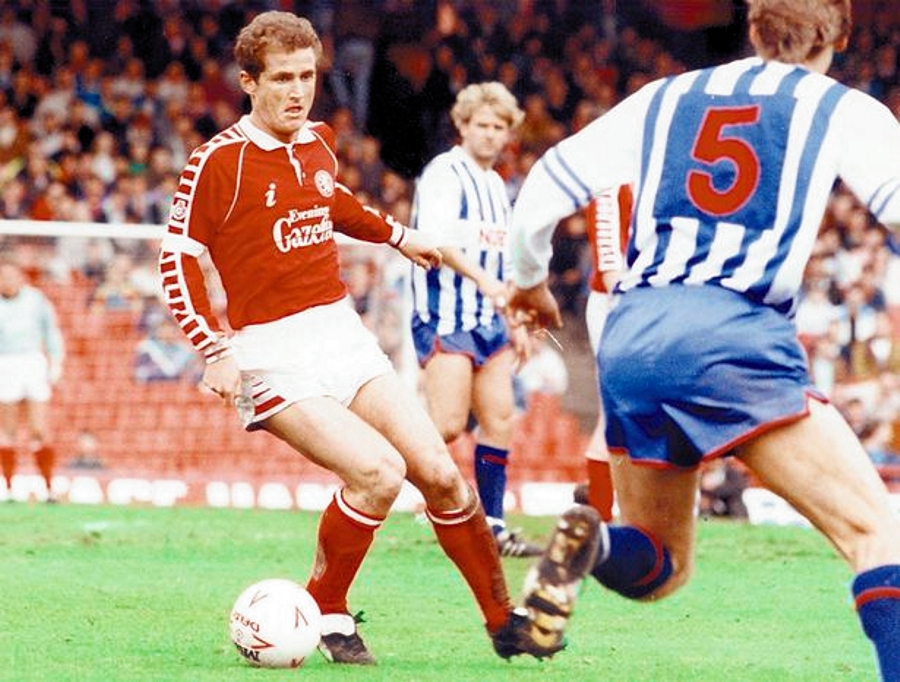
OFB: Of what, in his career, was Colin most proud?

DW: When his fellow professionals voted him their PFA Player of the Year for his outstanding performances in the 1974-75 season. As someone who’d known him from his school days you can guess how chuffed I was!

OFB: Did you ever see Colin play for England, live at Wembley?

DW: I didn’t but I watched England on TV and still do, even though I wish they would speed up their approach play.

OFB: When he started coaching were you in contact with him then?

DW: For day-to-day info, I was mainly in contact with the managers of the clubs not the coaches.

OFB: Can you tell us of his disciplinarian methods, when he became a coach and manager, was he respected?

DW: As far as I know, he’d try to be as firm and fair as was Brian Clough, who had heeded how manager Alan Brown practised discipline at Sunderland.

OFB: Were you in contact with him during the liquidation crisis at the Boro?

DW: I dealt mainly with Bruce Rioch during those sad days.

OFB: Were you surprised that Colin and Bruce stayed at the club, even though they weren’t getting paid?

DW: Not really, both had plenty of backbone and belief in their judgement.

OFB: It was a remarkable chapter in the history of MFC did you cover the news on it at that time and if so, are there any stories from behind the scenes?

DW: Yes, it was quite a story. I dealt mainly with Bruce with whom I’d developed a good working relationship. His father had been a military man and, as a former National Service sergeant myself, I could see that Bruce believed that with good judgement the club would eventually emerge from dark days.

OFB: What do you remember about Colin the most?

DW: That pace; that fair tackling. Brian Clough’s most common call to his teams was “Get it!” – where “It” was the ball. You can’t do much without it…

OFB: A huge thank you Doug, for taking the time to open up your Diary again, revealing this latest chapter to Diasboro and our readers.

In2views: Mark Proctor

The latest in a series of profiles and interviews, Orginal Fat Bob gives his personal view on the life and career of a footballing guest before sitting down for a chat and asking a few questions. Our Diasboro special guest this week is Mark Proctor…

1. The Overview – the man and his career

Mark Gerard Proctor, or ‘Proc’ as he was more commonly known, is another one of the Boro Juniors that I worked with whilst acting as a referee for Harold Shepherdson – who managed the Juniors at that time. Mark was a natural leader, even at an early age and was always polite and respectful, his mass of thick curly locks bobbing around the field, making him stand out.

I saw him a few years later, during his second spell with the Boro, as he and his family came to live close-by at Marton, near Fairy Dell. He’s moved away now, but still lives on Teesside and always has a close bond with the Boro. His record includes being a former player, coach and as assistant manager under Tony Mowbray.

Mark Proctor PitchAfter graduating from the  juniors, Mark Proctor made 229 appearances and scored 18 goals in his two spells at Boro (1978-81 and 1989-93)

I still see him now at the Riverside Stadium, where he acts as a match day host and representative. His best pal today is David Hodgson (Hodgie) as it was in those days. He laughs when he remembers that when his manager John Neal negotiated pay rises, that both he and Hodgie were called into the office together, as in John’s words “you’ll tell each other what we’ve offered you anyway!”

He made his debut for Boro in 1978 and played 109 games for us until 1981 scoring 12 goals.

He later joined Brian Clough’s Nottingham Forest in 1981 for £440,000 before moving on to Sunderland in 1983 where he was their player of the year in 1986. He remained with them for four years before moving to Sheffield Wednesday in 1987 for £275,000. After two years in Sheffield he returned home to us 1989 for £300,000. He went on to play another 120 games scoring 6 goals.

Talking to him, I asked what games stood out during his playing career with Boro. Without hesitation he said “three games I remember particularly that I will never forget;

“The first is when I made my first team debut as a raw seventeen-year-old in August 1978, when we beat Birmingham 3-1 away from home. I’d travelled down with the team on the coach as a way of getting some experience and being with the senior players. I had no idea that I was going to play that day and when I did I made sure that I would remember every minute of it. I had played a couple of friendly games with the first-team in Scotland so was familiar with the lads, and we all travelled down on Monday, one day before the match. John (Neal) never told me anything about the team selection, so we went to the hotel to prepare, had a sleep in the afternoon, and it wasn’t until about an hour before the game that I found out I was in the team. I didn’t have time to be nervous. I was just so excited to be playing. I remember John came up to me before the match and had a reassuring word. He said he knew my ability and told me to just go out there and do what I normally do. It was great to make my debut – but to do so in a winning team was extra special.

The second game that I remember well is when we beat Chelsea 7- 2 in December, was four months after I made my debut. I recall it because it was in this game that I scored my first league goal for the Boro and also it was such an impressive score-line. John Neal’s team were a well-established First Division force with a good blend of experienced pros like Stuart Boam, John Craggs and David Armstrong augmenting the development of a host of young players like myself, Craig Johnston and Terry Cochrane. Micky Burns scored four on that day and every ball he hit seemed to go into the net.

Proctor and Mogga TeamMark Proctor captained Boro for the final of the 1990 Zenith Data Systems cup after an injured Tony Mowbray could only lead the team out.
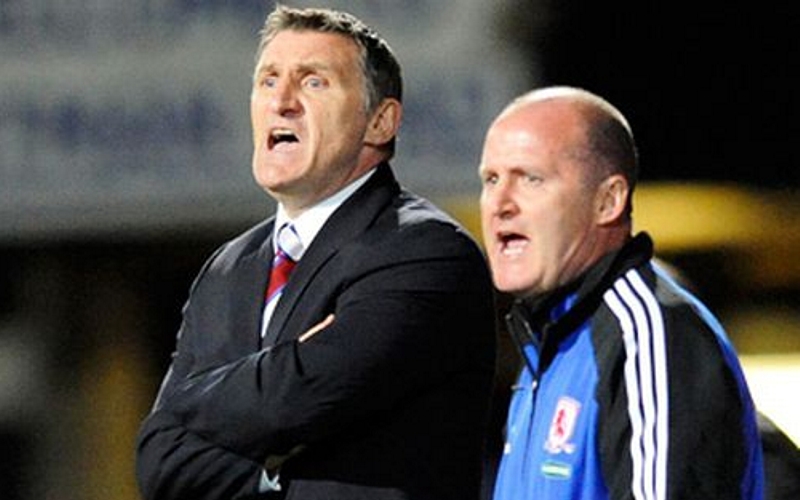
Then of course the last one that was so important to me, is when I was the Captain of Middlesbrough and led the team out at Wembley for the Zenith Data Services Cup Final at Wembley. Tony Mowbray, who was injured, took the place of our manager Colin Todd at the head of the team. Toddy felt Tony should be there and it was a marvelous gesture. I just loved the atmosphere and the roar of the crowd.

Proc later had moves towards the end of his career leaving us in 1993 to go to, Tranmere Rovers, South Shields and Hartlepool United before retiring in 1998.

His managerial career began when he proved to be an outstanding founding member of our hugely-successful Academy. This produced Premier League stars like; Stewart Downing, David Wheater and James Morrison under the careful Directorship of David Parnaby. He coached our youngsters to the FA Youth Cup in 2004, before winning it in 2005, then becoming our reserve team manager. He then left and became assistant manager at Darlington and wondering how to make the next step in his career, he phoned Mowbray who was the Hibernian Manager for some advice. Tony said there could be a role for him at Hibs and he subsequently became a coach there.

He was manager of Hibernian on a temporary basis for two matches between the departure of Tony and the appointment of John Collins. After leaving Hibs in the spring of 2007, he was appointed manager of Livingston during the 2007–08 season, he helped engineer Graham Dorrans’ switch from West Lothian to West Brom during his time as Livingston boss, but was sacked on 3 June 2008. He came back to the Boro in September 2008, as our under-18 coach. The former Lions manager kept a keen eye on the football fledglings at his old club however and he said;

“Andy Halliday was a player I identified and flagged up to our recruitment people,” he admitted. “I actually gave Andy his debut when he was just a schoolboy, I’ve kept an eye on him and heard good reports about him this season.”

Proctor and Mogga - CropMark eventually returned to Boro in 2008 when he was appointed as under-18 coach before being promoted to the first team set-up by Mogga

Mark was eventually promoted to first team coach by the then incumbent manager and his friend and former captain Tony Mowbray. After Mogga was relieved of his duties by Boro in November 2013, Mark also left the club.

Today, he still has a broad smile on his face, like he has had throughout his life with the Boro and he readily agreed to talk with me and give his answers to the Diasboro questions.

2. The Interview – a quick chat

OFB: What year did you join Boro as a professional footballer?

MP: I signed for the Boro in 1978 as an apprentice professional. I was about 14 when I signed for Boro, but I had been going to training long before that. In school holidays I would train with the club all the time as I had a relative who lived on Warwick Street, near Ayresome Park. I remember in the summer holidays I stayed there for six weeks, training with the club every day and I loved it.

OFB: Where did you usually stay? Did you rent, or did you live in digs?

MP: I lived with my folks initially at Priestfields then we moved up to Ormesby Bank and shared a bedroom with my brother. Later, Hodgy (David Hodgson – OFB), my best friend at the Boro came to live with us when his mother died. So, it ended up with the three of us sharing one bedroom, but we had a great time.

OFB: What football were you playing at the time?

MP: I played for St Anthony’s which was my own school, the County and I also used to play for Nunthorpe on a Sunday morning.

OFB: Who was your favourite Boro player and others that you have played with?

MP: I can name quite a few, John Hickton, Graeme Souness and Bobby Murdoch. I was about eight years old when I first went to watch my hometown town team play and one of the players who stands out from that time was John O’Rourke. I also enjoyed playing with Craig Johnston. He was my old midfield partner, he taught me to be driven, the importance of having energy which resulted in performance and goals, that was Roo, a class player!

OFB: So, to be specific, and to narrow it down to one, who is your favourite Boro player of all time and why?

MP: John Hickton, because of his goal-scoring achievements whilst playing for Boro.

OFB: Who were the best and worst trainers in the team?

MP: Craig Johnson was the best trainer and the worst has to be Pally! (Gary Pallister  -OFB). He’ll probably have a go at me now if he reads this, but he was the worst!

OFB: When did the team travel for away games, how did they get there, by bus or by train?

MP: We mostly travelled by bus, at least 99% of the time unless the weather was bad and then we would use the train.

OFB: How many players usually travelled and did the Directors travel with you?

MP: There were about thirteen or fourteen players and sometimes Directors would travel with us as well.

OFB: Did you have nice hotels or was it just bed and breakfast?

MP: We always stayed in very nice hotels. When I played for Forest we always went to a big, posh hotel and get a huge steak for a pre-match meal. All the players would wait for the steak whilst sat around the table. Cloughie and Peter Taylor would walk in and following behind them was a waitress carrying a huge platter of chips.

Cloughie would then point his finger at various players saying, “You can have chips, you can have chips, you can have chips …” but this was said to all the players who weren’t playing! That’s how he told us who was in the team. It was brilliant!

“I got a big plate of chips and ketchup – so I knew was dropped! You never got chips even in the 80s pre-match.”

OFB: Who did you room with at Boro for away matches?

MP: It was Hodgy until he left to go to Liverpool and then Bernie (Slaven – OFB).

OFB: Who was the joker in the team?

MP: Billy Ashcroft

OFB: Can you tell us any amusing anecdotes or pranks that were played?

MP: No!

OFB: Whose boots did you clean as an apprentice and who cleaned yours?

MP: I cleaned the boots for most of the senior players including Graeme Souness.

OFB: Did you try and emulate your style of play, on any individual player who played in your position?

MP: I loved Colin Bell at Manchester City and thought he was the most complete midfield player and tried to be like him.

Colin Bell CropGrowing up, Mark Proctor was a great admirer of Manchester City midfield legend Colin Bell, of whom he tried to model himself on
OFB: What was your most memorable game, your own individual performance and best experience with the fans?

MP: Leading the Boro team out at Wembley as Captain.

OFB: What was your worst game or experience and why?

MP: Unfortunately, it was losing in the Quarter Final of the FA Cup to Wolves.

OFB: Is there a game that you wished you had played in, either for Boro or another team?

MP: No

OFB: Who was in your opinion the best manager that Boro have ever had and why?

MP: It has to be Bruce Rioch

OFB: Who was in your opinion the manager that had the greatest influence on your career and why?

MP: Bobby Murdoch who took me under his wing from being a junior right through to the first team.

OFB: Which opposing team and which player did you fear playing against?

MP: Liverpool; they were just awesome with some fantastic players who included, Dalgleish, Souness and Ian Rush to name just three who were at the top of their game.

OFB: Which opposing team and which player did you like playing against?

MP: I always enjoyed playing against Tottenham Hotspur and liked Glenn Hoddle as a player.

OFB: Who is your current favourite Boro player and why?

MP: I still work at the Boro and I’m not going to be accused of any favouritism!

OFB: How do you think the match day has changed from the time that you played professional football to the present day?

MP: I don’t think it’s really changed at all from when I played football. You still have a ball, two goals and eleven players for each team.

OFB: If you could be a fly on the wall, is there any dressing room you would wish to eavesdrop on?

MP: Pep, Jose also Antonio (Conte – OFB).

OFB: Do you have any regrets in your career, or missed opportunities?

MP: Yes, when I went to Forest I was too young and could have developed more whilst playing for them. I look back on those days with great fondness because it is nice to say I worked with one of the greats. It wasn’t a massively positive experience for me if I am truthful. I was only 20 years old and Cloughie was a bit too abrasive for me, when I probably just needed an arm around me. You had to stand on your own two feet. Had I gone a couple more years later in life, then I think I would have been ready. The experience however, stood me in good stead for the rest of my career really.

OFB: Do you still follow the Boro and their results

MP: Of course, I’m a Boro lad!

OFB: Whereabouts in the Country do you live these days and what do you do?

MP: I live at Eaglescliffe and work as Director of Football at the Premier Player Academy with Neil Maddison and Graham Kavanagh. I also act as a host and Boro representative on home match days. I remember when I was a lad, lan Peacock had a newsagent shop in Ormesby Village on Cargo Fleet Lane. Someone told me he used to play for Boro, Leeds and England, so I made a point of going to his shop to buy my Gazette to try and see him. Now I see him every matchday at the Boro where he works as a Boro ambassador.

OFB: Whom have you made a lifelong friend through football?

MP: David Hodgson.

OFB: Finally, if you hadn’t had a professional career as a footballer, what do you think you would have done as a career?

MP: I’m not really sure what I would have done except being a footballer. I was only 17 when I made my debut against Birmingham in August 1978 and haven’t really known anything else. Can you imagine what it was like playing alongside big names like; David Armstrong, David Mills and Stuart Boam? It was my dream come true.

OFB: A huge thank you Mark, for taking the time to talk to Diasboro and our readers.

Doug’s Diaries: Brian Clough

Following on from our In2Views article with award winning columnist, broadcaster and journalist Doug Weatherall, Original Fat Bob has once again met up with him as Doug recalls his days involved with football and sportsmen at the highest level. We delve into his diaries to reveal never before told facts and intimate stories, which helps to bring back to life what it was like to meet the footballing heroes and be part of the footballing community. Doug was lucky enough to be able to share moments in those great and heady days or commiserate at the dark times that often everyone in the football world endures.  This first Diary post, is a view on the life and career of Mr Brian Howard Clough OBE.

Clough SuitBrian Clough was born in a council house in Grove Hill on 21 March 1935 and claimed he was a kid who came from a little part of paradise

OFB: What year did you first hear of Brian as a professional footballer?

DW: It was early in the 1956-57 season, my first as a full-time sports reporter. I’d returned to live in my native North-East from Manchester where I’d been a Daily Herald news man. All I knew about Brian was that he had begun the campaign out of Middlesbrough’s League side, having only tasted League Division Two action the previous season.

OFB: Did you read about him first or did you see him?

DW: My first real experience of him was the first Middlesbrough match I reported, Boro vs Grimsby Town on the night of Wednesday, September 12. From even early in the game I was taken up by him. He scored in a 2-1 win. My early impression of his play never left me. Indeed, I was so captivated by what I’d witnessed, I reported he was the most exciting player to enter a penalty area I’d seen in years.

OFB: Was he instantly recognizable as a footballer who was destined for greatness?

DW: Without a doubt. I could see that not only was he a terrific goal threat, he was also a fine leader of an attack, feeding wingers with sound delivery, as flank men Billy Day and Eddie Holliday were later to discover. It still irks me that Brian made only two appearances for the full England side. He didn’t score in those games but, given other chances to play, he would have extended his remarkable goals record to the international scene.

OFB: Did he try and emulate his style of play, on any individual player who played in his position?

DW: I was soon to do a comprehensive, exclusive interview with him, but there was no reference of effort to emulate any other’s style. While, with his typical frankness, remarkable for a 20-year-old, he told me who hadn’t helped him, he stressed who had, one of the two being reserve-team trainer Mickey Fenton, who, of course, had been a No. 9. He had also benefited from the advice of junior coach Jimmy Gordon, years later to be an aide in Brian’s fabulous successes as a manager of Derby County and Nottingham Forest.

Clough StrikerBrian Clough never attempted to emulate other strikers and went on to score 251 goals in just 274 appearances in his short playing career

OFB: When did you become friends?

DW: We quickly became mates after that first major interview. He must have enjoyed what he’d read! Obviously, I didn’t report all Boro’s games. The likes of Newcastle and Sunderland had to be covered, too. But often when I was assigned to Ayresome Park matches, I’d take with me my Dad, who lived in Seaham, County Durham. It seemed almost invariably that Dad enjoyed a Clough hat-trick. Brian said, “Keep bringing him!”

OFB: When the Boro and then Sunderland travelled for away games, did you meet up with them at the same hotel?

DW: I didn’t often travel to away games with Boro or Sunderland, but, when I did, Brian and I would try to socialise. Once when I motored to Edinburgh to cover a Hibernian v. Boro friendly he particularly welcomed a chat. That was in the Middlesbrough team’s strained atmosphere around the time when, scandously in my view, some Boro players signed a round-robin letter to the management, requesting that the captaincy be taken from Brian. No wonder he said the most happiness he enjoyed in his playing and managing career was as a player at Sunderland. Given that round-robin experience, I could understand his pride when Sunderland captain Charlie Hurley told him after a match at Plymouth, that it was great to have him in the side.

OFB: Did you have long chats with Brian about his football?

DW: Very much so. As I’ve often said, I believe he could have managed a team even when he was only 20. His perceptiveness was sharp even then. “Management,” he said after a few months as Hartlepool’s team boss, “is about judgement of players: those you have and those you want.” With outstanding buys like centre-half Roy McFarland for Derby from Tranmere Rovers he and his assistant, ex-Boro keeper Peter Taylor, underlined he practised what he preached.

OFB: Did they have nice hotels then or was it just bed and breakfast and did you stay at the same hotels?

DW: Of course. Both Boro and Sunderland were noted for looking after their players and, indeed, the travelling Press.

OFB: Did you manage to have a few drinks together?

DW: It has been known… After that Plymouth match and Charlie Hurley’s tribute, Brian was naturally in great nick and we downed one or two. And the Hurley words provided an exclusive angle for my Herald report.

OFB: What was his most memorable game, his own individual performance and your best experience watching him as a player?

DW: I just loved seeing his one-touch goals at the near post when Billy Day, for instance, would cross low from the right. I recall Newcastle fans saying after he’d scored a couple at St James’. “Well, he just had to knock them in from a few yards.” My answer to that: If it’s so easy why don’t more strikers get goals like that? Freddie Trueman used to dismiss tail-end batsmen regularly but didn’t other bowlers face tail-enders without equal success.

OFB: What was his worst game or experience, was it sustaining a career ending injury?

DW: The saddest sight of my 76 years of spectating and reporting football was of Brian, lying on an icy Roker Park, beating the ground with his right hand. He hardly ever missed a game through illness or injury, so I knew he was seriously hurt. His eyes on the ball as it came from the left, he stretched to make contact. Unknown to him Bury keeper Chris Harker was diving out to meet that ball. The cruciate ligament damage from the inevitable clash was to end a fabulous playing career. That blow affected Sunderland’s destiny. It delayed their promotion to the top grade long enough for stars like Hurley to be past their best by the time they were in the old First Division.

Clough injury 2Brian Clough’s playing career effectively ended on Boxing Day 1962 after a collision with the Bury keeper on an icy pitch ruptured his cruciate

OFB: When he was injured, he coached Sunderland Juniors, were you still in contact with him during that time?

DW: Yes, his first crack at coaching was exciting for him and for those who saw a very young Roker side reach an FA Youth Cup semi-final for the first time. As we in the Press raved about the likes of Bobby Kerr in that junior team, I asked Brian who, in his opinion, was his top player. “Number 4,” he replied. He was talking about Colin Todd, the wing-half for whom he was to pay £170,000 – a whopping fee then – when he managed Derby.

OFB: Can you tell us any amusing anecdotes or pranks that he played? Or tell of his disciplinarian methods?

DW: Pre-season groups of playing staffs group photographs have been routine for years, but certainly a different one emerged when a Sunderland one was published. Brian was pretending to smoke a pipe. He liked a laugh. As a disciplinarian, he learned a lot from the manager who signed him from Boro. Sunderland boss Alan Brown was the most daunting man I had to deal with in football. But Brian noted his strength of character. As a manager himself, he told his players never to confront referees or doubt their decisions. Hence refs, were to say Brian’s Nottingham Forest players were the best behaved.

OFB: When he joined Hartlepool United as Manager, he famously took his PSV driving license so he could drive the team bus. Was that true, or part of his publicity for Hartlepool?

DW: That bus-driving certainly wasn’t a gimmick. That picture piece was another exclusive for me, this time in the Daily Mail. It wasn’t a publicity stunt. As Brian explained, if a bus driver was to take ill miles away from the North-East, how would they get home. He was a bright lad who, amazingly, had failed his 11-plus.

Clough Bus DriverAfter becoming manager of Hartlepools United, Brian Clough even learned to drive the team coach to ensure they were never left stranded

OFB: He took John McGovern from Hartlepool to all his clubs as a player did he really rate him that much?

DW: Not many people rated John McGovern in his early days as a Hartlepool United teenager, but Peter Taylor was the first to spot his potential. Eventually Brian – and I -were convinced of his ability. Then John was nearly to have aching arms through hoisting trophies for Forest. Now John, a lovely lad, does terrific impersonations of that famous Clough drawl.

OFB: What was his most memorable game as a Manager at Hartlepool.

DW: Brian’s most notable achievement at the Victoria Ground in my opinion was his success over the man who appointed him as manager. Chairman Ernest Ord was a formidable man. He could be really nasty. But Brian took him on – and Mr Ord departed. Brian’s legacy on leaving Pools for Derby was a team able to win promotion.

OFB: Did you get to know Peter Taylor very well?

DW: I got to know Peter soon after meeting Brian for the first time. We used to meet in the ice cream shop near Ayresome Park after they had trained. Over cups of tea was born one of the geatest partnerships football has known. That is where two great judges talked football, goalkeeper Peter having been among the first to recognise Brian’s great centre-forward play. Peter was amusing, but cunning. He seemed to prefer a dicey approach to a straightforward one to achieve the same object, just for the hell of it…

OFB: When he went to Derby as manager did you continue to report on his team and his performance?

DW: I maintained a strong interest in what he and his team did, but I didn’t report them often. I kept in touch with Brian, though, and, in effect, at times scouted for him. So well did I recommend Willie Carlin, of Carlisle United, to him that I was banned by the Cumbrian club. Carlisle turned down Derby’s approach for him, but accepted Sheffield United’s after persuading Carlin to reveal that I had tapped him on behalf of County. My Brunton ban didn’t end until Bob Stokoe replaced Tim Ward as manager. Carlin remains the only player who ever “shopped” me! Eventually, Brian bought him from Bramall Lane.

OFB: Who was in your opinion the manager that had the greatest influence on his career and why?

DW: As I mentioned earlier, Alan Brown underlined for Brian the value of firm discipline.

OFB: Which opposing team and which player did he fear his team playing against?

DW: Brian respected teams and players but feared none. I’ve often been asked what was the secret of his success. The simple answer is that he had terrific talent. He was a genius as a scorer and as a manager. Certainly, as a manager of his best teams, he always said in advance of a game that he thought he’d win. “You don’t expect me to say we’ll lose,” he’d say.

OFB: Which opposing team and which player did he like his team playing against?

DW: He was always particularly proud for his teams to beat the Liverpools and Manchester Uniteds. I saw Derby, thanks to a McGovern goal, see off Liverpool to win the League title for the first time. I also saw Forest put out Liverpool on the way to their winning the European Cup. I know, too, that he and his Forest lads were thrilled to beat Man Utd 4-0 at Old Trafford. I recall that as an amazing show.

OFB: Who was his favourite player of all time and why?

DW: I think his boyhood idol remained his favourite. That was Boro, England and Great Britain inside-forward Wilf Mannion. Soon after making Trevor Francis Britain’s first £1million player I witnessed Brian saying to Trevor, “Come and meet someone who could really play.” That someone was Teesside’s Golden Boy. Old Boro fans wouldn’t disagree.

OFB: Did Brian talk to you about his time at Leeds? It was the only real setback in his career.

DW: Brian’s sacking at Elland Road actually made him an even better manager. Leeds honoured his contract to the penny and this gave him financial security for the rest of his career. Thus this man of immense strength of character, anyway, had even more self-confidence as he transformed struggling, second grade Forest into League champions and twice the tops in Europe.

OFB: That was probably his greatest success in winning the European Cup with Nottingham Forest – were you there?

DW: I wasn’t, but I was cheering at home as they won it and, remember, retained it.

Clough European Trophy bwThe pinnacle of a glittering managerial career that saw him win Division One with two clubs was lifting the European Cup twice with Forest

OFB: Did you go away on holiday a lot together as a family?

DW: We didn’t holiday together. You probably remember my being pictured with Brian in Majorca, but, believe me, I was working! I was there because he was likely to be appointed Leeds United’s manager. He was then with Brighton.

OFB: You said previously, that you tried to get him to join Sunderland as a manager on a few occasions, can you elaborate?

DW: My greatest footballing regret is that he didn’t manage a big North-East club – despite my efforts. I set it up three times. And Brian would have loved to have managed Sunderland in particular. But their board preferred other people. The chairmen of Boro and Newcastle also told me they wouldn’t have him. And by the time Sunderland’s Tom Cowie wanted him – Brian was handed a cheque for him to write in a figure – the Cloughs were too settled in the East Midlands. Imagine what Brian would have achieved on Wearside. After all, he is the only person to have managed two clubs to the top League title who had never previously won one.

OFB: He had a reputation for being hard on his players but he made them into Internationals. Did he have a soft side?

DW: Players still swear by him. I could never forget the tribute Martin O’Neill paid Brian at a Pride Park memorial service. Martin said that without Brian, Forest wouldn’t have won a thing. A soft side? He was very thoughtful and sensitive. How could I ever forget that on the day he paid a record fee to take David Nish from Leicester to Derby he had dispatched to Shotley Bridge Hospital a lovely rose bouquet? The recipient was my wife, Edna, who, aged only 35, had had major heart surgery. She lived with happy memories of Brian and his wife, Barbara, until she died 18 years ago, aged 62

OFB: What do you remember about him the most?

DW: I can’t top my previous answer.

OFB: A huge thank you Doug for taking the time to open up your Diary and reveal this chapter to Diasboro and our readers.