Blog Posts

Boro show some fight against classless Mourinho

This was one of the games instantly underlined in Boro fans diaries when the fixture lists first came out, the sorcerer versus his apprentice. The TV Company would have had the same intrigue although I’m sure that was well before Boro’s usual defensive paralysis had been fully considered as verging on anything remotely suitable for entertainment before the watershed. With AK now departed the game had taken on a new perspective and one that I would suspect was much to the relief of BT Sport. Man United will always get the punters in but a bus parking Boro bore draw isn’t a great advert for plugging a box/package/bundle/landline/broadband services.

The pre KO talk in the concourses was of some optimism given the purported injury list and suspensions for Mourinho’s men. Boro of course were not without their own injuries and crucially key ones in Friend and Chambers (still can’t believe he was ridiculously risked in that Oxford FA Cup game) along with Ayala and Espinosa leaving Steve Agnew with sparse defensive resources.

United had a gruelling fixture schedule this week with this their 3rd game in 7 days and early kick offs don’t particularly agree with them. This season they only picked up all 3 points from 2 out of 7 televised lunchtime matches. Straws and statistics were being grasped from wherever we could find them as the line ups were announced providing the earliest indications of Steve Agnew’s intentions. The team when announced indicated that a clean slate was the order of the day from Steve Agnew as the starting line-up included Downing, Negredo and Ramirez all in the side.

The Kick off saw Boro push further up field and with far greater attacking intent than I have seen all this season. Instead of the monotonous side to side defensive passing than has been the hallmark for the last few years we had Fabio and Downing providing width pushing wide with Ramirez in front of Fabio just inside working one twos and Grant buzzing around centrally looking to play forward passes. I think I witnessed better football in the first 6 minutes from Boro than I have since Swansea. OK this was Manchester United and they had something to play for and so we didn’t have it all our own way by any means and were it not for Valdes pulling off two great first half saves the game could have turned very sour very quickly.

As it was we were entertained by Stewy pinging balls across the pitch setting up Fabio and Ramirez, putting crosses into the box albeit many overhit but at long last we had entertainment something that the Riverside faithful had been starved off for what seemed like an eternity. After a quarter of an hour United seemed to have regrouped and started to offer more threat going forwards and inevitably Fellaini met a cross from Young at the far post not surprisingly outjumping Fabio to put United 1-0 up. We all know what happens this season when Boro go behind yet we didn’t see the usual signs. The Red sashed shirts rolled their sleeves up supported by the fans and got stuck in again and once more took the game to United. It was clear that word had reached Mourinho to target Espinosa as the weak link at the back and yes he did have some torrid times but he also got his head to a few balls and intercepted a few whilst staying upright as Young tore through the Boro defence to time a tackle to perfection.

As the first half whistle was blown the home fans stood and applauded Boro off the pitch as their endeavours were well received and acknowledged. The “bad boys” looked a totally different proposition as both Stewy and Ramirez looked up for it with Ramirez storming back at one point to nick the ball off I think Rashford’s toes just as he was about to pull the trigger on the edge of the Boro box. Young and Lingard were tormenting the Boro right side and Valencia was getting forward picking up a lot of balls played in behind Fabio and their wide men were the main source of build up and trouble for Boro all afternoon. I would say that even if we had played with a flat back 9 as has been levelled at AK in the past their pace and trickery still would have caused problems.

The second half started pretty much the same with Boro showing the same positive intent but left the back door open for Lingard to run onto a clearance and charge down the middle of the pitch blasting a beauty into the top corner clipping the inside of the upright as it went in giving Valdes no chance. 2-0 and it seemed very cruel but in fairness to United they had created the more clear cut chances despite Boro having the lion’s share of the ball. It would have been easy for Boro heads to have dropped sensing another defeat and never coming from behind but again they pushed forward and incredibly we seen a double substitution that actual had an effect, changed our style and positions forcing Mourinho to switch to playing six (or even seven) at the back.

Traore and Gestede came on for the tired limbs of Ramirez and Leadbitter and as Boro upped the ante we looked like we could get something out of it. Traore’s pace clearly worried United as he ran past them for fun teasing and putting crosses in to service Negredo and his partner (yes two up top!) Gestede and suddenly Smalling and Co. weren’t having it all their own way. With Downing now having switched sides for Traore and Adama being trusted to do his thing without needing micro coaching the Boro pressure paid off as Gestede poked home through De Gea’s legs at close range to make it 2-1 and game on.

The equaliser didn’t come in the end but had it ended 2-2 it would arguably have been a fair result for the effort that the Boro players put in as cramp started to set in with many but it wasn’t to be. A slip at the death from MOM Valdes gave the score line an unfair reflection but as we have been saying for a while I’d rather lose 3-1, seeing us giving it a go then meekly surrendering 1-0 with no effort or passion. There was plenty of passion as United started their time wasting techniques and the Ref seemed overly cautious not to incur the wrath of the media by upsetting the Chosen One with any contentious decisions so the game was held up for Lingard to tie his laces and when Young kicked the ball away blatantly for a Boro throw in he just ignored it rather give out a straight yellow.

OK, we lost again and conceded 3 goals but what I saw today was so refreshing that I along with around 15,000 other Boro fans hung around after the final whistle to applaud the Boro Players off the pitch. Play like this every week and who knows I’d probably buy a Season Ticket!

Driving home I listened to some abject phone ins from individuals who were either not at the game or had consumed so much booze that it addled what few brain cells they did have but anyone who was actually at the game experienced a different atmosphere and with it optimism that despite there only being ten games left with 30 points to play for this new vibrant attacking football means the previous form book has been thrown out of the window.

Shame that Mourinho was ungracious in victory and chose instead to give Stewy verbals from the touchline before disappearing down the tunnel to avoid shaking Agnew’s hand, unfortunately there were no chairs around this time.
Boro need a united front to begin a post-Karanka revival

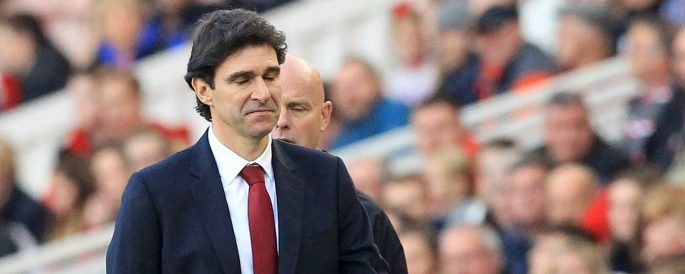
This weekend’s game was originally billed as the meeting between Aitor Karanka and his friend and mentor Jose Mourinho – now it is the beginning of a new phase in the club’s history and the start of an urgent quest for Premier League safety. The most obvious thing about Aitor Karanka’s departure is that he is no longer the focal point of the club and that in itself leaves Boro and their followers wondering what direction the club is going to take next. It’s hard to tell at this stage how much of the Spaniard’s methodology will be retained in the coming weeks.

The noises coming out of the club seem to indicate Steve Agnew is to be given a chance to become a kind of Teesside Shakespearean character – though hopefully the analogy won’t stretch to making a drama out of a crisis. On the face of it, this appears to be a high risk strategy – Boro are essentially putting their hopes of avoiding relegation on a man with no track record in management.

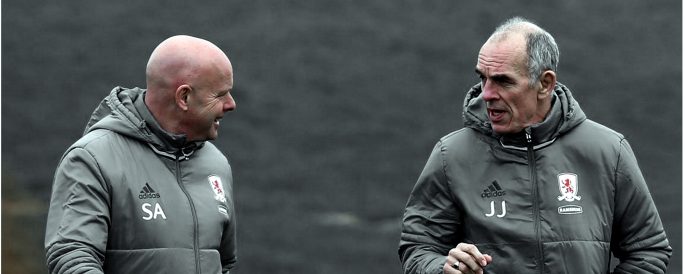
In his press conference on Friday Steve Agnew played it extremely circumspect and didn’t imply that his role was anything more than being in charge for the game against Man Utd. Though having just appointed Joe Jordan as his number two it would seem to suggest his role wasn’t about keeping the hot seat up to temperature for an imminent arrival. He also revealed that he had only a brief discussion with the Steve Gibson, who simply told him to enjoy it – though it didn’t include ‘while it lasts’.

It may well be that the Boro chairman doesn’t want to distract his new ‘head coach’ (apparently that is the chosen title these days as according to Agnew the one of ‘manager’ carries with it too much burden of responsibility with an all-encompassing role that is best spread among others) and realistically he needs to concentrate on preparing the players without the distraction of getting involved in setting out a plan of action – there will be time for that in the international break.

But Agnew has declared that this is a massive opportunity that Boro have given him and would like the job on a permanent basis as he feels he has served his apprenticeship and is ready to become the man in charge. Clearly, he has identified the need to score as the main problem to address and has confidently declared that he sees himself as a ‘creative coach’ – his intention is to ‘drip feed ideas into the group that will pay dividends’. Though if I’m being honest ‘drip’ sounds a tad on the slow side given the urgency of the task at hand – perhaps now is the time to turn the tap on to full!

Also rather interestingly he said ‘I have a clear view of exactly what’s needed’ – which raises the question of whether this had already been communicated to his former boss and have they already attempted to address the problem but as of yet without success. Though it’s also possible it fell on deaf ears and now this is his chance to try out his ideas.

Maybe we shouldn’t be surprised if Steve Gibson has decided to go down the familiar route of appointing a first-time manager – Since he became chairman in 1994 he has appointed Bryan Robson, Steve McClaren, Gareth Southgate and Aitor Karanka to their first positions as a number one – indeed it looks like it is his preferred option on that evidence.

By all accounts, the Boro Chairman rates Agnew highly and went to a lot of trouble to prise him from Hull just over two years ago and even blocked him from rejoining Steve Bruce at Villa recently with the carrot (or was it stick) that that would prevent him from becoming Boro boss in the future. So clearly he has been earmarked as the succession candidate and possibly in view of Karanka’s previous temperament issues, Gibson preferred him close to hand.

The advantage Steve Agnew has is that he obviously knows the players and it seems he is well respected by them too and doesn’t appear to have any baggage from the reported unrest among a few individuals that apparently Jose Mourinho has blamed for his friend’s departure. Though once you become the man responsible for deciding who plays and where, his relationship with the players will change – but the reality is that by the time any of them may feel they’ve been sidelined the games that will decide our survival will have already been played.

Unless Steve Gibson is waiting on a answer from someone of stature in the coming days then it will be down to Steve Agnew to save the club from relegation. The fact that the Boro chairman sees this as a better option than having Karanka in charge would appear to suggest the departed boss was out of ideas, energy and probably belief. So Gibson wants to ‘find out about Steve’ and regards him as ‘more than a safe pair of hands’ and sounds determined to avoid the drop after all the hard work of getting to the top table – but he’s had his ‘It is what it is’ moment and declared ‘Where we’ll find ourselves is where we’ll find ourselves’ – So let’s hope the old Garmin Satnav has been dusted down to find our way back.

The game itself is something of a free hit for Agnew – losing won’t be seen as failure and anything gained would be regarded as a success – even a goal would be greeted as an achievement and probably a sign of vindication. The worry of course is what our relegation rivals will manage before we take to the pitch – Palace are at home to Watford and a win for them would leave us trailing by six points. Hull are away to Everton, which is never an easy prospect but at the moment they are not the team to chase to escape the bottom three. A win for Leicester or Swansea would put them eight points clear and maybe out of reach, so Boro will be looking for some help before they play.

The team news is mixed with Friend, Ayala and Chambers still injured with Bamford also missing due to illness. The good news is that Bernado is fit so Boro have a reasonable back four to choose from, plus Gestede has recovered from his hamstring and is available.

I wouldn’t expect a major change in formation at this stage of the new regime but maybe just two defensive midfielders would help shift the balance in favour of scoring – maybe 4-4-1-1 would be the most adventurous line-up we could expect but who will get the number ten role? Gaston, Downing or even Adama playing off Gestede. Perhaps he’ll just keep it simple and try to encourage intent – though that’s what Karanka has seemingly tried in recent weeks without much success. It may be that something ‘different’ is actually needed to prevent the players reverting to old habits.

Well it’s a new start and anything can happen in theory – will we see a Boro bounce at the expense of a somewhat depleted Man Utd. I’m sure Mourinho would take great pleasure in seeking revenge for the ‘sacking’ of his friend as he chose to call it. Maybe he’ll be emotionally distracted and try to overplay his hand – I wonder if this will be a typical Boro moment?

So time for predictions – what kind of team line-up will Agnew decide to show his hand with? And what will be the score and will we have a Boro goal to cheer?

Karanka departs Boro

So Aitor Karanka has left Boro today and Steve Agnew is in charge for the game against Manchester United.

There hasn’t been that much light shed on the unexpected departure by the club but they are adamant that it was by mutual consent – which basically means they both decided it wasn’t working.

Matters came to a head following a boardroom discussion on the best way forward to ensure Boro’s survival in the Premier League – it appears the conclusion arrived at was that some kind of change was needed. Rather surprisingly Aitor Karanka seemed to have agreed that the best way forward for the club was going to be without him in charge.

Whether Karanka was unsure what more he could do to turnaround Boro’s slump in form and perhaps the idea of him changing his methodology in what remains of the season proved to be something he was not willing to contemplate – no doubt as that would basically be an acceptance that he was wrong in his approach.

It’s clear that some players were struggling to see where they fitted in under Karanka’s system in the same way he was struggling to see how they did too. This was probably a significant stumbling block given the need to get everyone pulling in the same direction – so a decision on the way forward was needed.

Interim manager Steve Agnew is well respected by the players and likewise by the board so he will have everyone onside with plenty of goodwill to succeed – but it’s going to be a another surprise if the Boro chairman will trust him with devising a survival strategy until the end of the season.

Whilst there has been little indication of whether there is someone waiting in the wings, there must be a candidate in mind who has been sounded out. It would be unlikely Peter Kenyon has been hanging out with Gibson and Bauser these last few weeks just for the small talk. It’s more than likely a relegation avoidance strategy will have been hammered out and a short list of candidates that would offer the best solution whittled down.

The ideal scenario will be the new boss walking into the dressing room just before kick-off on Sunday to send the adrenaline surging in the players before they walk out into the pitch. Boro really need points a.s.a.p. to put the brakes on their slide back to the Championship so every extra percentage point must be grasped.

No doubt the media will be touting the usual suspects of possibilities that will have the supporters pleading insanity on the chairman’s behalf – but one thing is for certain the person put in charge needs to not only hit the ground running faster than Adama can but should also be an excellent communicator and man-manager if Boro re going to get all their players fired up for the cause.

Overall I think the general feeling is one of relief – it’s never pretty jettisoning a manger but there seemed no other option left given the stakes and the time left to make any difference.

So Boro need a bit of luck and perhaps we can hope that a weight has been taken off the shoulders of the players to express themselves and give us the bounce that other clubs in our position have had before us.

Boro are facing a soft 'PLexit' in comparison to 2009

For Steve Gibson the last seven years were all about returning to the Premier League, but now there’s a strong possibility that Boro are going to be heading back to the second tier as the bad run has turned into a slump and the games are starting to run out. OK, it’s not a forgone conclusion but I’m sure the prospect is starting to be planned for. This appears to be the nightmare scenario for all the hard work getting to the promised land, though there’s even been some suggestion from a few that relegation may be part of the chairman’s master plan to bolster the club’s finances and regroup.

Personally, for me that’s a conspiracy theory too far for a man who has spent his life building the club into a top tier outfit – incidentally Steve Gibson will be celebrating his 60th birthday next season and has over 30 seasons behind him steering the club as primarily a Boro fan. Naturally mistakes will have been made but surely no chairman who has been around for so long would consider relegation a viable option. So that argument doesn’t make sense but I’ve decide to look at the financial implication that relegation would entail and how it compares to the last time we went down.

After our last relegation the Chairman no doubt planned to oversee a swift return to the top flight but he probably couldn’t have imagined it would take so long in the end. Although our first campaign saw an indifferent start under Southgate, Boro were still well placed but Steve Gibson decided change was required and gambled on one last last throw of the dice under Strachan’s infamous ‘Jockification’ project. Sadly it failed miserably and it was then left to Tony Mowbray to rebuild slowly when the money ran out. Unfortunately, Mogga couldn’t sustain his early progress on a shoestring and that subsequently heralded the arrival of Aitor Karanka, who organised Boro into promotion contenders with support from a relaxing of the purse strings after Gibson had wrote off the club’s debts.

The financial situation last time was shaped by the fact the club had accumulated over their years in the top flight a massive debt of nearly £100m – this was also in the shadow of the banking crisis of 2008 and no doubt Bulkhaul were expecting tough times ahead too. In 2009, when Boro were last relegated the gap in terms of TV income between the Premier League and Championship was £40m and parachute payments were around £11m with only £2.5m for second tier TV money – which meant the shortfall was around £25m. For those interested in reading more about Boro’s financial situation back then David Conn of the Guardian wrote this piece at the time: Gibson confident relegation need not be life-threatening for Middlesbrough

Premier League Bonanza

This year has seen a huge jump in the rewards for being at the top table. The Premier League domestic prize money pot is split into three parts – 50% is shared equally between all clubs, 25% is divided based on final position with £2m per place up the ladder (e.g. 20th = £2m, 19th = £4m … 1st = £40m) with the remaining 25% based on TV appearances and is dependent on how often a club is on the box (last season most clubs in bottom half received between £10-12m and the top clubs getting around double that at £21-24m). In addition, each club now receives an equal share of £47m from overseas TV rights.

The new formula for Parachute Payments is that relegated clubs get a percentage of the equal share TV money paid to Premier League members (which doesn’t include place money or TV appearance money). This season, from the figures I’ve seen published, that share represents £38m domestic rights plus £47m overseas rights – giving a base total of £85m. This share represents the following Parachute sums:

Year 1: 55% (£85m) = £47m
Year 2: 45% (£85m) = £38m
Year 3: 20% (£85m) = £17m

It should be noted that promoted clubs that only survive a single season will not get a Year 3 payment – which would affect Boro if they went down.

The club finishing in last place this season should expect a payment of £97m in prize money – so in the words of Jim Bowen ‘That’s safe’. You should also take into account that Boro will have enjoyed increased ticket revenues this season as attendances have remained around the 30,000 mark – plus sponsorship deals and merchandising revenues will no doubt be higher for being in the PL.

Taking prize money and potential parachute payments, it probably means promotion has given Boro a guaranteed £183m and we can probably assume that is closer to £200m with subsequent increased PL revenues. Naturally costs in the PL will be higher in terms of wages and transfer fees – though I would think most of these cost will be easily manageable on relegation as, for example, Negredo is probably our biggest earner and he’s on loan – no doubt Ramirez will be off too come summer and probably closely followed by Downing.

So relegation for Boro in the short term should not be a major financial hardship and given that it is a new system they will be one of the clubs with the biggest budget next season if they go down. In some ways it’s helpful that Boro haven’t been in the PL long enough to have accumulated players on unsustainable contracts, so it’s less likely that the club will have to sell players on the cheap to get their wages off the books.

Championship Budget

In the Championship every pound counts when it comes to financing a promotion campaign – Boro managed to increase their turnover in the season before they got promoted by £8m to £20m. This was thanks to the £3m Play-off bonus (where there is a convention that losing finalist takes all the gate money) and £1.5m from two big cup away-days at Man City and Arsenal – on top of that Riverside attendance rose by around 25% from 16k to 20k.

So in the context of Boro’s budget for our last promotion year, you could probably estimate it was around £33m, as that £20m turnover will have been bolstered by a further £13m from the combination of Steve Gibson’s own pocket as the maximum permitted cash injection by an owner under FFP (Financial Fair Play) was £8m and the maximum loss under FFP rules was £5m – which gives an extra £13m beyond turnover to play with.

So in financial terms Boro would be in a far greater position to fund a promotion push should they go down this season. They will pickup between £97-101m in PL prize money at the end of this season as a relegated club – on top of that they will be entitled to Year 1 parachute payments of £47m plus you could perhaps expect £15m on turnover.

Incidentally, Championship prize money is now calculated as 30% of a Year 3 Parachute payment – which works out as about £5m.

So in comparison to our last year in the Championship where Boro had a budget around £33m, the club’s coffers should be swelled to £160m – that’s more or less five times more. Naturally the club will be carrying extra running costs as player’s contracts will have been upgraded and the club will have incurred costs when the Riverside was refurbished to meet PL requirements. It’s quite possible that some of those contracts will have relegation clauses in them, it was something I recall Steve Gibson and Neil Bausor indicated was a sensible approach in the Untypical Boro boardroom meeting that I attended when Mogga was still in charge.

In addition, FFP rules are no longer based on yearly accounts but are now averaged over three years – though rather than allowing Boro to spend more next year I would suggest it may be more beneficial as insurance for spending more in years 3 and 4 when the parachute payments run out. Surely the £160m windfall is considerably more than enough to finance a Championship team capable of promotion.

Relegation as a plan?

Some might be reading these figures and thinking that maybe relegation is a better financial option after all if you’ve just picked up over £150m and you can avoid more heavy spending in the Premier League as you attempt to upgrade the players. On the face of it that may look an attractive option but there is a slight problem.

Statistically, around two-thirds of relegated clubs don’t come back up and as it will become increasingly harder as parachute payments run out. Boro would essentially have only two seasons to make their financial clout count – then it would be back to belt-tightening and competing probably against at least half-dozen clubs with much bigger budgets.

The difference in TV prize money for clubs without Parachute Payments is growing – when Boro were last relegated it was about £40m, it’s now more than double that at £100m. Anyone thinking getting relegated is a risk worth taking in order to bank a quick profit needs to consider that after two years the club will be essentially back to running on gate-receipts and other generated income – and that adds up to around £15m

So in conclusion – being relegated probably won’t be a major financial problem for two years – but by being out of the PL you are probably losing out on around £50m per year depending on your operating costs. Therefore it’s highly unlikely Steve Gibson would see going down as a chance to cash in as he’s probably got an evens chance that he’ll be bankrolling the club out of his own pocket again within three years.

Of course the key question will be if Boro do go down can they regroup and bounce back? I can’t see finances as being any kind of obstacle but it will be on the field where this is determined. Some have suggested perhaps the tried and tested methods of Aitor Karanka are best suited to the grind of the Championship, where playing twice a week against on the whole average sides needs steady rather than spectacular football. They may be right but I’ll leave that argument for another day…

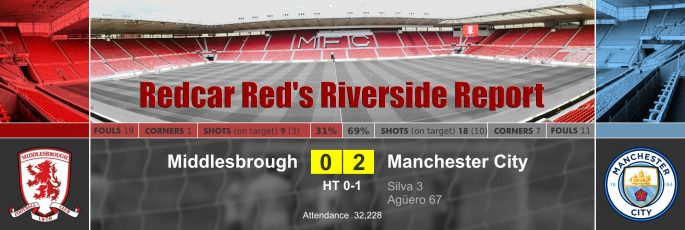
City Slickers prove too pacy for Boro battlers

The team announcements asked a few question for those of us gathered in the concourse pre kick off. Downing obviously is still on the naughty step yet Gaston was on the bench, go figure as Brad would probably say. Clearly Stewy must have been very, very naughty compared to Gaston. Incredible that not only was he allowed into the Riverside after recent showings but also got one of the best seats in the house. One rule for one and another for another it would appear, whatever the reasoning for the Uruguayans inclusion and the omission of Pally Parks finest it left a bitter taste with many.

As the Teams came out I admit to a feeling of que sera sera not that I thought for one second Boro were going to Wembley more just a case of whatever will be will be. And so it was, a side full of £50m players against a side with a few £5m players (not counting Stewy of course or even the recently purchased Bamford) was always going to be a tough ask. A team full of gifted talent and skills against a side that are generally pedestrian and so deep in their own half aqua lungs and flippers wouldn’t go amiss were ripped apart as City without fear of a Boro assault piled men and bodies forward and put Boro under pressure from the off and ripped us apart with some slick quick passing.

With Toure under absolutely no pressure he splayed the ball out wide and Zabaleta fired a fierce ball into the middle where the blue shirts had set up base camp and despite Sterling doing his best to miss Silva managed to eventually turn it in. Two minutes, 40 seconds on the clock, 0-1 and the random Cup attendees were still trying to find their seats whilst balancing their Burgers, Chips, Coffees, Fanta and various designer shopping bags.

At that point the omens looked bad, in fact we were cut open so easily and quickly that it looked like there was little on the field in Red that could put up any sort of defence with a likely cricket score looming. The rest of the half seen Guzan and Gibson having several discussions about our defensive organisation, I’m not sure what was being said but clearly Brad was not too happy about something.

To be fair it could have been about any number of things, our midfield seemed porous to City charging forwards. Grant seemed slow and hesitant at times, Adama was running around in circles beating three City players before losing possession, Sane was tearing Barragan apart (as he has with many Premiership defenders since his arrival). We looked and were very ragged but on the positive the normal backs to the wall keep them out at all costs and don’t attack default was no longer an option as this was a knock out competition with only the winners going to Wembley. As a consequence we saw Boro attempt to attack but the contrast in build-up and style was light years apart and try as we might our slow passing game was easily read and intercepted and picked off.

On 15 minutes it should have been 0-2 after Sane skinned Barragan but his shot come cross across goal was fortunately missed by Aguerro. Our only outlet was a long ball up to Gestede who clearly is still in favour with the Boss who did win aerial duels but unlike City who would have had 4 or 5 players like as not following up and supporting our offensive threat was somewhat reticent. In fairness de Roon who was playing as the advanced midfielder did pick up one knock down but his snatched shot was both woeful and wide. We did manage to get the ball up to Gestede again and he

managed winning his duel got a header off that went over but in all honesty our long balls looked more in desperation than as any part of a game plan. In fairness to Benin’s best, Otamendi and Stones looked very uncomfortable against him but with no one near him his battles were in vain. Whether it was the extra effort required in being a one man attack or simply a question of warm up routines and stretching but for the second week we saw a Boro player leave the field early in the first half with a hammy. Twenty six minutes gone and AK was forced to put Negredo on.

On paper we shouldn’t be able to live with City purely on the amount of spend between the two squads but in fairness to Boro a few did role sleeves up and get stuck in. Guzan was Boro MOM between the sticks, Gibson had one dodgy moment but was class apart from that, Fabio struggled against Zabaleta at times but still pushed, chased, ran and harried and was unlucky in the second half to see an attempt cleared after a Negredo knock down. The fact that it was our LB attacking on the edge of the 6 yard box tells its own story. Our Dutch International de Roon ran and chased and fought as did Clayton. Grant gave a 100% but at this level struggled with the pace speed and athleticism of his opponents. Indeed de Roon put in a cross that was met by Stuani and caused Bravo to make a save late in the first half.

For me the most stand out performance apart from Guzan was Stuani, he really put a shift in, tackling, fighting (literally at one point) and looking determined not to give up. No goals but an honourable days graft as was Negredo when he came on who chased down Bravo in goal and got at the susceptible looking City defence as they passed the ball out and not always convincingly. Traore was a mixed bag, when he got a chance his pace led to a few runs down the flanks and crosses but one in the first half was wayward but another did find Negredo in the second for the aforementioned Fabio effort on 77 minutes.

For all our best efforts we never really looked likely to make a serious impact apart from a first half effort that was cleared off the line whereas in reality how City didn’t score at least 5 was down to Gibson and Guzan (who in my opinion done enough to keep his starting spot). When the second half started City once more came out all guns blazing with de Bruyne looking lively causing problems. By now we were playing far higher up the pitch and despite the fact we only had 31% possession we actually looked a lot better than of late. The fans stuck behind the players and kept with them even when Gaston came on for the weary looking Grant there was a mixed reception with a crescendo of boos drowned out by polite applause overly extended from the appreciation of Grant’s departure.

Meanwhile Guzan was inspired tipping away a Silva shot from the bottom corner and again palming away the same from Sane but was helpless with Aguero making it two for City from Sane’s cross. He then went on to block another Silva effort with his legs and reach spectacularly to prevent a Sterling effort. It ended 0-2 but as the day trippers dawdled away in the last ten minutes the stalwarts remained to clap the players off the pitch.

Tactically there was little on offer and starting with our predictable defensive line up didn’t help and handed City the initiative. Interestingly Pep was stood watching our warm up routines so whether that gave him any clues I don’t know but on the day we were simply beaten by a far better side and although there will be some who no doubt will lay a lot of the blame at AK’s door and some of it fairly City quite simply had far better players.

Karanka attempts confidence trick with one eye on Wembley

This weekend we enter the parallel universe of the FA Cup once again, Boro have nudged to one side the trivial matter of a home game to bottom club Sunderland for a chance of glory against the pale blue side of Manchester and the prospect of a trip to Wembley. After seeing off at the Riverside Championship, League Two and League One opposition, those in charge of the numbered balls have decide if Boro are going to win the cup then we’re probably now going to have to beat three of the best sides from the Premier League.

OK for a team who hasn’t beaten a Premier League team for nearly three months this may sound like a big ask, but the cup is not the league and Boro have actually fared pretty well against those top teams still left in the competition – two draws and three single goal defeats. The other good news is that it’s actually possible to lift the trophy without scoring a single goal in open play – so better get practising those spot kicks gents. Though to be fair the FA Cup has been something of goal-fest for Boro this season, having twice knocked in a treble to give us a magnificent seven in total – that’s equivalent to over three-months worth of league net action.

All eyes were on the press conference yesterday as Karanka made his first public appearance since many of us, along with most of the media, have been discussing whether or not he has reached the end at Boro. Though when the eagerly anticipated question of whether he had spoke to Steve Gibson arose, the Boro boss revealed that the only topic of conversation between him and chairman was this weekend’s FA Cup game – well they’ve no doubt exhausted the topic of talking about the weather over dinner during recent weeks, so it must be a welcome distraction to be able to talk about football again.

Though the buzz word for the press conference was ‘Confidence’ – it was everywhere. When the Boro boss was asked whether the fact that Steve Gibson has always been patient and helpful to his managers had given him confidence, he replied “The most difficult moment for me was when I arrived here, but he was the first one who transmitted his confidence. I don’t need to feel that every day.” Indeed the confidence theme continued with Karanka declaring that he and his staff were trying to show their confidence to the players – who he revealed still had a good spirit but were low in confidence following the recent games.

Perhaps the only nod in the direction of the growing pressure on him was when he expressed the view that every situation is new for him as a manager so he must learn, modify his training, know the mistakes he is making and try to give the players all his confidence. Karanka went on to explain that you can train to play more attacking, which he said they have been for several weeks, but all this work is for nothing if the players don’t have the confidence to execute what they have been working on.

So Karanka has been primarily concerned with raising that confidence and he decided to show them a few videos. On hearing the news, some of the players had no doubt started making themselves comfy in anticipation of a box-set of a Game of Thrones – though perhaps ahead of his return to the team Barragan would have gained more from a private viewing of a game of throw-ins. Anyway, the Boro boss plumped for showing the lads some of their best bits, including the decent showing of their trip to Arsenal. Whether this was the perfect antidote for a team who has struggled to score is debatable, though Karanka’s attention to detail appears to have overlooked that the game ended 0-0. Maybe he didn’t want them getting too excited just in case they go all gung-ho at the weekend and besides from his post-match reflections I believe the Swansea game is not in his best bits collection.

I suspect copies of the Daily Telegraph will have been removed from the training ground as part of the positive mood ambience being created. They claimed yesterday that Karanka’s Boro are the second most boring team ever in Premier League history, narrowly being edged out of top spot by George Graham’s Leeds team – apparently we’re like watching paint dry. I couldn’t disagree more – clearly they’ve never attempted to paint a 60 square meter freshly plaster-boarded living room ceiling in the middle of summer – I practically ran with the roller as I tried to avoid lapping marks as the emulsion rapidly dried, it was so exciting I ended up putting on a further 6 coats. Anyway, I better save my paint drying anecdotes for the international break.

So returning back to the quarter-finals, and rather sadly (and perhaps pedantically) this has now become the last chance for football fans to sing Que sera sera, whatever will be will be, we going to Wembley, Que sera sera. Yes, the move to Wembley for the semi-finals has somewhat robbed many fans of this vocal ritual. I mean, what exactly are delirious supporters now supposed to sing as their team goes two-up with ten minutes to play in the semi’s – it just wouldn’t make sense to sing you’re going somewhere when you’re already standing there – clearly the FA haven’t thought through the impact that their ill-conceived premature pilgrimage to the home of football will have on this crooning crescendo rite of passage – You may as well have the teams arrive on the pitch in an open-top double-decker bus holding replica trophies. It has both devalued the competition and cheapened the experience.

Though I’m still unsure how a 1956 Doris Day number became the song of choice for glory-seeking football fans everywhere – besides I find the lyrics are perhaps a tad too philosophical about the possible outcome of your team’s chances in the cup final once they get there – If one of my mates asked me “Won’t it be great if we win the cup?” and I just replied “whatever will be will be” he’d probably assume I wasn’t that bothered and would make plans go with someone else.

Still there’s a long tradition of pop songs making their way onto the terraces so maybe we’ll now see a more fitting anthem emerge one day – though given the latest video technology and the recent trend of pop duets from beyond the grave, perhaps the time has come for Mogga and Doris Day to release ‘It is what it is’- though not rhyming with Wembley could prove to be a problem.

The team news for Saturday will be interesting – though Boro are back in another defensive injury crisis and there is little room to manoeuvre – Ayala and Chambers are definitely out and George is extremely doubtful with a re-occurence of his calf strain. That means Barragan will return at right-back as Fabio moves back to the left, which leaves Gibson and Bernado in the centre with only Dael Fry as back-up. Karanka was being coy about whether Negredo will return but it probably wouldn’t be a smart move to leave him out against his old club if he’s trying to lift spirits. There was no mention of Gaston yesterday but the enigmatic Uruguayan needs to decide if he’s in the boat or sulking in a dingy being towed along by his team-mates. I suspect we’ll see a midfield three as Boro are playing a top-six side and although Adama was poor last time out, without his pace there may be little to worry City.

So will Boro be on their way to Wembley singing Que Sera Sera or will it be Hasta la Vista Baby to the Cup as City terminate our run. As usual give your predictions of Score, Scorers (yes it happens in the cup) and will Barragan have learnt to throw the ball during his absence.

A big club methodology for a small town in Europe

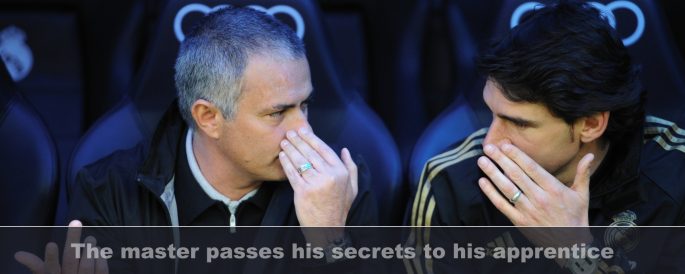
It’s no secret that Aitor Karanka is a disciple of the self-styled messiah and self-anointed ‘special one’ Jose Mourinho – in fact it is essentially the USP of the former Real Madrid number two, who spent three years as his apprentice learning the Mourinho methodology. For a club like Boro, having a manager who imitates the most successful coach in Europe is the nearest they will get to the real thing – but is it possible to get the whole package or is it even desirable to roll out a big club template on a small town in Europe?

In last Thursday’s press conference the issue of ‘Jose’ was raised and Karanka was asked if he still spoke to him regularly – at that moment the widest of smiles lit up Aitor’s face followed by a joyous sigh a nod of the head and the word ‘yes’ – he went on to say that Mourinho as always was a great help and they both share the same mentality, focusing 24 hours a day on their jobs as football managers.

There is something bordering on a cult with Mourinho and he himself has described the bond with those in his group as ‘forever is forever’ as in his eyes there’s no such thing as an ex-player as once you have played for the special one you are deemed ‘one of theirs’. This may stem from Jose’s belief in managing through charismatic leadership – something he admitted to actually working on as he often planned the performance-like nature of his touchline escapades to inspire the players and raise the supporters mood.

The Rules of the Game

One thing Karanka will have learned from his mentor is that everyone has to accept there is only one way to behave under him – his way! – And there are no exceptions.

It’s been documented that when Jose Mourinho first addresses the players after taking over at a club he will use the saying “you are either in the boat or off it”. He’s basically telling his squad you buy in totally or you are out. The rules are clear, Mourinho will promise to be direct and say what he means to their faces, gossip and leaks from the dressing room are not tolerated. It is quite likely that most managers will demand loyalty but the Mourinho template is perhaps more zealous – no doubt devotees and followers of his methodology, such as Karanka, will instill a similar regime.

This regime also extends to his staff and he will expect total devotion from his backroom staff, who it’s claimed are almost choreographed in their responses on the touchline – it’s said if Mourinho protests at a referee’s decision, they too must all protest. You can perhaps see similar things with Karanka, but he’s a little less of a showman than his former boss but having Leo on your bench probably more than makes up for that. Then your mind thinks back to ‘Higgy-gate’ who perhaps made a fatal mistake of seeing the referee’s side when he apparently apologised on Karanka’s behalf.

It may well be that Karanka has copied Jose’s style of leadership but is it imitation without the personality to carry it off? Mourinho believes in charasmatic leadership and has at his disposal all the attributes, mannerisms, humour and sharp wit and actually enjoys jousting with the press as it provides a stage to display his complete inner belief and arrogance – whereas Aitor appears to be a bit more reserved and less confident in front of the media. Perhaps he sometimes comes across as clumsy as he’s delivering his pre-planned lines in press conferences – sometimes they are just shoe-horned randomly into the conversation like he’s only there to make that point as a means of creating a distraction. The worry is that we sometimes get Jose Mourinho as manager by proxy!

Training and Tactics

In 2012, Karanka was part of a Real Madrid delegation that was giving a practical demonstration of Jose Mourinho’s methods of coaching at UCLA – it was attended by a football coach Gary Curneen on behalf on Just-Football.com, who wrote a rather interesting three part blog on his experiences. From what I previously read and heard of Karanka’s methods it pretty much appears to describe the template to which he bases his own methodology.

The selection of training exercises is always consistent with the style of play – naturally there can be no contradictions – with these training drills being carefully designed and practised over time until they become instinctive and automatic for the players. The objective is to create a “Play Culture” that is defined as players knowing exactly what their individual roles and the collective roles are within the team.

What was interesting is that training included specific exercises that practised patterns of play – such as how the team moved forward in a specific way as a unit by creating passing options – right-back to central defender to left back to advancing central defender etc – all very precise and methodical until the ball is released in the final third – sounds familiar? But perhaps it’s what happens in that final third where Boro are short on ideas and movement or indeed quality.

This to me puts into question any idea that a Karanka Boro can suddenly re-invent themselves into a more dynamic progressive team – they have presumably spent the whole season, and some cases several seasons being drilled with exercises to perform instinctively in the boss’s methodology and desired pattern of play.

For example, defensive organisation focuses on shape, marking patterns, and breaking the team into sections including how attacking players should press immediately after losing the ball. What we see emerge is how Mourinho has developed a methodology to instill into his teams the tools to think how he thinks as a tactician and strategist. It also allows other to follow his template but of course it will always be interpreted slightly differently by other coaches and the players themselves.

The natural conclusion is that players conform to the strategy and this is perhaps why we observe our forwards change their attention from looking to attack the ball and instead getting into the drilled defensive shape – perhaps this kind of training has gradually taken the instinctive edge off our forwards in terms of looking at goal opportunities and moved them to be part of a more strategic defensive structure.

The difference for Mourinho is that he generally works with world class players who have more explosive qualities and skills that can still manifest themselves within such tightly controlled structures. But I suspect for most player they simply don’t have the physical attributes or mental alertness to multitask to such degree that allows them to retain extra capacity to perform beyond the framework.

At the heart of Mourinho’s match preparation is the importance of thorough analysis of the opposition. It is something he learnt from Van Gaal, who it has been said is more obsessed by stopping the other team playing that getting his own to play. In fact Mourinho is even far more aggressive than his former mentor in that regard and has also learnt to pass this analysis on to his players in a more succinct method.

Detailed analysis, video clips, emails and even text messages are provided to individual players but they are designed to be short and sharp. At Real Madrid these were condensed down to two or three key video clips about the team they would next face and were played in a loop in the dressing room, medical room, gym and canteen during the week before the match. We know that this has also become part of Karanka’s pre-match methods for the players as every detail is carefully planned.

Darker Downside

One of the downsides to Mourinho’s approach is he prefers not to develop talent as he regards his methods are better suited to more mature players with a greater understanding of the game – though it’s possible for a big club with the riches to take that view but I suspect Karanka will have to work within his resources at Boro and also with players who are perhaps not as rounded in their development. In addition, big clubs can naughty-step good players who don’t buy in as they usually have other options, but if a club of our resources do the same they are somewhat reduced of options – plus there is also a general problem in attracting players for teams like Boro, something big clubs don’t share.

To some degree I think we’ve seen that a Mourinho methodology is also better suited to a big club who have match-winning players to bolt onto a highly organised unit – Yes Boro look organised but they lack the quality to explode in the last third or counter-attack with speed and precision. Boro don’t have either the players to deliver the quality ball or take the few half-chances that come their way – that may be so for whatever system we employ, but under Karanka a more direct approach has been frowned upon as it’s not part of the methodology – other clubs are not so fussy as a goal is still a goal.

Sitting underneath the carefully planned training sessions, tactical analysis and match preparation there is another side to the Mourinho method – a darker side. Part of the psychology is to also create controversy and stoke up tensions with the aim of making either his staff, players or even the board show that they are 100% behind him. Whilst this has shown to be an excellent short-term method of creating the desired siege mentality, which acts as a kind of energy-hit to gain that extra couple of percent when it’s needed, it does tend to gradually leave everyone mentally and physically exhausted.

Recently Fabio Capello claimed that Mourinho always “burns out” his players mentally within two years because of the intensity in his working methods. People also eventually get worn down from the constant friction created from the off-field activities and controversy. It’s not usually a problem for the Special One as his plan is usually to achieve his goals quickly and then move on to the next club – he’s always in demand as other clubs crave success at any cost. Though we saw in his last season at Chelsea what can happen once the players and staff grow tired of his games. One wonders if such an approach is particularly unsuited to a club like Boro who are looking probably for a more long-term sustainable model.

It has also been observed that such is the intensity of the training and match preparations that players eventually reach the point where they find it impossible to give the manager any more. Karanka’s solution to the current bad run appears to be that ‘we must work harder’, which comes on top of recent statements declaring that he, his staff and players are all working extremely hard. Perhaps Boro have just reached that ‘burn out’ point in the Mourinho methodology – notably our best performance recently came against Everton after a break in Benidorm – maybe we have just gone past peak Karanka-Boro and there is no more to give.

Boot or Reboot

It seems the Boro chairman has decided to give his manager more time to turn things around – but how easy will it be to change our style of play? The idea that Karanka can work on Boro playing in a more progressive manner is perhaps a tall order given how the players have been coached meticulously with session upon session to play a particular way. The Boro boss told the Telegraph recently that they had been working for 2-3 weeks on being more attacking – there has been no indication in the last two performances of this but maybe it has instead actually left the players mentally confused in the flux between their instinctive defensive template and the new more attacking version.

It’s quite possible that a new playing style will just take longer to manifest itself and require more sessions in training – but what do you think will be the tactics to face both Manchester clubs before the crucial relegation six-pointers? Yes, it’s highly unlikely we’ll try to outplay either of those teams so the next test run of Karanka-Boro Mk II will be in a month’s time. It may be that a new voice is required to change our fortunes as the players may have subconsciously and mentally shut down Karanka’s.

Aitor’s feet of clay unearthed at the Potteries

Looking at the fixture list at the start of the season an away game to Stoke was hardly a stand out game in Boro’s Premiership season. As the months and weeks have progressed and we are now well into the final third of the season this game could be make or break not only for Boro but also our Manager. Before Kick-off Ladbrokes had odds of 6/4 that AK would not be on Teesside come the last game of the season.

Having not won a Premiership game since December 17, and scoring just three goals in our last nine matches and only one goal in our last six away games against a backdrop of blame culture and a rumoured fall out with the up until now untouchable Negredo, pressure was growing on AK. Early speculation on team selection beforehand was that Gestede was to get the nod over naughty Negredo and with it an opportunity to end his 36 game Premiership streak of not being on a winning side.

Defeat today could see Boro slip into the relegation zone and with other relegation candidates showing recent signs of improvement even a draw could be seen as a negative result with only 11 games left to hold onto our place at the top table. Team news at 2.00 revealed that Bamford had again been ignored as expected but also surprisingly Downing whilst Gestede as rumoured got the nod over Negredo. Leadbitter was preferred to Forshaw which pleased many along with the sight of Ayala back alongside Gibson with the nervy Espinosa benched and Friend at LB.

A steady start seen not much quarter given but with Stoke making the most of the play then inexplicably Ayala pulled up with a hamstring after only 5 minutes action for us to see Espinosa coming on. On 13 minutes Boro’s packed defence was cut open and Ramadan was unlucky with his effort from 6 yards out hitting the post. Boro were playing on the break but in the opening quarter of an hour it was Stoke looking much the more likely. Our main tactic seemed to be try and get it wide to Traore on the left to put a cross into Gestede. I can only assume that Gaston was on his weak right side and Traore on his weak left side so AK could coach Adama as Ramirez was conspicuous by his absence.

On 18 minutes Gaston dallied on the right trying to defend and played Joe Allen in who stumbled and fell over then Ben came out with it, passed it to Grant who then bumped into Ben giving the ball away for it to eventually ricochet and Valdes collected thankfully. Comedic but very worrying, Grant was looking slow and rusty. Shawcross then upended Traore and took a yellow for his troubles but the resultant free kick from Grant was poor although that wasn’t the language I used at the time.

De Roon had a great opportunity as the ball was played over the top of the Stoke defence but he hesitated momentarily bringing it under control and all was lost. At this point of the game the passing from Boro was diabolical, constantly giving away possession, scrappy best described it.

Stoke pressure was slowly building as Boro offered little threat and then a hoofed ball up to £2m Marco Arnautovic seen him bring the ball down, leaving George for dead, spun around and slotted home. Boro now had to forget clean sheets and attack but there was little to show thus far that attacking was an option for this side. The weather started to change as the rain came down and with it any pre Kick Off optimism was coming down with it. Fabio was having a tough time and Gaston wasn’t influencing anything whilst Grant really struggled to get up to speed.

A Grant free kick was lofted into Espinosa on 35 minutes but it sailed straight into the Keepers arms. There was little to get excited about for the traveling Boro fans apart from a rainbow which appeared and seemed to spark Grant into one of his trademark thunderbastards which was tipped wide for a corner. The ensuing corner was put outside the box in a training ground routine to see Gaston blaze the ball over the roof of the stand.

Just before half-time a corner for Stoke saw Valdes blocked off, who was then helpless to see the ball float over to Anautovic to get his second. “Attack, Attack, Attack” chorused from the terraces as the first half drew to a close. Once again a weak dispirited showing with no strategy for attacking or creating, Boro were looking totally devoid of ideas with Traore running and dribbling but a headless chicken if ever there was one despite being on the Managers preferred coaching side. To rub salt in the wounds George was booked as Arnautovic was giving him a torrid time. Forty-five minutes gone and there looked to be nothing left from the blue shirts. Down and out with eleven and a half games to go, boos from the traveling fans accompanied the half time whistle.

Gibson and in fairness Espinosa were still fighting as was de Roon but Clayton was quiet. Gaston was anonymous, Grant was trying but largely a bystander apart from free-kicks, Friend was clearly not match sharp, Fabio couldn’t get forward, Traore again had no end product and Gestede was winning headers but then what? AK selected Gestede but had no tactics to make his selection remotely effective.

It’s clear Gaston was mentally gone and if that wasn’t bad enough as AK left the field the boos rang louder. Not quite Barnsley yet but the Manager and his charges looked like a boxer out on his feet, after last week at the Palace this was very poor fayre and not what was required. Contrasting the £2m Arnautovic with our £6m Gestede and the issue with our scouting and recruitment was frankly embarrassing. Was the second half to be AK’s final 45 minutes? Would he keep it tight to protect GD or try and get a result? This was his biggest managerial challenge but the signs looked ominous.

The second half unsurprisingly saw Stuani come on for the already emotionally absent Ramirez taking up position on the left with Traore switching to his preferred right. The change did little to affect our attacking prowess as passes still went astray, challenges looked ineffective and crosses were over hit as chants of “Attack, Attack, Attack” rained down again from the traveling army in blatant disregard and disrespect to AK.

“Come on Boro” chants then came to the fore in a desperate attempt to inspire those who looked to have lost the will to live let alone attack. Fabio broke through and teed up Gestede but his touch was wayward. Stoke then broke and de Roon was chasing back in the RB slot giving Valdes time to clear it for a Corner on which Valdes was once again blocked off by the big lads in Stoke’s front line. Meanwhile news was filtering through that Rhodes had bagged a brace for Wednesday just to rub more salt in along with Nugent netting.

Boro were playing statues again, nobody making runs, nobody looking to receive, nobody dragging defenders, just passing to static individuals. On 60 minutes it looked as though we were back in it as Boro’s MOM Ben Gibson met a cross from a Grant free kick to put it in the net under the Keeper but the Lino’s flag was up for an infringement or imaginary offside perhaps. Fortunately for Boro

Arnautovic pulled up cream crackered after roasting Friend all afternoon and being a thorn in the Boro’s side.

What we were witnessing was a side who were trying to attack but who were new and raw to this skill set. Stuani at least was getting stuck in and putting in a shift, trying to mix it up but it was a team of individuals with no collective organisation.

Traore stupidly bulldozed Peters over near our corner flag and the resultant Stoke free kick fortunately led to nothing. Fabio was having a torrid time from Ramadan as our attacks were intercepted quite predictably and Stoke kept pushing us back. In the last throw of the dice Guedioura came on for Grant on 75 minutes who was visibly tiring. In the 79th minute Valdes took a free kick in the Stoke half as everyone in a blue shirt piled forward, oh for such attacking intent earlier in the season. Of course it came to nothing. Guedioura then had a shot on the 18 yard line after a combined Stuani/Gestede knock down but as we know by now accuracy is not the ex Watford man’s strong point and it sailed well over.

Moments later Stoke broke quickly again and £5m man Ramadan nearly caught us out. Interesting to contrast Stoke passing quickly into space making the ball do the work and cover the ground whilst we still played our mono paced passing game and seeing our attacking intentions easily read. “One Stevie Gibson” rang out followed by “I’m Boro till I die” as the traveling army made their position and loyalties clear. It wasn’t getting any better and quite frankly things were getting dire when the Boro fans ironically cheered a throw-in in the 89th minute. Five added minutes were called over the tannoy as Ramadan now twisted and turned de Roon and Espinosa with Fabio caught upfield. It should have been 3-0 but for Valdes saving at the feet of Affelay his former Barca team mate.

Overall another poor performance with little skill or creativity evident in the side, it had the look of Gareth Southgate’s Boro as they slipped meekly into the bottom three. Looking lost, bereft of hope and belief as they trudged off it was questionable if the players still buy into AK’s philosophy, the fans certainly made their feelings clear.

The heat is on as fired-up Boro head to the Potteries

Watching Karanka’s press conference yesterday he appeared in confident mood ahead of the trip to Stoke and there was little sign of a man under pressure – he actually made the point that he sets the example to his players by walking with his head up and showing belief in what they are doing.

His reflection on the Palace game was that it was simply an aberration brought on by the last minute news from the Team Doctor that Friend was not available and thus ruining the week’s game preparation – no doubt his mentor would have offered more severe treatment to such an oversight from a member of his medical team.

Though why Karanka thought it was better to completely change the shape of the team rather than use a makeshift full-back remains unanswered. Interesting when quizzed over why Husband didn’t get the shout his reply was basically he was not up to dealing with Townsend and it would have been an ‘excuse’ to select him – though how the player takes that damning assessment is anyone’s guess.

There is often a degree of news management with Karanka when quizzed about Boro’s current position in the table and where we may expect to finish. According to the boss “We are in the position I thought we would be” – so the bar he has set is 17th place and that is the message he wants to get across.

Though is this our realistic position and are we meeting expectations? I had a quick check yesterday on where promoted clubs finish in their first season – it’s not usually as low as 17th for two-thirds of the newly arrived teams as the average finish is actually 15th –  with many clubs finishing comfortably in mid-table and only one of the three promoted teams actually ending up being relegated. So whilst a promoted club would happily snap your hand off for 17th spot before the season started it’s not, or it should not be the measure or the target to aspire to.

Below is a table showing the finishing positions of the promoted teams in the seven seasons Boro were out of the Premier League.

Season Promoted Teams (Position finished)
2009-10 Birmingham (9) Wolves (15) Burnley (18)
2010-11 West Brom (11) Newcastle (12) Blackpool (18)
2011-12 Swansea (11) Norwich (12) QPR (17)
2012-13 West Ham (10) Southampton (14) Reading (19)
2013-14 Palace (11) Hull (16) Cardiff (20)
2014-15 Leicester (14) Burnley (19) QPR (20)
2015-16 Watford (13) Bournemouth (16) Norwich (19)

I defy any manager (even those prone to control freakery) to be able to finesse one position above the relegation zone – in fact even Karanka mentioned that Boro could have had 32 points based on performances, which could be interpreted as we’ve either under-achieved or were the victim of unforeseen bad luck – though he may be right, I can probably think of five draws that Boro could on another day quite easily have won: Stoke (H), West Brom (H), Burnley (A), Leicester (A), West Ham (A).

So in some ways he’s saying we are where he thought we would be, but at the same time countering that by claiming an extra ten points would have been a fairer reflection, which could be an attempt to move the jelly-like goalposts away from those holding the hammer as they try to nail them in place. Though this type of duality is often what you tend to get with Karanka (and perhaps he’s not alone in the art of spin among managers) – it’s painting the picture in shades of grey to avoid having his hands tied by his record, though I’ll leave it to others to determine just how many shades of grey are permissible before the relegation watershed.

The Boro boss is also good at deflecting a seemingly critical point about being overly defensive and turning it with a straight face into a compliment – “we are in this position because we have a good balance between our defence and scoring goals”. There seems to be little acknowledgement to questions posed of how Boro can change in order to improve our goals-for record and he dismisses the idea of needing to change by just reiterating “we must continue to work hard” – he’s in no doubt that he and his team are working hard (which no doubt they are) and “they will fight until the last day” – though thankfully no mention of beaches.

However, in an article in the Telegraph yesterday he is quoted on the same subject of addressing the lack of goals with “There are things we are trying to do… For two or three weeks, we’ve been training to play quicker and doing exercises on the pitch to get the ball to the box quicker and to get more players into the box. But when you change things from one day to the next, it’s difficult.”

This raises the question of why has it only occurred to the Boro boss in the last couple of weeks that something needed to be done to address the problem of our pedestrian approach to scoring goals – these points have been highlighted for months by pundits and analysts alike so it will not surely have escaped his attention. Maybe someone raised the point in Benidorm after plucking up the courage after secretly downing a Zombie cocktail before an informal pool-side meeting. Perhaps it was Negredo with his lounger 30 yards away from the others who professed to be lonely on his own, which made something twig.

He has also pointed to the improved performances going forward against West Brom and Everton as an indication of his belief that Boro will prevail against their relegation rivals. He said about the game on Saturday “We have to show from the first minute that we want to win… as three points at Stoke is really important” – and that last statement cannot be over emphasised.

To have a good chance of avoiding relegation, Boro have few realistic opportunities left to achieve the four wins that must be regarded as needed at this stage. We still have to play five of the top six in our 11 remaining games after Stoke and although we play four of our relegation rivals, three of those are away (Swansea, Hull, Bournemouth) – plus the rearranged game at home to Sunderland – that leaves two other games where we host Burnley and Southampton.

These run of fixtures are in contrast to Hull and Swansea, who both only have two of the top six to play in their run-ins – plus they have shown in recent weeks that they have found much better form. On top of that Leicester looked back to their former selves post-Ranieri, which means the task facing is Boro beginning to appear less comfortable and surely it must be time to put the emphasis on employing tactics that concentrate on winning key games rather than attempting not to lose them. In addition, the meek performance last week at Palace is even more galling given that they also must play five from the top six and up until that point had no reason to cheer.

Karanka has batted away any suggestion that he has set a target for the number of wins required and insists he only focuses on each game as it comes. But surely that is just rather damp flannel for public consumption as he must have at least privately identified games that Boro need to try and win – especially as he also stated yesterday that the difference between the Championship and the Premier League is that we were capable of beating any team in the second tier but now the gap between the top six and the rest is massive. Which means he believes five of our remaining games are unlikely to lead to three points – leaving a realistic target of winning four from seven.

The good news is that both Friend and Barragan have trained all week with the squad, which should mean Karanka can field near enough his strongest XI. I suspect Ayala will partner Gibson with the looming aerial threat of Crouch and hopefully Friend and Fabio as conventional full-backs. The next question is how many defensive midfielders Boro will deploy – if it really is crunch time then the answer must be two. It could mean 4-2-3-1 and personally I’d play Downing behind Negredo and Gaston on the left, primarily because the Uruguayan has more pace for the counter attack. We should start with Negredo up top and surely Adama on the right. Who will be the midfield two? Leadbitter would drive the team forward and perhaps Clayton will want to celebrate his new contract.

Make no mistake this is probably the most important game of the season for Karanka – if Boro fail to turn up like last week then the message to the chairman will be stark. With only two games against both Manchester clubs before the international break, the question must come to mind of whether Karanka’s Boro are capable of winning at least two of those three games in the six days that follow the fortnight off. I’m of the view that Karanka will be unlikely to hang around should we be relegated – so it may well be a short-term decision is the only decision on the table – though I suspect Steve Gibson, despite all the stodge to digest, will not want to to be rude to his regular dining partner and won’t ask the waiter for the bill until he has brought the just desserts menu.

It’s impossible to conceive that Boro won’t be fired up for their visit to the Potteries – the relegation wheel may be turning but I’m not expecting Boro to throw this one as Stoke seemingly have nothing meaningful to play for.  Come the full time whistle there will be a sigh of relief and hopefully Gibson won’t be left to ponder whether it’s Karanka who has feet of clay.

OK, as usual give your predictions of team, score and scorers – will it be victory on a fine Wedgewood plate for Boro or will Karanka be looking at a wedgie from the chairman as Boro misfire?

Where did it go wrong Aitor?

When Steve Gibson summoned Aitor Karanka to take charge of Middlesbrough FC, he was hiring more than Boro’s first foreign manager. He was hiring a symbol. Someone who would take Boro beyond their parochial shell and into the dreams, and realities, of twenty-first century top flight football while retaining the local pride that made Boro unique.

Under Tony Mowbray, Boro had restored that pride. We had at times played exciting football on an unenviable budget. But we had lost that feeling of belonging at the top.

Then Karanka, or Aitor, or AK, came along. Now, AK had won titles and European Cups. He’d worked for a manager who’d won titles and European Cups. His homeland were then World and European Champions. He clearly felt entitled to win, to succeed, to compete at the very top, and wanted everyone else to share his desire, faith and commitment to the cause in a unified atmosphere. It is the kind of arrival that, when it goes right, fuels upwardly mobile momentum – and before long, it almost certainly did.

Having taken time – albeit significantly longer than fans would have liked – to lay strong defensive foundations and steer the club clear of danger, the team were granted license to move forward, and how they responded. After just under a year in charge the confidence of a newly unified and imperious Boro backline had spread to the rest of the team. A model of stylish solidity and patient, passing probing, a commanding collective, had gradually emerged from the shambles of a sadly-never-forgotten first half at Barnsley in October 2013.

Of course it was far from all sweetness and light – there were naughty steps, costly mistakes, painful fall-outs and the most typical of Typical Boro heartaches to come on the way to the Premier League, but it was an unforgettable, remarkable and admirable journey.

So where did it go wrong?

On paper it would not appear to have gone wrong. Boro have been promoted after a seven-year absence from the top flight, are in the quarter-finals of the FA Cup, and are out of the bottom three, a situation that, at first glance, a lot of managers would gladly take.

But football is played on grass and mud, not paper, and the dour fare that the paying public have generally seen at the Riverside and on the road this season neither inspires nor motivates. There have been exceptions, but they’ve been small oases in a much larger desert.

In a way, early season contentment with a 17th place finish was a breath of rational air, which spoke to a long-term plan of establishing Boro in the Premier League. But, for Boro, it also falls into what writer Nick Miller called the who-are-you-trying-to-kid camp. A club that has invested so much money in and fan base that have waited so long for a return to the top will not, and cannot, simply be pleased with consistently and inescapably hovering above the drop zone, especially not in the manner Boro are.

There is no easy answer for this current malaise, but part of the blame has to lie with Karanka’s handling of individual skill. Despite brilliance, consistent or otherwise, from totems and wingers like Muzzy Carayol, Emmanuel Ledesma, Albert Adomah, Lee Tomlin, Diego Fabbrini, Gaston Ramirez, Adama Traore and home boy Stewart Downing, the strengths of Karanka’s Boro – AKBoro – have mainly sprung from the power of the consistent collective. Two of the most memorable AKBoro victories, at Manchester City and Brighton, sprung from a team effort focused on containment, keeping a clean sheet and sprinkles of individual class when it mattered. As perfect as those afternoons may have seemed then, is it unreasonable to suggest some may have preferred the shackles of the system to be let loose a little more?

With AKBoro, the offensive personnel have been traded over with almost alarming regularity. It is not that each set of signings, at least up until Ramirez and Jordan Rhodes, weren’t an undeniable improvement on what came before – it was more concerning that AKBoro, despite incredible statistics, struggled to find the right attacking blend. And with Boro no longer coasting on the goodwill of a title race or promotion, it is harder to attract or retain the right talent. Hence, perhaps, the underwhelming January signings and the trouble with Ramirez.

When a collective is no longer moving in the right direction, individual brilliance, more than ever, is required to raise it from stagnation and kick it into gear again. This is exactly what had to happen in January 2016, when the tide of the Karankanaut began to turn from the crest of its wave.

As talent in the squad grew, so did wages. And egos. And there can be little doubt Karanka was not wholly comfortable with this. As harsh as it may sound, we could say this arguably spoke to a relatable but unfortunate insecurity in AK’s character back then. It came to a head post-Rotherham, when an undermining of his authority in the heat of a promotion battle going wrong led to a threat to leave; theoretically, a possible psychological ploy to be reassured of his importance to the cause. It didn’t work. His bluff was called, and by the time he realised what he’d done it was too late. Of course, he came back and made up, and Boro made it up, but serious cracks had been exposed in a once imperious facade. As under Bryan Robson, we were thought of in some circles as a small club who tried to buy their way to the top and either failed, or nearly failed.

Karanka has sadly not learned his lesson over this unfortunate reverse psychology. What exactly did he hope to gain by naming Boro’s biggest win of the season as our worst performance of the season? In fairness, it was not a very good performance at all, and he may well have been reminding his players not to get carried away, but to make a public utterance like that, at Christmas, when we are so starved of wins and goals, invites fan theories that the manager is unhappy the team did things more their way than his. Sometimes you’ve got to play the game – and that time, he didn’t play it.

Patience has regularly been a virtue with AKBoro. We have seen that. But it is hard to ignore the feeling that this time, we have sailed into a storm. A manager once in control and seemingly at one with the club (remember the celebration in the stands against Derby?) looks like he is now fighting vainly to hide his desperation and edginess. We feel your pain too, Aitor, but at this time we need a positively strong figurehead to guide us to safety – and you must convince us you can be that again. We have the tools, the foundations, the goal difference and the position to build a successful end to the season, but we don’t seem to have the momentum and belief. It may still work out – but have we enough reason to believe that it will work out?

We can but wait. And hope that AK’s Boro can once again remind us why we dared to dream.