Blog Posts

Millwall 2 – 1 Boro

Millwall Middlesbrough
Wallace
Saville
31′
37′
Downing 67′
Possession
Shots
On target
Corners
Fouls
34%
15
 8
 7
11
Possession
Shots
On target
Corners
Fouls
66%
12
 3
 2
17

Big bullies batter Boro boys

Redcar Red reports on the defeat at The Den…

The pre game intro piece about the dark skies and the dark blue shirts along with highlights of segments of the game felt pretty meaningless at 5.00pm so what follows is now curtailed, blunt short and sweet, mindful that sometimes less is more.

A daunting trip to one of football’s toughest, roughest football environs saw GM stick with the slick passing side that delivered against Ipswich last week. If it was questionable before KO the folly of playing thoroughbreds against agricultural beasts soon began to unravel after the opening quarter of an hour. Route one aggressive brutal football seemed to terrify at least four or five in red shirts. Even our talismanic terrier turned into Santa Claus nine days early by gifting presents complete with ribbons on a few occasions.

Braithwaite was feisty but ineffective; Assombalonga was surplus to our battling needs as he found himself off side when we needed street smart striker savvy. Bamford was pretty well anonymous after the first half. Howson seemed to be chasing and clattering but never in control. Christie like Randolph has lost his mojo after their Danish mauling. Ayala was as ungainly and awkward as has been his want of late, Ben alongside looked powerless to prevent his defence dissolving all around him. Fabio had gusto but lacked end product, overall a very poor showing from Boro.

Three shots on target compared to eight for Millwall tells a damning story. Millwall don’t play football they simply bury you, bombard you, they fight and scrap for everything leaving no mercy. Hoof the ball forward, play for corners and set pieces, close down and fight. It was like Dirty Harry versus the Sound of Music. Incredibly GM didn’t see fit to change things at half time as his pantomime ponies were trampled by the farmyard Clydesdales. Sending players out early does not come across as a management masterstroke with no change to address the obvious shortcomings at half time and in doing so totally wasted the opening moments of the second half as we needed to claw our way back into the game but it’s difficult to claw your way back into a scrappy affair with manicured nails.

When the changes came they were disconnected. Gestede came on yet we done nothing to address the requirement to provide service to him, a limited Footballer but one that can win balls in the air yet those balls never came until late on. Downing one of our better deliverers was covering for the departed Howson. That alone smacked of a confused knee jerk not fully thought out team tactic and simply highlighted the Managers inability to select tactics suitable for the occasion and failed further in being able to address those shortcomings mid game.

GM claimed in his after match interview that he had prepared his side all week for a very direct game yet his side looked more like they had prepared for a weekend of flower arranging. They were bullied and many of them bottled it yet there was nothing changed to address the Lions brash tactics. I do feel some sympathy towards GM for the shambolic defending but this afternoon is yet another tick in the charge list against him. Too many times, too many games and too many instances of shortcomings as that charge sheet builds. Those basic mistakes he referred to are without doubt a genuine complaint and the naivety he laid at his charges door are without doubt fair but who is responsible for organising them. Someone has to show leadership, define and enforce standards with consequences for bottlers. If you coach and train players all week prepared for an onslaught and your side look weak, soft and intimidated then you have clearly failed in your objective.

One player looked reasonable and again that was Downing, incredible that week in week out he keeps delivering consistently decent performances yet the rest of the squad are hit and miss.

Prior to KO I thought that today Monk would have brought in Clayts alongside Grant in view of the anticipated battle. Assombalonga has scored goals but in the last few games he hasn’t offered much else and in a scrap he doesn’t offer much at all, that said there were nine others out there on the pitch that collectively didn’t offer much either.

Results like this happen over a season but again it was the nature of the defeat. Disjointed and disorganised but in this case there was no fight, spirit or bottle, no plan B. Stewys spawny goal gave undeserved hope and highlighted the fact that it was down to incompetence of the opposition keeper rather than brilliant game management and a tactical masterclass from GM.

The better team “on paper” lost yet again but more alarmingly they didn’t look like they had anything in reserve or on the bench to change things. Once again another false dawn under this Manager has come and gone. The manner of his after match interview told me that he is now out of ideas and struggling to see where things are going wrong. GM said he feels like a broken record, maybe it’s time SG realises that if not broken the record is certainly very badly scratched and like as not beyond repair.

Monk sees the moment for momentum

Werdermouth previews the trip to Millwall…

Following the momentous victory over a team in the top half of the table last week, Garry Monk has called on his team to take the opportunity to move forward and build momentum. Although, his chosen metaphor sounded like the team is still lucky to be walking as he expressed his frustrations with “We’ve taken steps forward already this season, and then shot ourselves in the foot and taken a few steps backwards”. Personally, it doesn’t sound like a good idea to take step backwards after shooting yourself in the foot as you could easily fall badly – perhaps that is why Boro have put in some limp performances in this campaign.

In a week when Manchester City set a record of 15 consecutive victories in the Premier League, Boro head to Millwall looking to extend their own winning run – albeit to two. As football writers desperately seek a suitable metaphor for the literal act of entering the Lion’s Den, it only remain to say the visitors will be facing a difficult situation as they walk out in the hostile environment that is Millwall’s ground. I suspect none more so than Ayala who will be hoping he’s on first name terms with the Lions as he instead proves to be a thorn in their side as they come forward to attack – though whether he’ll manage to keep his paws off them in the penalty area is another matter and is indeed not in the script of the more famous book.

So as the Boro players head a little belatedly to London to undertake their Christmas shopping, they will first need to stop off in Millwall to carry out some contractually required obligations that is expected of them by their employers. In this season of goodwill to all men, Boro have have decided it is now time to be a little more mean spirited and stop parking their sleigh in front of their goal and offering gifts to many of those who ask questions of the defence. It’s possible that even Adam Clayton may be contemplating regrowing his impressively long beard in a bid to escape exile in his grotto and get in on the act by being the secret tattooed Santa at the centre of the exchanges by those less gifted.

Although the sleeping Lions lie down in 17th spot, three-quarter of their points have come from home games – with five victories, including wins over Sheffield United, Leeds and Norwich. They’ve actually only conceded one more goal than Boro this season but have scored five fewer – so although they trail Garry Monk’s men by nine points, their performances appear not too far behind on paper. Indeed, Millwall have only conceded two goals in their last four home games at the Den so Boro will need to be on the front foot from the start – as well as avoiding shooting at it!

Millwall Middlesbrough
Neil Harris Garry Monk
P21 – W5 – D8 – L8 – F22 – A21 P21 – W9 – D5 – L7 – F27 – A20
Position
Points
Points per game
Projected points
17th
23
1.1
50
Position
Points
Points per game
Projected points
8th
32
1.5
70
Last 6 Games
Aston Villa (A)
Sheff Utd (H)
Fulham (A)
Hull (H)
Sunderland (A)
Burton (H)
F-T (H-T)
0:0 (0:0) D
3:1 (1:1) W
0:1 (0:1) L
0:0 (0:0) D
2:2 (2:1) D
0:1 (0:0) L
Last 6 Games
Ipswich (H)
Bristol City (A)
Derby (H)
Birmingham (H)
Leeds (A)
Sunderland (H)
F-T (H-T)
2:0 (1:0) W
1:2 (0:0) L
0:3 (0:1) L
2:0 (2:0) W
1:2 (0:1) L
1:0 (1:0) W

Following victory over Ipswich last week there was an expectation that it wouldn’t be long before we would start to hear proclamations from some in the Boro camp that the season was back on track. Thankfully we haven’t been disappointed, after keeping a clean sheet at the Riverside Ben Gibson has declared the team have ‘rediscovered their defensive resilience’ and has now set a target of keeping 23 clean sheets this season to spark a promotion challenge, before further announcing (gulp) that Boro can ‘go all the way’ – though he added it may ultimately not be this season. Whilst it’s possible Boro defended better it should be viewed in the context that Mick McCarthy’s men were not the most adventurous visitors we’ve seen and the Tractor Boys never really got out of second gear as they sat back on their own land, rarely threatening the goal of the townies of Teesside.

Though this recent declaration shouldn’t be confused with a similar one made by the manager just over a month ago in the international break when he claimed Boro had “struck the right balance” following three successive victories over Reading, Hull and Sunderland. Garry Monk had admitted in previous games his side “were not paying enough attention to their defensive responsibilities”. Whether everyone then felt that was job done and the problem was sorted and our promotion challenge was back on track was not eluded to, but after the break that defensive problem returned in spades with three defeats in four games after some quite frankly laughable defending produced a whole series of comedy of errors that left few on Teesside smiling. Still it’s reassuring to know that this time the team are convinced that our defensive resilience is back.

Just in case you were wondering why the defensive side of Boro’s game had been neglected, though I’m sure you’ve already guessed, Monk pleaded guilty to something that many had long suspected was happening by saying “we’ve been focusing on the offensive a bit too much”. Yes all those goals and chances had come at a price (other than the £50m of course) – that free-flowing football that had kept many supporters out of their seats from August to October as they cursed Monk’s Keeganesque approach that was being played out in front of them instead of the solid Karanka wooly comfort blanket they deep down craved. The new Boro manager was still trying to find the right balance and many will be puzzled that in his head he’d been seemingly imagining the sideways and backward passing in our own half was all just a bit too gung ho.

It appears that following the crisis defeat at Bristol City, enough was enough – Boro needed to be more solid and if that meant passing the ball forwards then so be it. Tricking the opposition into thinking Boro were not attacking by windscreen-wiper passing was now off the agenda. Boro’s forwards, particularly Braithwaite, had also been told not to try and set up Darren Randolph with goal assists. In a desperate attempt to shore up a team leaking goals, Patrick Bamford has been recalled to run away from the Boro goal and try and kick it towards the opposition – or failing that to another team-mate in front of him. OK, it will probably lead to less goalmouth action – especially in out own half – but something needed to change if Boro were to make a promotion challenge.

Whilst Man City’s timely winning run has been ably assisted by Jesus – that’s the one pronounced Jay-Zuss by football commentators (presumably in case they inadvertently upset viewers who may think they are cursing when they suddenly shout out his name) – many Boro supporter’s prayers have been answered with the return of St Patrick, who last week was instrumental in the more proactive approach and even managed to snake his way through the Ipswich defence to seal victory. For those who have been following the Boro star, he is now part of a promising trio up front where the three wise heads of Downing, Bamford and Braithwaite all have good control of the ball that are capable of linking up intelligently together if they are allowed game-time to develop.

Though this week Garry Monk was dealt a major blow when it emerged that one of his multi-million pound midfielders has been sidelined for the foreseeable future – Yes, never-present former lad from Watford, Guedioura, has Tweeted from Qatar to reveal he has been ruled out with a hamstring tear. Obviously, treatment is probably not available in the rather cold climate of Teesside at this time of year and it’s still not clear if this untimely injury, which has reduced the manager’s options on who to have on the bench for the development squad, will rule him out from the January sales too.

As for which team Monk will opt for, well it’s probably a good bet that we’ll see an unchanged team given that there are no other injury worries. The key to last week was playing with a number ten who appeared to know how to actually play the role and Patrick Bamford was able to both pass the ball, hold it up, run with it and even score – probably not since Gaston Ramirez have we seen someone in a Boro shirt look effective in that position. It was his first start in over ten weeks and Monk has challenged him to remain in the team – though perhaps the challenge should be the other way round as he was previously dropped when playing some of his best football – maybe the challenge is actually for his manager to recognise the difference he brings to the team.

So will Garry Monk get a step closer to equalling his Boro record of winning three games in a row? Or will the Lions hunger be greater than that of his slightly peckish promotion-seeking players? As usual your predictions on score, scorers and team selection – plus will a red-nosed Rudy come on to shine and leave Millwall with red faces?

In2views: Ian Bailey

In the latest in a series of profiles and interviews, Orginal Fat Bob gives his personal view on the life and career of a footballing guest before sitting down for chat and asking a few questions. Our Diasboro special guest this week is Ian Bailey…

1. The Overview – the man and his career

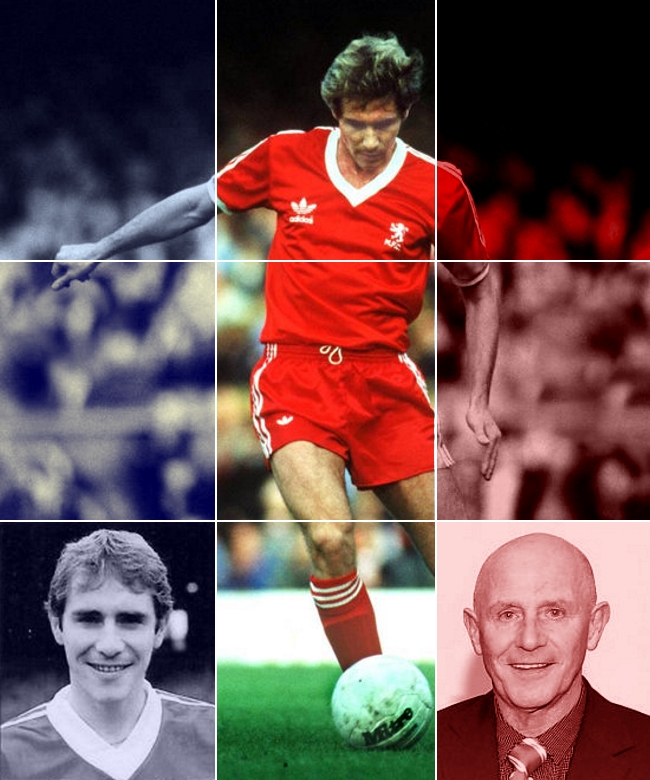
Ian Bailey was born in Middlesbrough on the 20 October 1956 (age 61). Another local lad to play for his home town club, he was an accomplished defender. His best position was as a left back from the years 1975 to 1982 making over 144 appearances. He made his debut for us on Saturday, 20th December 1975 in a 1-0 win at home to Tottenham Hotspur. His long flowing blonde locks used to stream behind him in the wind. Whilst talking to him, I pointed at his head (which was most indelicate of me) and asked what had happened to his blonde tresses. He ruefully grinned and passed his hand over his follicle challenged scalp and replied, “they’ve been long gone, years ago!” Fans may remember the cracking goal he scored against Sunderland at Roker Park which I believe was the only goal he ever scored for the Boro.

Reminiscing, he recalled being involved in a serious encounter in an FA Cup game with our own Bruce Rioch, who at that time was playing for Everton. Rioch made a horrendous tackle on Ian which Jim Platt has said was the worst thing he had ever seen in football. Ian was laid on the ground after the tackle, when both sets of trainers and medical staff raced onto the pitch to attend to him. Rioch was immediately surrounded by both Boro and Everton players who were jostling and remonstrating with him over the tackle. Ian was stretchered off the pitch and fortunately had not broken his leg, or suffered any long-term damage. Not so for Rioch, who was promptly told by the Everton Directors and Manager that this was not the standards expected by their club and he was shipped out of the club a short time later.

Ian Bailey collection 8

After having a great career with his home town club, Ian was signed in 1982 by our own Big Jack Charlton, who was by then the Sheffield Wednesday manager. He made over 35 appearances for them and would have made more, but he broke his leg. He left in 1984 to go to Blackpool, then Bolton Wanderers, but talking to me, he felt that he was never the same player again after his injury. After retiring as a professional footballer, Ian went on to become a physio starting at Rotherham. Whilst qualifying to be a physiotherapist, Ian had to undertake some on the job training and worked with Steve Smelt who was the physio for the Boro at that time. Strangely enough for Ian, the manager at Boro was a certain Bruce Rioch. Now this was a man who was always known for not shirking his duty. He made a point of meeting up with Ian at the Boro and personally apologis ing for that awful tackle he had made on Ian years previously. The apology made, Ian being the nice guy he is, graciously accepted. Incident closed, but not forgotten.

I remember Ian making his way into professional football because I was one of the referees who watched his rapid progress from the juniors, to the reserves and then first team football at 19 years of age. As part of a three-man refereeing team and newly promoted myself, we worked with Harold Shepherdson, who was a wonderful man and a strict disciplinarian. Harold insisted that all the junior players were respectful of all refereeing decisions and would not allow his lads to swear on the pitch. I cannot ever remember Ian being booked or even sternly talked to, so he must have been one of the nice guys. It says a lot for the junior team in those days (which was pre-academy) that so many local lads were turned into professional footballers. The always cold, open field at Hutton Road with the many training pitches, was surrounded by nice houses at the Longlands. The neighbours were used to footballs going over the high wire fence into their back gardens and generally would throw them back. Sometimes if a junior hadn’t been training very well, he was sent off to round up any missing footballs. These were usually located at a house where a large dog was barking fiercely. It certainly encouraged the lads to train well and make sure there were no wayward footballs.

Ian is today the same as he always was, quiet, softly spoken and a gentleman, whose love of football still shines through, to whoever has the pleasure to meet him.

2. The Interview – a quick chat

OFB: What year did you join Boro as a professional footballer?

IB: I joined the Boro in 1975.

OFB: Where did you stay? Did you rent, or did you live in digs?

IB: I lived in Middlesbrough when I signed for the club, so I still lived at home.

OFB: Who was your favourite Boro player that you played with at the time?

IB: It was Graeme Souness, a player with skill and the steel and grit to be a winner.

OFB: Who was the best trainer in the team?

IB: It was the late Willie Maddren who was a lovely lad and used to train very hard, even with a dodgy knee!

OFB: How do you think the match day has changed from the time that you played professional football to the present day?

IB: Everything is done for the professional players these days. The players only turn up for training and for match days. They have masseurs, fitness coaches and someone to look after their kit. They have their strip laid out and boots cleaned and polished, all ready to put on and go out playing. When I was a professional footballer, we had to clean our own boots, do our own warm up routines and stretching exercises and get ourselves ready to play. Mind, thinking back to those days, we wouldn’t have had it any other way.

OFB: When did the team travel for away games, how did they get there, by bus or by train?

IB: We used to set off to away games every Friday and always by coach. We never used the train or charter-planes!

OFB: How many players usually travelled and did the Directors travel with you?

IB: There was usually about 15 or 16 of us in case anyone felt ill the next day. I can never remember any Directors being on the coach with us.

OFB: Did you have nice hotels or was it just bed and breakfast?

IB: It was always hotels and never a bed and breakfast and they were always good hotels.

OFB: Who did you room with for away matches?

IB: My roomy was Spike, the great David Armstrong.

OFB: Who was the joker in the team?

IB: There were always jokers in the Boro team over the years. I do remember though that Brian Taylor and Patt Cuff were comical and funny characters.

OFB: Who was in your opinion the best manager that Boro have ever had?

IB: Without any doubt it was Jack Charlton.

OFB: Why?

IB: Because he was the man who gave me my first pre-contract as a professional player. The other reason is he got the Boro into the First Division in his first season.

OFB: Who is your favourite Boro player of all time?

IB: Juninho

OFB: Who is your current favourite Boro player?

IB: Patrick Bamford

OFB: Do you still follow the Boro, their results and where do you live now?

IB: Yes, I always look out for their result and these days I am retired and live in Rotherham.

OFB: What do you think of the current Boro team?

IB: Presently they look disjointed and they don’t go forward enough especially at home. As a former Left Back, I don’t think Fabio is enough of a team player and is too individual. Unfortunately, I don’t think they will get promoted this year. The midfield is poor and play too many passes sideways and back. The midfield also doesn’t help the strikers and score enough goals. What I do know is I wouldn’t have liked to play against Traore! If it was up to me I would stick him in the middle of the park and play balls over the top and get him to run at defences, he terrifies defenders!

OFB: A huge thank you to Ian for taking the time to talk to Diasboro and our readers.

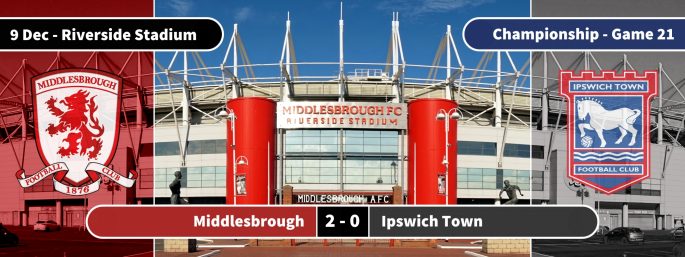
Boro 2 – 0 Ipswich

Middlesbrough Ipswich Town
Braithwaite
Bamford
44′
51′
Possession
Shots
On target
Corners
Fouls
57%
17
 6
 4
14
Possession
Shots
On target
Corners
Fouls
43%
 7
 1
 4
18

Bamford blasts the blues away

Redcar Red reports on Boro’s victory over Ipswich at the Riverside…

Perhaps this afternoon’s game should have been played at high noon to compliment the pre match build up over the last week. For many home fans it was do or die for our Manager after some pretty disappointing results of late. Just about everything was dissected, from selections, tactics, omissions, confidence, and belief right through to potential changing room trouble makers stirring the pot. Regardless of who had or hadn’t done what and when this afternoon was going to be about 90 minutes of football that for many felt would decide GM’s Boro fate rightly or wrongly.

In a game with so much at stake the amateur psychoanalysts amongst us would be dissecting GM’s team selection first and formation second to get a clue of what goes on inside Garry Monks mind. Old tried and tested with Grant and Clayts in the engine room or perhaps three at the back to cover for the wing backs that had been badly exposed lately. Downing left or left out, Traore on the right or on the bench? The eagerly awaited team sheet at 2.00 declared that Grant was indeed restored but partnered with Howson but the biggest change was Bamford starting with Traore dropping to the bench.

The atmosphere was very subdued not helped by the cold and the seemingly growing expanse of Red Plastic with the home crowd now slipping to 22,500. Boro started off bright and lively which was just as well as anything other than a win and a convincing one at that was the order of the day. Paddy was in the hole behind Britt with Stewy on the right and Braithwaite on the left. Within the first ten minutes it was very clear that words had been said about passing it out from the back and passing sideways. The inclusion of Bamford was more than an appeasement or act of contrition from a Manager trying to avoid the sack for the second time in his career on the same day. Paddy was quick, mobile, running into space, looking for the ball and creating, playing clever intelligent passes linking up Britt with the middle of the park and integrating with both Braithwaite and Downing.

Tension filled the Riverside as Ipswich stood firm, frustrating Boro and obviously under instruction to keep their heads, keep Boro quiet and the home fans would do the rest. Celina on loan from Man City had cut through the Boro defence only for Ayala to clear the danger. After 15 minutes the tempo like the temperature dipped a little and the Riverside resembled a still pond. The lack of noise from the stands was deafening, pressure was building but not on the pitch. A roll out from Randolph saw Christie and Ayala closed down quickly and one of those self-inflicted wounds seen so commonly of late avoided as the North Stand vented their spleen at the return of bad habits creeping in. It was exactly this type of slow monotonous passing about at the back build up that has seen us adrift of the play offs let alone automatic promotion.

Downing was looking lively and trying to create while Fabio was a bundle of energy winning a succession of headers as high balls were played out to his flank in an orchestrated attempt to gain a height advantage. Mick’s game plan wasn’t working as the diminutive Brazilian out leapt everyone in a blue shirt timing his headers to perfection. Grant was dominating the midfield and was a true Captain and leader flying into tackles, breaking up play but encouragingly setting up Bamford, Braithwaite and Downing to do their thing. Howson was trying to keep the forward momentum going with a few speculative balls that were being played into space that just weren’t coming off. It was the right approach but a brave one given the quiet nature of the church like Riverside.

A free kick from Stewy fell to Ben who sliced his attempt goal wards only to see Bialkowski get down to save. A quick break out from Ipswich saw Spence their RB surge forward leaving Boro stranded up field and Grant having to takeone for the Team as he simply took the lad out thereby ending any threat. Clearly the Players knew that if Ipswich went a goal to the good the flat atmosphere could quickly turn toxic. You could almost sense 21,000 Boro fans mentally saying to their side “go on then, prove it”.

Just before the half hour mark Downing in a crowded area spotted Fabio free and pinged a brilliant 35 yard cross field ball to the on rushing wing back who hit the ball on the volley only to see it go just wide. At this stage it would have been just reward for Boro as they totally dominated the game and more importantly were showing zest and zeal and looked up for the fight. For the first time in weeks they looked like they wanted it more than the opposition and prepared to put a shift in, none more so than Braithwaite put in a show worthy of the famous battery brand. He was running, chasing, closing down, setting up attacks and shooting himself.

Waghorn was a bit of a pain, moaning constantly and proving a handful and so the inevitable yellow for Ayala came as he clattered through him upending the mouthy Geordie striker. There was definitely more urgency and the intent was much improved but both Grant and Dani had now collected Yellows and after Christie, Randolphs and Ayala’s passing faux pas the home fans were sensing a “Typical Boro” moment. Against Derby we were excellent in the opening 13 minutes until going behind and imploding. Would the Tractor men do the same and kill off the nervy hopes that we all had watching from the stands, too anxious to sing, too desperate to get excited about the more positive slicker Boro, watching in relative silence interspersed with the odd moan about the Ref who seemed to see the game somewhat different from the majority in Red.

There were some really clever enjoyable passages of play namely between Bamford, Braithwaite and Britt but nothing bringing any ultimate joy. Stewy had a wild effort as did Britt as chances were limited and despite playing most of the game in the Blue half no desperately needed nerve breaking opener would come. Someone behind me remarked about what does Downing bring to the team and just at that moment he stopped the ball from going out of play, twisted and turned the Ipswich defender in front of him leaving him unceremoniously on his backside crossing for Britt through a packed 6 yard box, the ball bobbled about before breaking back across to Braithwaite on the edge of the 6 yard box and lashed in a close range right footed shot to lance the boil that had been ready to burst all afternoon. The Riverside was relieved rather than erupted and with only a minute until half time cool heads were required to see the half out.

The second half saw a change for Ipswich as Huws came off and Garner came on but the Ref also retired himself much to the pleasure of those around me with the 4th official taking charge for the second 45 minutes. The half started with Boro still dominant but with a bit more intent from McCarthy’s men with Garner now providing more attacking threat. Five minutes had passed and Christie slid a ball through to Paddy just ahead of Downing and danced his way as only Bamford can towards the 18 yard box. Braithwaite made an opening to receive the ball to Paddy’s left and Britt was running through on goal anticipating the pass but Paddy had other ideas and hit a low shot with the ball going past the stranded Bialkowski hitting the bottom of the upright rebounding into the net. That was the moment the Riverside relieved itself literally with joyous celebrations, going two up, easing the anxiety but most of all to see Paddy celebrate. All afternoon he had been the catalyst which enabled faster more pacier movement and passages of play and the goal was a well-earned and just reward. Moments later Paddy put the ball through for Britt who was just blocked by Knudsen getting back in a last desperate block. Boro were now in charge of the game with Grant bossing the middle, Howson covering when Christie went up field and clattering into challenges showing grit and determination. Celina pulled Grant back to go into the Ref’s book as frustration started building in the Ipswich ranks as they saw their frustrate and niggle policy founder.

Big Mick made a double substitution but the game looked well beyond them at this stage as Christie, Fabio, Downing, Bamford and Braithwaite were running the show with Grant still impeccably pulling the strings. Randolph had become a virtual spectator and GM decided to put on some fresh legs and take a few of his heroes off. Johnson came on for Downing and shortly after Gestede for Bamford. The logic was understandable but once those two went off the impetus was handed back to the Tractor men. Johnson didn’t quite get up to speed and wasn’t as effective as Downing and whilst Gestede won headers and knock downs for Britt they were nearer the half way line than Bialkowski ‘s goal line. Had Ipswich scored the consequences could have been horrific, as it was we held on for those last few minutes and ran the clock down with Forshaw coming on for Grant. All three of those substituted richly deserved their standing ovations. The game ended 2-0 to Boro in what was a really surreal afternoon. A much needed win for the Manager, far more positivity from Boro actually “passing forwards” but it remains to be seen if it is too little too late despite it being only December.

MOM for me was Bamford; his languid grace was the main difference in this Boro side adding intelligence, pace and movement. Special recognition however goes to Downing, Leadbitter, Braithwaite and Fabio who were worthy nominees.

Monk hopes not to come a cropper

Werdermouth previews the visit of Ipswich to the Riverside…

As Boro spent the week preparing for the arrival of the Tractor Boys, Garry Monk has perhaps been left to plough a lone furrow as he searches for a combination that will harvest the three points for Boro this weekend. The question for many supporters though is whether the Boro manager has reaped what he has sown after scattering seeds of doubt among the faithful as the team’s performances have wilted under the heat of the promotion challenge. Others have argued that the current crop of players, which were unearthed in the summer transfer window, have been rotated accordingly but have still been unable to flourish – leaving the managerial prospects of the new boss looking more than a tinge blighted in the process.

Whatever the reasons for the failure of Boro’s team to grow as the season has progressed, one thing is pretty much certain on Saturday, defeat is not an option for Garry Monk. Not only is it not an option but it will most likely leave him facing having to dress up in a red suit and donning a fake white beard if he is to be gainfully employed this Christmas – though he’d probably make good use of the sack for that particular job. Though having said that it’s perhaps not the right job for a man who cancelled Christmas this week – yes, spare a thought for the poor children of the unfortunate Boro players who face the prospect of empty designer Gucci stockings after the long-planned collective Crimbo shopping trip in the bright lights of London was unplugged after the team displayed a somewhat festering spirit against the unfestive Robins.

Apparently it was alarm bells rather than slay bells that started ringing for Garry and he panicked when the players said they’re going to shop until they drop – one thing is failing to gain promotion but talk of a relegation battle was surely a step too far! OK it’s another thing for Steve Gibson to let his managers shop until they drop but the players have already been gift-wrapping presents for the opposition in recent weeks. Though as promotion now seems half a world away, perhaps Steve Gibson will be inspired by the John Lewis man on the moon advert from a couple of years back and start contemplating looking through his telescope to see if he can find a rather thrifty Mogga once the parachute payments run out.

After a good start to the season that left them in second spot, Ipswich went on a run that saw them lose 7 games in the next 10 as they plunged down the table. However, Mick McCarthy’s men seemed to have regained their composure of late and have lost just one of their last six to put them three points ahead of Boro in seventh spot. Defeat for Boro could see the notion of promotion slip out the consciousness for many supporters as it could leave the club as much as 9 points off the play-off pack. Indeed many may start looking over their shoulders as Garry Monk’s team is only three points above 15th place and 4 defeats in 5 would start to look like something more terminal.

Middlesbrough Ipswich Town
Garry Monk Mick McCarthy
P20 – W8 – D5 – L7 – F25 – A20 P20 – W10 – D2 – L8 – F35 – A30
Position
Points
Points per game
Projected points
9th
29
1.45
67
Position
Points
Points per game
Projected points
7th
32
1.6
74
Last 6 Games
Bristol City (A)
Derby (H)
Birmingham (H)
Leeds (A)
Sunderland (H)
Hull (A)
(H-T)
1:2 (0:0) L
0:3 (0:1) L
2:0 (2:0) W
1:2 (0:1) L
1:0 (1:0) W
3:1 (2:0) W
Last 6 Games
Nottm Forest (H)
Derby (A)
Aston Villa (A)
Sheff Wed (H)
Hull (A)
Preston (H)
F-T (H-T)
4:2 (2:2) W
1:0 (1:0) W
0:2 (0:1) L
2:2 (0:0) D
2:2 (1:1) D
3:0 (1:0) W

Whilst many supporters have been vocal in their lack of confidence in Garry Monk, others are seemingly waiting in silence for a change in direction to materialise one way or the other. This pregnant pause in proceedings, following the Bristol debacle, means everyone is now holding their breath in anticipation of what will happen against Ipswich – though I imagine Steve Gibson is surely reluctant to dismiss his third manager within nine months despite this promotion campaign proving to be a difficult birth. Having thrown out the baby with the the bañera-aqua at the end of last season, many Boro followers are beginning to think that there is still much work to do on the discarding side.

What has become clearer, or indeed less clear, as each game has been witnessed and dissected is what is it that Boro are trying to achieve on the pitch. Is it back to the solid less adventurous model that brought Karanka his promotion success? or will we see at any point the supposedly planned expansive game materialise that the chairman sanctioned the spending of all those millions in the summer. The reality is that Garry Monk doesn’t appear to be on message on either of those scenarios – he’s not a manager who looks to organise his team and execute a meticulous game plan – nor is he particularly driven to put out a team that delivers free-flowing attacking football. At the moment we just have a manager looking to just somehow win each game by picking a safe combination of players who just don’t make a costly error.

It’s this almost frozen by fear of failure approach that has left many of the players looking ponderous on the pitch and uncertain of whether to stick or twist when they receive the ball. The free kick just outside the box in the dying seconds at Ashton Gate perhaps summed up the entire season – Nobody wanted the responsibility of taking the risk that the right ball could be delivered into the box that could earn Boro an unlikely point. Instead a meaningless short sideways kick passed the responsibility to someone else and the opportunity was gone in that instance.

At this moment in time I feel almost that I couldn’t tell you what XI should be picked to play for any particular game – there appears to be nobody screaming pick me and I’ll show you what the team are missing. Confidence has left the building and it’s now unclear what it’s going to take to rebuild it other than a string of victories – it’s that Catch 22 situation that leaves the outcome of successful season relying on success manifesting on the pitch. If the players don’t believe in themselves and each other or the manager then this is the stuff that bad runs are made of.

Though for some players, perhaps they are prone to getting carried away after a few good results against limited opposition and forget that there is no right for Boro to win games by just turning up with their multi-million pound teamsheet acting as some kind of Championship top trump card. This kind of talk was for me summed up by an article from early November, which had initially passed me by at the time but a link appeared at the bottom of one about the Bristol inquest in the Northern Echo. Stuart Downing announced ‘Martin Braithwaite is showing he’s too good for the Championship’ adding that he wants ‘everyone connected with Boro to help Braithwaite reach the Premier League’. This is a dangerous thought to have and it’s the kind of mindset that leads to complacency – a couple of good personal performances doesn’t make you into a Premier League player, for that you need to perform consistently well week in week out and take your chances when the team is not playing well. Besides Premier League forwards occasionally attempt to score goals from their own half like Wayne Rooney did last week – not attempt an ill-judged back-pass to their own keeper from within the opposition half.

There is a feeling that it’s possible many players arrived at Boro believing the pre-season hype that they were the Championship supergroup getting ready to go on tour and soak up the adulation and envy of other clubs. Whether the out-of-tune band needs breaking up and some being left to pursue a solo career in self-promotion elsewhere is not certain – but we urgently need a team not a collection of individuals looking for a better gig more suitable for their imagined talents.

So will Garry Monk be able to avoid becoming the next Boro manager to pick up his golden trowel and head off to Middlesbrough Garden City? Or will all the money ploughed into the summer recruitment finally start showing some green shoots of recovery against the Tractor Boys? As usual your predictions on score, scorers and team selection – plus will Steve Gibson be able to spot where his investment on the pitch is hiding with his new telescope?

In2views: Jim Platt

In the first in a series of profiles and interviews, Orginal Fat Bob gives his personal view on the life and career of a footballing guest before sitting down for chat and asking a few questions. Our Diasboro special guest this week is Jim Platt…

1. The Overview – the man and his career

I’ve got to know Jim very well over the last few years and he still looks as if he could play in goal tomorrow for a professional team. He still coaches at the Reds Football Academy with Bernie Slaven, Craig Hignett and Gary Pallister. He has also played regular football into middle age and was once beaten in goal by our own regular of these boards Jarkko! who has never forgotten the experience.

Tall slim and always immaculate, Jim personifies what a former athlete should look like and should not be compared with some of his contemporaries who look a lot older! I’m sure I’ll get some stick from some of them when next I see them for saying that, but Jim does look pretty good.

We signed him for £7,000 from Northern Irish side Ballymena and he went on to become a regular in the seventies and the eighties. During his playing career at Ayresome Park, he had five managers and played 481 games, which makes him (I think), Boro’s fifth highest all-time appearance maker. I’m sure our resident keeper of records, Ken Smith, will check that and correct me though.

jim platt colour

One of our greatest ever goalkeepers, he was a great striker as well. Jim always liked playing up front and was a striker when he was at school, before being moved back between the sticks. He once played for the Boro reserves as a striker at Lincoln and scored a hat-trick. If you can remember those halcyon days, there was just one substitute allowed. Jim was travelling with the team as 13th man, but one of his team mates was ill on the bus. So, Jim was put on the bench and then during the game another Boro player pulled a hamstring after 15 minutes and had to go off. The rest is the stuff that readers of the Hotspur or Roy of the Rovers will feel familiar with. Jim came on and got first a good goal, then another one, this time a tap in and finally a great header which puts him in the history books.

I actually saw him play centre-forward for the reserves when I couldn’t get enough football and used to go to Ayresome Park. These were usually mid-week games on cold winter nights when I wanted to see what players were coming through from the juniors. I took an avid interest, as in those days I was a referee who as part of a three-man team, we used to officiate for all the Boro trial and junior games. It was nice to see the players we thought would make it, including the likes of: Mark Proctor, Craig Johnson and Stan Cummins break into the reserves, then the first team. Jim Platt always caught the eye playing up front and could have made a decent living as an outfield player.

During his long and distinguished career, Jim won 23 caps for Northern Ireland. He undoubtedly would have won many more, but at that time there was another one of football’s great players who was also in competition for the International goalkeeper’s shirt. That was of course, the great Pat Jennings, who also played for Spurs. Jim was also in the Irish team that won the Home Championship, the last time it was played. The former chief scout for the Boro Jack Watson insisted: “If it hadn’t been for Pat Jennings, who was world class, he’d have got more than 100 caps.”

Jim was eventually started to be edged out by John Neal, who brought in Jim Stewart, and exiled Platt with loans spells at Hartlepool and Cardiff in 1979.But both times he played his way back and his form in his later years was good enough to ensure he went to the 1982 World Cup in Spain with Northern Ireland, playing against Austria. His testimonial game included international team-mate George Best, someone that I thought I would never get to see play in a Boro shirt. Best even agreed to sign for the club but then went on a drinking spree and sadly it never happened.

Although fans may know he played for Ballymena United he also acted as their manager for a season from 1984–85, after which he had a longer spell at Coleraine, managing them for six years from 1985 to 1991. In 1991, he had another short spell, this time at Ballyclare, for just one season from 1991–92.

For the 1992–93 season he was given the job of managing Swedish outfit Assyriska, in the Swedish First Division. He had a two-season spell managing Darlington one partly with another former Boro player David Hodgson, then the other from 1995–96, before leaving full-time management to take a job with Gateshead.

He has also previously been Middlesbrough’s Chief Coach at their Football Community Centre and now he acts as a match day Boro ambassador and host. He welcomes guests from the world of football and former players, joining in discussions with fans, reminiscing of past glories and hopeful of new ones.

2. The Interview – a quick chat

OFB: What year did you join Boro as a professional footballer?

JP: I joined the Boro in 1970 at the age of 18.

OFB: Where did you stay? Did you rent, or did you live in digs?

JP: I lived firstly in the MFC Hostel and then we moved out of that and into digs. I hated digs!

OFB: Who was your favourite Boro player that you played with at the time?

JP: It was probably Eric McMordie as he was from Northern Ireland as well.

OFB: Who was the best trainer in the team?

JP: There were several players at that time who were good on the training field. These included the likes of, Derrick Downing and Alan Moody. Later in my career, the best players who showed up well on the training pitch were David Hodgson and Craig Johnson.

OFB: Who did you room with for away matches?

JP: I was a groupie! Several of us used to room together in those days but later in my career I used to share with the late, great, Bosco Jankovic.

OFB: Who was the joker in the team?

JP: Eric McMordie was always playing pranks and was the joker in the pack.

OFB: Can you tell us any amusing anecdotes or pranks that were played?

JP: I remember when we travelled on the train as a team, Cliff Mitchell who was the Evening Gazette Chief Sports writer at the time, used to travel with us. One day we were going to an away game and Cliff who was on expenses went for lunch leaving his beloved trilby on his seat. Eric having the “divvil” in him casually picked up the trilby, slid back the window of the coach and threw it out, to be lost forever. When Cliff came back to his seat, he spent the rest of the journey searching high and low for his hat!

OFB: Who was in your opinion the best manager that Boro have ever had?

JP: Oh! undoubtedly Jack Charlton was the greatest manager that I played under at M.F.C, however, great credit must also go to Stan Anderson. Stan carefully scouted and searched for the players and ended up with and assembled some great players. It wasn’t all plain sailing though, I fell out with Charlton and was dropped for 23 games in 1976-77 in a dispute over where I should be standing at corners.

OFB: Why do you think Jack was the greatest manager?

JP: It was his ability to change things. He could read the game that was in front of him and change the shape of the team and the formation by his astute use of tactics.

OFB: Who is your favourite Boro player of all time?

JP: I don’t really have a favourite player of all time, but I admired David Armstrong who played some 300+ consecutive games for the Boro.

OFB: Who is your current favourite Boro player?

JP: Again I don’t have a favourite player. Let’s be honest it’s a team game and that’s why I’m not a fan of Traore! I would hate to have to play with him.

OFB: Do you still follow the Boro, their results and where do you live now?

JP: Yes of course I do, I will always follow the Boro, they are my team. I had over 13 years and played 481 games for them. As you know, I am here every match day acting as a M.F.C ambassador and host and it’s nice to catch up with old friends and make new ones. I still live locally in Ingleby Barwick and I love being here with my lovely wife and we also enjoy our holidays abroad and back in Ireland.

OFB: A huge thank you Jim for taking the time to talk to Diasboro and our readers.

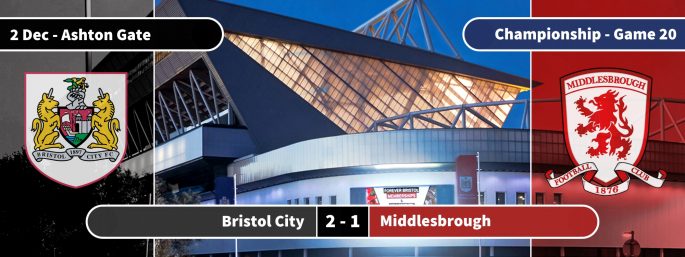
Bristol City 2 – 1 Boro

Bristol City Middlesbrough
Bryan
Paterson
51′
54′
Magnusson 75′ (og)
Possession
Shots
On target
Corners
Fouls
49%
15
 7
 0
10
Possession
Shots
On target
Corners
Fouls
51%
 7
 1
 5
13

Rockin Robins give Boro the bird!

Redcar Red reports on the match at Bristol…

The team news saw Forshaw and Howson paired in the middle with Traore getting a rare start and Dael Fry getting the nod ahead of Shotton. Bristol normally play with tempo and use their height to good advantage so it was going to be another test for Monk’s men. Our inability to beat teams above and around us once again meant that this game had extra pressure on our Manager.

Traore lined up on the left for Boro and was soon involved in blocking a ball played down the wing. Almost immediately he linked up well with Britt and won the opening corner of the game. From the corner Bristol broke with Reid and a Dael Fry header spared our blushes. This was a warning that would go unheeded and eventually be our downfall.

A long through ball over the top of the Boro defence saw Bobby Reid in on Randolph with the Robins first real threat shepherded by Ben Gibson to safety. Howson then had to nip in at LB to block an immediate second attack with the ball fortunately taking a deflection for a Boro throw in. On twenty minutes a slip from Christie when he was trying to launch an attack allowed a break which saw the ball fizz across the face of the Boro goal as the pressure started to mount. Moments later the best chance of the game fell to Bristol when we defended a free kick and a shot from Pack just outside the 18 yard box was cleared off the line by Britt.

Bristol were growing in confidence, gaining a head of steam and Boro had some resolute defending to do. Forshaw was getting involved a lot and a rare threaded ball to Britt was cut out by the Bristol defence. Boro won another corner but Forshaw was penalised by the Ref and the opportunity gone. At the other end Bristol had a throw in accompanied by the Icelandic clap for Magnusson who has a Delap type distance on his throws but with more useful height. Fabio cleared and then as the ball was coming back at us he gave away a ridiculous free kick twenty yards out for a blatant shove. Not the cleverest of tactic from the Brazilian considering that Bristol are one of the tallest sides in the division and set pieces are bread and butter for them. In the last minute of the half Downing squared the ball across to Fabio who hit it hard as Fielding scrambled to get down and deflect the ball away in Boro’s only shot on target of the game.

No changes for either side at half time as Bristol continued to break with pace and crucially precision passing. Traore lost possession and Fabio deserted his LB role then Bristol through a series of fast slick passes of the type we would love to see from Boro saw a cross from the unattended right flank to the far post for it to be headed home by former alleged Boro target Bryan. Boro tried to get themselves back into the game via a confused and muddled free kick on the edge of the Bristol box from which the Robins broke again, even pausing to allow for reinforcements and carved us open again to make it 2-0 in as many minutes. It was a repeat of the second half Derby implosion all over again.

Gestede was brought on for the ineffective Braithwaite on 56 minutes and on joining the action flicked a ball on for Fabio who skewed his cross much to the derision of the home support. Bristol were sitting and picking their moments to simply slice through us. Stewy put another cross into the Bristol box which like most all evening seemed to be sponsored by Flymo as Fabio was laid prostrate in what looked to me like a recurrence of whatever it was that troubled him earlier in the season.

On 66 minutes Johnson came on for Downing with Traore swapping flanks to the right with Gestede supporting Assombalonga up front who had been looking even more isolated since the start of the second half. Boro looked scrappy, lacking structure and second best to 50/50 balls. Once again we were watching us pass the ball around in front of the opposition as our possession stats rose but with no idea of forward or penetrative activity. A corner from Johnson on seventy three minutes summed up our evening as he hit a daisy cutter when Gestede was looking for something greater than ankle height.

A speculative punt of a free kick was easily headed clear by another former Boro target Flint back out to Forshaw who lofted the ball back into the box for Gestede who was unceremoniously upended. The melee presumably distracted Magnusson who headed into his own net. Boro now looked somewhat rejuvenated sensing that they might just nick another. Bamford came on for Fabio with Johnson dropping back and Paddy into the Braithwaite role.

With ten minutes to go Paddy picked out a great ball to Britt but there was just too much pace on the ball otherwise our top scorer would have been clean through. With three minutes of normal time remaining Traore was pulled down and Johnson lined up the free lick with Fry, Gibson and Gestede waiting in the box for the delivery which was knee height and failed to beat the first defender. Assombalonga was wrongly adjudged to be offside when Howson played a ball over the top from deep in the Boro half as we desperately tried to get an equaliser.

Christie who had an uninspiring performance by his own hitherto standards then managed to get himself booked for a shoulder block after being turned at pace. Just as Boro looked to be out of what few ideas they might have had Adama broke from his own half beating three players before Smith took him down for a Free Kick just outside the Robins 18 yard box. Bamford took the free kick passing it back to Howson who then played it wide to Christie and our last opportunity was gone in another negative backwards pass. Even Bamford now seems to be infected with the passive passing virus. Forshaw was our best player today but in reality we just were not good enough to beat a functional, disciplined and hardworking Bristol side that pressed and passed forward at every opportunity, pace and power once again costing us the game.

So here we are in December, six points off that last play off spot and I witnessed absolutely nothing that showed improvement in organisation, attitude, ability, tactics or belief. The Tractor Boys are up next and I fancy the wily experienced McCarthy to walk away with all three points next Saturday at the Riverside. 13 points off a relegation spot and 14 points off an automatic promotion spot. It is up to SG if or when he acts but I have seen nothing for a while now that makes me feel that we are a work in progress and that things are falling into place, more like things are dropping off and falling apart.

Boro need to shape up at Bristol

Werdermouth previews the trip to Ashton Gate…

Boro travel to Bristol for Saturday’s late afternoon televised Championship ‘main event’ in what is quite probably a must-win game for Garry Monk’s inconsistent promotion hopefuls. As we approach the halfway point, the Robins are bob bob bobbin’ along quite nicely in the play-off positions having spent less than a quarter of what Boro threw at the market. Following the resumption of hostilities after international break, Garry Monk’s promotion vessel seems somewhat in the doldrums after two defeats in three games took the wind out of their sails. His accident prone team are shipping goals alarmingly and still don’t look like shaping up into contenders of a similar fashion to that of those Bristol cruisers.

The Robins have not fallen away as the promotion race has heated up and lost just one of their last six games. Their less expensively assembled attack has already notched up 30 goals and Boro could find themselves three wins behind the Bristol outfit if they lose at Ashton Gate – plus quite likely falling down a tightly packed table. Surely this is a game Garry Monk’s team need to win if they are to keep in touch with the play-off pack. Automatic promotion is a boat that the Teessider’s have almost certainly missed with Wolves already five wins ahead after nearly half the season gone and Cardiff pretty close behind. To catch them up, Boro would need to emulate their impressive 75% win rate and then hope they dropped to our less impressive 40% one. In fact Boro need to up their points per game to nearly 2.4 (which essentially means 4 wins out of every 5) for the rest of the season just to reach the 2 points per game average.

Bristol City Middlesbrough
Lee Johnson Garry Monk
P19 – W9 – D7 – L3 – F30 – A20 P19 – W8 – D5 – L6 – F24 – A18
Position
Points
Points per game
Projected points
5th
34
1.8
82
Position
Points
Points per game
Projected points
7th
29
1.5
70
Last 6 Games
Hull (A)
Preston (H)
Sheff Wed (A)
Cardiff (H)
Fulham (A)
Sunderland (A)
F-T (H-T)
3:2 (0:1) W
1:2 (0:1) L
0:0 (0:0) D
2:1 (1:1) D
2:0 (2:0) W
2:1 (1:1) W
Last 6 Games
Derby (H)
Birmingham (H)
Leeds (A)
Sunderland (H)
Hull City (A)
Reading (A)
F-T (H-T)
0:3 (0:1) L
2:0 (2:0) W
1:2 (0:1) L
1:0 (1:0) W
3:1 (2:0) W
2:0 (1:0) W

Whilst we generally admire the long-term nature of Boro’s approach when it comes to the running of the club and making appointments, perhaps we have misjudged the recent nature of football and the shorter-term goals in which it now operates. Given the disparity in the financial rewards between the top-flight and the second tier, Boro have a very limited time-frame in which they must achieve their goal within the budget constraints. It is almost meaningless to imagine there is such a thing as a long-term strategy that can exist in a consistent form for more than a season or two. Any club must radically adapt to the cost of failure as the options available get reduced year on year – the majority of players who can play at a higher level will move on as the market pulls the levers and the window of opportunity that presents itself is either taken or lost by those who have them. For example, should Ben Gibson, if he wants to play at the highest level, contemplate turning down offers in the summer unless he’s absolutely convinced that Boro are going up? His form peaked under an ultra-defensive coach and he indeed he may beginning to wonder if his stock is still high enough to get him back onto the gravy train.

Are the club hierarchy actually actively measuring progress or even questioning the apparent lack of it? If so, other than results, what is that measure? You could easily argue even measuring performances under Monk would maybe be less satisfactory than points or position would be. Presumably it must soon becomes a question of whether the manager or head coach is demonstrating that he is capable of delivering the desired outcome in what for Boro is a two-year time period. After two seasons the option probably becomes either a one season gamble of front-loading the resources before the need to make severe cuts to stay within Financial Fair Play (FFP) or a new two to three year plan back on to average Championship spending where Boro are no longer able to force the market.

The puzzle for many looking back is that Boro’s transfer strategy in the summer appeared to be out of sync with the actual time-frame we had to work within. The mantra was the tried and the tested – but having tried and tested most of them they don’t appear to have passed. Also the signing of young up-and-coming players who needed more experience and pitch time doesn’t seem to fit with what is actually needed to achieve our short-term set goal. We can ask when was it exactly that Ashley Fletcher was supposed to make an impact? £7m is a lot of money to invest in a project who is not able to get game time and develop – he just doesn’t seem to fit into the urgency of the task. Though that price range for Boro has been the going rate for projects in the last year or so – Adama, Bamford and Gestede were signed for similar fees but deemed not ready to play and nearly a year later are no nearer becoming first choice players. In fact is more likely they never will be as time progresses. As for those in the £3m price bracket – well Shotton has at least proved to be of similar value to Guedioura and de Pena.

We don’t know if the squad assembled was specifically designed to suit Monk’s requirements or was part of a more general collective shopping list that the chairman deemed necessary to make the team more attack-minded in view of last season’s failings. Though many are still unsure of what the manager’s footballing philosophy is – he seemed to go back to basics around six weeks ago to make the team more solid and has shown little to suggest he needed the large number of attacking players that Boro eventually signed. In fact when Monk first arrived at Boro he was rather coy about what his style of football is and preferred not to put forward a label but simply said that he’d “leave his style and philosophy for others to describe as the important thing is to win games and that is the purpose of how he trains himself, his staff, players and club” – he added that his footballing philosophy sat on top of that ideal and he believes the key is to get the crowd engaged and the players engaged. It’s not clear if that statement can now be interpreted as meaning he doesn’t have an overall idea on what methodology he wants the players to adopt – it may not be important but this season may have shown he knows more about what he doesn’t want than what he does.

Unusually for Boro by recent standards, they failed to use the loan market effectively – the only two to arrive have become almost anonymous with Baker gone from the first team picture and Connor Roberts unlikely to get a game unless Christie is out. This lack of action may put off any future recruits from opting for Boro but it may be the only route open to the club in January to persuade creative players with something extra to join the party.

The feeling among many supporters is that there isn’t a coherent strategy on the pitch and Boro are still a collection of individuals rather than a team. The initially surplus Downing has become a key player for Monk but you could argue he still has no end product with I believe no goals and just one assist to his name this season. It’s a stat made more stark if you think he’s probably taken over 50 corners this term – what has happened to the idea that a set-piece is a goal scoring opportunity at Boro? So few now expect a goal from a corner that I wonder why the supporters still cheer when we get one. The irony about Downing’s stats is that he’s keeping Adama out of the team because it’s deemed he doesn’t have an end product – though Traore actually has two assists in 50% less minutes on the pitch. Either way not exactly inspiring figures from either man.

The main problem that was not resolved in the summer transfer windows was one of creativity – Boro still have a mainly one-dimensional defensive central midfield and nobody to supply the strikers. Assombalonga is a fish out of water outside of the box – though that particular analogy is perhaps a little strong as a fish out of water is normally a dead fish, maybe more a penguin out of water or even a seal – he just needs someone to feed him a bucket-load of fish and preferably not red herrings.

The season hangs in the balance and we have learned more about its failings than its successes – central defence is no longer reliable and the full-backs have become more like attacking wing-backs without protection. Our central midfield are the former defensive shield who look puzzled by the additional responsibility of passing the ball forward – to the extent that they serve neither purpose. Braithwaite blows hot and cold but mainly blows while Britt runs around waiting for the ball. None of the attacking wide options have so far delivered with anything like the consistency required and the result has been Boro have only had enough in their locker to see off the failing teams at the bottom of the table.

When Captain Monk set sail in August, we were told by those who built the good ship Boro that the state-of-the-art design was unsinkable as it embarked on its journey back to the new world of the Premier League. However, with winter approaching and despite heading towards the iceberg of all frosty end-of-season receptions, there appears no sign of changing course in this titanic battle to gain promotion. The Boro manager hasn’t quite got to the stage of rearranging the deck-chairs yet but when he does he may consider using some of those which were there before he arrived. Steve Gibson has probably been made aware that there may not be enough lifeboat payments from the Premier League to allow the club to survive too long in the icy waters of the Championship – at some point he may have to wrestle the wheel away from his relatively inexperienced captain if his dream is to stay afloat.

So will Boro keep their season afloat and steer a course through the troubled waters at Bristol? Or will the promotion pack sail into the sunset after a listless performance from Garry Monk’s press-ganged crew? As usual your predictions on score, scorers and team selection. – plus will first mate Rudy be back up in the crow’s nest to catch a glimpse of the promised land ahoy.

Talking Point: Finding A Voice

Now five months into his tenure, Simon Fallaha puts forward the suggestion that if Garry Monk is to make his mark, or find a voice, at Boro, he should not discard the past altogether but instead learn from it, building on the right positives

Bryan Robson, Steve McClaren and Aitor Karanka are the three longest-serving, and also, interestingly, my three favourite Boro managers since 1994.

Why is this? Opinions have never seemed so divisive as they have during their tenures. Be it the football, the recruitment, the press conferences, the image, the man management (or lack of it). It is swings and roundabouts, and it is also true that they were given a lot of money to spend, as our current boss Garry Monk has been.

But, in each case, I don’t think anyone can doubt the mark all three have made on the modern Boro story. Like Gareth “Arsenal-lite” Southgate, Gordon “Jockification” Strachan and Tony “One Of Our Own” Mowbray, they had a distinct voice. Unlike those three, they had the greatest means to implement it. And in doing so, they became masters of what I’d like to call the “Big Moment”.

Where do you want me to start? Uwe Fuchs. Promotion. The Riverside Stadium opening. Juninho. Emerson. Fabrizio Ravanelli. Home grown and adopted Teessiders making a mockery of the Manchester United defence. The old Wembley, twice. Paul Merson. Marco Branca. Promotion, again. Hamilton Ricard. Victory at Old Trafford, three times over. Benito Carbone. The Southgatian punch. Juninho, again. Bolo Zenden. Cardiff. Our first foray into Europe. Jimmy Floyd Hasselbaink, Mark Viduka and Aiyegbeni Yakubu’s goals. Beating the Premier League’s top three at home in the same season. The Road to Eindhoven, though not the denouement.

And, under Karanka alone? The Anfield penalty marathon. Looking Manchester City in the eye in that memorable victory at the Etihad. Grant Leadbitter’s celebrations. Tomlinho. Patrick Bamford’s breathless opportunism. La Bamba. Tomas Mejias, blunderer turned Old Trafford hero. Brentford at home in the play-offs. The new Wembley, though, again, not the denouement. A heart-warming Ali Brownlee tribute. David Nugent against Hull. Jordan Rhodes at Bolton. Brighton, both home and away. Pitch invasions and promotion. Gaston before Gasgone. Adama Traore terrifying Arsenal. Marten De Roon at City. Alvaro Negredo at the King Power, though, yet again, not the denouement.

There’s a trend emerging here, for better or worse. In isolation, these moments would make a wonderful story, critic-defying triumphs against the odds, pessimism to optimism, the ridiculous to the sublime.

But it is not wise to treat them in isolation. They should be seen as part of a bigger picture. One should not overlook that these very same big moments betrayed all three managers in the end, and Boro themselves.

It is seductive to lose oneself in the romanticism of it all, to simply embrace the moment while one can, and to tell the party-pooping naysayers to stop raining on the parade. To simply worship the heroes and smile about the memories. To appreciate who, what, when and where… without asking why.

There’s the rub. Boro’s “best” managers post-Lennie Lawrence, and indeed many of the fans during that time – me included, I’m not ashamed to admit – could all be accused of living for the moment and not contemplating the consequences. Being content with the occasional moment in the limelight, because, after all, we’re only Boro, and shouldn’t expect anything more. Being strictly sentimental when reflection is also called for.

As literary critic Alan Jacobs once implied, reflection strengthens true emotions while exposing feelings that are shallow and disingenuous, whereas a purely sentimental approach avoids reality and tries to keep people from asking questions. Questions that, when at least attempted to be answered, could provide more of an idea about why Boro continuously fail to make the most of the greatest opportunities that present themselves. And give more of an insight, perhaps, into how the same Boro that were dismantled by Aston Villa could dismantle Chelsea the following week, or the same Boro that ran on empty at home to Watford could fearlessly take on Arsenal soon afterwards.

Or how, to use a more recent example, Karanka and his collective alarmingly metamorphosed from being efficient, effective and in control to panicky, fearful and doubtful. A miniature self-destruction engineered by nerves, mind games and a cup defeat, after which which the manager and his team never regained their aura of invincibility. What once seemed wonderful turned toxic, narratives of “incompetent” coaching and “victimised” players staining the public face of the club in such a way that we are still reeling from it even now.

What to make of Garry Monk’s Boro? Or Boro as a whole?

Last year, we came “home”, to the Premier League, after a long hiatus. Today, one could be forgiven for thinking that Boro are homeless, unsure of whether they should be bouncing back immediately or treating this as a season of transition with a possible promotion charge.

So far, Monk has given us what I can call, at best, a handful of “little big moments”, aspects which, if reflected and built upon, could guide his Boro towards finding a voice for themselves. Traore bouncing off from what wasn’t really a naughty step to terrorise Bolton, coming from behind to win twice in the same game, a new goal hero in Britt Assombalonga, and Bamford’s playmaking and goalscoring attributes, at least until he lost favour and form. There has even been, to a point, Rudy Gestede’s redemption. Once seen as superfluous, he is now much missed in attack.

These “little big moments” arose from the creative and industrious sparks that our midfield and supply line has so conspicuously been lacking in for years. Two years ago I made the point that it is midfield, not strike force, that defines a club’s season, and I stand by that. Without the right support, strikers cannot thrive fully. Without the right protection, a defence cannot fully function. A combination of character, leadership, organisation and skill, not just organisation and skill.

“Character is just as important as skill.” When he said those words, Roy Keane was referring to Arsenal and what made the difference between Arsene Wenger’s champions of the past and stable nearly men of the present. And it was what made the difference for Robson’s, McClaren’s and Karanka’s Boro, in a big way.

Grant Leadbitter was Karanka’s Nigel Pearson, or Gareth Southgate, in that he was so much more than a player. He was, and still is, a leader, offering presence and character that still can’t be found anywhere else in the squad. Boro are not the same without him. Arguments that he will not last forever, he is now in his thirties, his engine is not what it was and Boro shouldn’t still be so reliant on him are all valid, as is the belief that transition is necessary in football and that bringing in the likes of Adam Forshaw, Marten De Roon and Jonny Howson was crucial for freshness and continuity.

Towards the end of Karanka’s reign, however, it was hard to ignore the suspicion that the manager was not so much naturally transitioning as attempting to maintain total control. Karanka was renowned for wanting his own way, something far more likely with an eager, willing newcomer than an independently-minded thinker. And the more prominent that mindset becomes, the soul continues to drain from the team until they are a shadow of what they once were, let alone what they could be.

Nowadays the absence of Bamford and Traore, neither of them Monk’s signings, has raised eyebrows. Regardless of unreliability, one knows what these players can offer to the team, and one would be disappointed if Monk was not to make use of their qualities accordingly at the expense of proving that his signings are the right ones. In other words, he should follow what Karanka did at the beginning and not at the end – build on the right strengths, making the most of the resources left to him.

Giving Monk the keys to the transfer treasure chest so soon has done him and Boro no favours, presenting the image of someone too keen to undo the sterility of the defensively-minded, deeply divisive regime that played its part in splitting the club. Often, those keen to highlight the negative aspects of a previous regime – I won’t go into all that here – tend to forget why we believed in it to begin with.

For eighteen months Karanka’s Boro were, for the most part, an imperious collective – and why? I take you back further, to Jack Charlton’s Champions of 1973-74 and Bruce Rioch’s Promotion Heroes of 1986-87 – the only teams to concede fewer goals than Karanka’s Boro circa 2015-16 since the war – and ask you to note that while, to the paying customer, goals are football’s oxygen and all that, having a rock solid defence gives you confidence, a feeling of relaxation. For if you take the lead, the game is almost certainly yours. When the right foundations are there, everything else will follow, and not just on the pitch.

However. The next step, which Karanka and even Robson proved incapable of taking, was evolving, not retreating. A year into Karanka’s reign and I couldn’t believe how confidently we passed the ball and how sublime some of our team play was, even if it was constrained by a safety blanket. Robson’s Boro were laughed at and ridiculed in 1996-97, and not unreasonably so, but we will never forget daring to, and living the, dream. Both managers, however, retreated when faced with pressure, playing it safer. In each case the mercurial and spontaneous were gradually eschewed for the workmanlike and dependable. Were Stuani and Nugent, or Deane and Ricard, as eye-catching as Tomlin and Bamford, or Juninho and Ravanelli?

It was a retreat. And while the results may have improved, the football didn’t. Passivity, and protection, had replaced activity and initiative. If a manager and a club harbour ambition, this is fatal.

Especially when spending a lot of money on players and aspiring to fit in with the top clubs in a division, something that Monk’s Boro have set out to do. We came to associate Karanka with fear of failure, but there’s also such a thing as fear of success. It’s also known as the “I want to be sure I’m ready for it” mentality, something that stops a club from getting what they really desire. Thus they stand still in time while everyone else goes for it. Like, say, Bournemouth. They weren’t expected to, and, at least financially, had no right to reach the Premier League, but went for it anyway and are finding their way. They’re a club Monk could learn from.

Now, one may conclude that freedom of expression for our attacking players is the answer, full stop. I’ve heard the “We have some good players, just let them play” argument before, and am aware that if too many individuals subvert their skills for the sake of a collective it is doomed to fail. But if a manager wants to find a voice, to make his mark, freedom alone is not the answer – a lasting impression is not solely created by players, but also by the restrictions imposed by the man in charge. Each restriction or order imposes upon the team makes it more distinct. Freedom on its own means chaos, which ultimately means boldly going nowhere.

That’s where I unfortunately feel Monk’s Boro are right now, and will continue to be unless we find a voice. It might be time for Monk to show his authority, to stir the players up a bit and make them take notice. It may well have reached the point where the players have “become complacent and started taking advantage. They might have done nothing wrong, just become a bit blasé about the results or their performances… It is then you have to crack the whip.”

So spoke Jock Stein to Jack Charlton in 1973 – and we know exactly how well the following season turned out for Boro.

Boro 0 – 3 Derby

Middlesbrough Derby County
Ayala 60′ Vydra 13′
47′ (pen)
63′
Possession
Shots
On target
Corners
Fouls
59%
16
 2
11
12
Possession
Shots
On target
Corners
Fouls
41%
13
 8
 6
10

Ram Raid Rocked Riverside

Redcar Red reports on Derby’s victory at the Riverside…

Bright winter sunshine lit up the Riverside on a cold and freezing afternoon as Derby and Gary Rowett attempted to end a ten game winless jinx at the Riverside. Both sides looked fairly well matched on paper at least judging by their respective league placings but the Rams have a game in hand and all Boro’s victories were largely against the bottom feeders so this afternoon was going to be a real test for Garry Monk.

Boro were without the suspended Howson and Bradley Johnson was missing for Derby due to a Hamstring which pleased me personally because I always felt he was a real nuisance any time Boro faced him. It was the first time since that Brighton game that Nugent would be back at the Riverside, hopefully he would make an appearance but if it was to be then the hopes also wished that it was to be an ineffective one. Gary Rowett’s men have been hard to beat on their travels this season suffering just two defeats in their last ten away days.

The team news was that Grant was only fit enough for the bench (I would have thought either you are fit or not fit?) so Forshaw as expected started as did the forgotten Clayts, recalled from the wilderness in an entirely new look midfield for Boro. Surprising for some Johnson had kept his starting berth with Paddy and Adama on the bench. Nugent was in the starting line-up for Derby a selection we would later live to regret. As the teams came out the winter sun had dipped and there was now a decidedly icy feel in the air.

The opening 13 minutes saw some of the best football from Boro for a long time with balls down the flanks played into the Rams box repeatedly. The one sided dominance was such that it looked like Derby were in for a torrid afternoon. Carson pulled off a reflex save from Britt to prevent Boro taking a deserved lead. Then Derby broke free from the onslaught down the their right wing. Gibson came across to help out Fabio but instead of shielding, clattering or tackling the attacker rounded Ben with ease, played a through ball between Fabio and Clayts to Vydra past Forshaw and a quick one two with Nugent saw the ball in the back off the Boro net totally against the run of play. Fast, slick, pacy and powerful football, not a dithering moment or backwards pass in the entire build up, not even a lumped in cross just on the ground direct football.

That single solitary goal knocked the stuffing out of Boro, hopes, belief and confidence just visibly drained from the faces of the Boro players after that sickening blow to an otherwise very positive start. When Boro restarted the game Nugent went flying into the Boro half chasing the ball with vigour resulting in Ayala clattering his former team mate and taking a yellow for his troubles. If it wasn’t bad enough conceding you would think we could restart the game with a bit of drive. Derby and Nugent in particular knew that we like to pass the ball around like pensioners playing pass the parcel at an incontinence fund raiser. Hassle, pressurise and confuse by closing down quickly and the floor becomes very wet around those in possession.

The next 20 minutes or so saw Boro looking sheepish, plenty of possession and lofted crosses but not with the style and swagger in those first opening minutes. Derby were not going to push us too much and seemed happy and content with their one goal advantage. Carson must have wasted over 5 minutes himself just taking goal kicks yet the Officials seemed oblivious to the time wasting. Fair play to him, Derby hadn’t won at the Riverside in 17 years and this was an opportunity not to let slip.

The last ten minutes of the first half saw Boro start to shake off their woes and begin firing on all cylinders again as they ended the half in the same manner in which they had started. We possibly saw some of the best Boro build ups and moves this season yet we were a goal behind. Surely after a half time team talk, extra application, and determined focus we would come out and grab an equaliser and push on. We had all the possession and were by far the better side it was just a matter of time.

I don’t know what happened in the Boro dressing room at half time but it clearly didn’t gee them up or have them coming out fired up. If I was a betting man my money would have been on them taking a nap because they fell asleep straight from the off. Braithwaite dawdled and passed back (which was something we actually excelled at all afternoon) why? I have no idea, I actually think he was confused and hadn’t realised we had changed ends and were still shooting towards the opposite goal. It wasn’t just a bad back pass it was unbelievably unnecessarily stupid beyond belief. It was the sort of ball that would have Far East bookmakers launching a frenzied investigation had there been a huge bet on Derby scoring in the 46th minute. Nugent raced on to that suicide ball, played in Vydra who was up ended by the already booked Ayala. Straight Red card most of us feared yet he stayed on the pitch thankfully much to the annoyance of the away support.

The resultant penalty was despatched with confidence by Vydra for his and Derby’s second of the match. At this point Ayala had become a serious liability especially when considering his grappling and flailing arm display at Leeds just 6 days previously. GM had to remove him from the fray and put on Dael Fry yet he somehow didn’t see what 23,000 odd could see was going to happen. We know that when Dani is on fire he is brilliant but we also know that he has his off days and with it the odd rick in him. This penalty wasn’t of his making, that blame lay squarely at the feet of Braithwaite but to remain on the pitch was about as fortunate as GM and us Boro fans could have wished for. Take the good fortune and get him the heck out of there surely. Bizarrely Ayala remained on the pitch which left me surprised and shaking my head at the gullible naivety of GM.

I didn’t have to wait long before the absolute bleeding obvious happened and headless Dani clattered into a stupid challenge over the half way line in the Derby half to give the Ref the easiest second yellow and sending off decision he will ever have to make in his entire career. Now 2-0 down and down to ten men and to rub salt in the wounds it was Nugent who was the justifiably aggrieved party picking himself off the floor.

As Boro resorted to default passing sideways and backwards ever more so it was Nugent again who chased a lost cause down the Derby right forcing Fabio to try and find Randolph with a rushed back pass only for the ROI stopper to slice his kick and present Vydra with the opportunity to smash it past him for his hat trick. My hope is that if Randolph was going to drop a clanger then it may as well have been in this game because there was absolutely nothing from the moment the second the half kicked off that made us hope that Boro would mount any further threat. It was a series of balls back to Randolph interspersed with the odd Forshaw Cryuff turn to nowhere before then passing back or sideways.

All momentum, ingenuity, organisation and discipline had gone. Fry came on too late to shore up a pitiful back line let down by a dysfunctional midfield and poor Britt was isolated and alone. Downing and Fabio tried and along with Christie showed some effort but from the opening brilliance to sheer abject garbage was beyond the effort of just three individuals. The Derby fans oleyed every pass as Randolph had to save further Boro blushes. Adama had come on but it was too little too late. Bamford too was brought on but again too little too late. The lack of in-game management meant that instead of changing things around we just continued rolling it out from the back putting ourselves straight back into trouble.

There is no way a manager can be held responsible for a player losing his head and being unprofessional but having been given a get out of jail card free and not hooking him is culpable. Interestingly I had said earlier in the week about Braithwaite looking a different class at times but as yet there is just something that I’m not quite sure off, well after that back pass he would have been hooked within seconds and replaced immediately by me. I’m sure our previous Manager would have done that and probably start speaking to him again by next Easter if he was lucky.

It started brilliantly; it clicked but fell apart and derailed all too easily and quickly. Another team at the sharp end of the table that we fail to beat and worse still let humiliate us. To me this isn’t just about this one game, there is a pattern emerging and one that after 19 games of a clunky, spluttering, “time to gel” season is not a coincidence nor a series of unfortunate events. Team selection, tactics, devoid of a settled plan or pattern is blindingly obvious. A Leeds fan said (very smugly) to me last week that I shouldn’t get so worked up and expect so much, Boro have a manager who will keep us in the top half, even top third but hasn’t the ability to go any higher. I think he is right and the more I reflect upon our season I’m convinced he is. Unless we are playing the bottom six sides we are totally out of our depth and Bolton apart and periods of Hull I haven’t seen anything to convince me that my smug Leeds colleague is wrong.

This was the third draft of the match report, believe me I had to edit out huge swathes of observations and tone it down before settling for this version. The team, tactics and direction simply fell apart and whilst certain individuals undisputedly let the team, manager and fans down today I suspect it was symptomatic of a deeper underlying cause. I have seen it before and I know it will have to wait until it becomes ridiculously unbearable but something has to change, no doubt it will as usual be too late.

My MOM was Nugent, by far the best Boro player on the pitch, just a shame that he was playing for Derby, at least the Boro fans showed their class and gave him a good ovation when he was subbed.

Boro hope to ram home advantage

Werdermouth previews the visit of Derby to the Riverside…

After the arguments last week of whether Leeds was still a derby game, there is no doubt that the game on Saturday is definitely the Derby game. In midweek, Boro got their promotion aspirations back on track following the disappointing display last Sunday at Elland Road with an improved performance against Birmingham. Admittedly the Blues were possibly the least effective side to turn up at the Riverside this season and Garry Monk’s team did enough to get the job done without overly impressing.

The Rams should prove a much sterner test this weekend as they currently sit level on points with Boro just behind on goal difference but having played a game less. We now know Boro can generally overcome the opposition at the foot of the table and happily the current bottom six have all been defeated by our expensively assembled team with 13 goals knocked in. Boro have fared less well against teams in the top half with just the Blades being put to the sword early in the season – the other six games saw four defeats and two draws with just 3 goals in those 7 games. Is that telling us something? Probably, but maybe it’s only telling us that Boro are failing to overly trouble teams that are not low on confidence and ability.

Despite the win over Birmingham and signs that Boro had actively tried to be more adventurous going forward, the team failed to go on to the next level against limited opposition. Indeed, they actually did what I suspected and mentioned in the match preview after scoring – they relaxed and took their foot off the gas and seemed to lose their initial intent as the Blues appeared to get back in the game before a sublime pass from Fabio and a clinical finish from Assombalonga meant the points were staying on Teesside. Boro will not have a chance to win on Saturday unless they keep at it for the whole 90 minutes – this is what we need to see against the better teams. Derby’s form going into the game at the Riverside is pretty good – slightly better than Boro’s with 13 points from the last 18 and usually a couple of goals in the opposition net.

Middlesbrough Derby County
Garry Monk Gary Rowett
P18 – W8 – D5 – L5 – F24 – A15 P17 – W8 – D5 – L4 – F26 – A20
Position
Points
Points per game
Projected points
6th
29
1.6
74
Position
Points
Points per game
Projected points
7th
29
1.7
78
Last 6 Games
Birmingham (H)
Leeds (A)
Sunderland (H)
Hull (A)
Reading (A)
Cardiff (H)
(H-T)
2:0 (2:0) W
1:2 (0:1) L
1:0 (1:0) W
3:1 (2:0) W
2:0 (1:0) W
0:1 (0:0) L
Last 6 Games
QPR (H)
Fulham (A)
Reading (H)
Leeds (A)
Norwich (A)
Sheff Wed (H)
F-T (H-T)
2:0 (1:0) W
1:1 (0:1) D
2:4 (0:2) L
2:1 (0:1) W
2:1 (1:0) W
2:0 (1:0) W

Like many relegated clubs, Derby County have struggled to regain their top-flight status after they parted company with the so-called elite clubs just over 15 years ago. The post-millennial Derby lost their Premier League status in 2002 after six seasons at the top table, which saw them have three different managers in Jim Smith, Colin Todd and finally former Villa boss John Gregory – it was also incidentally the season in which former Boro striker Fabrizio Ravenelli and soon to be Boro striker Malcolm Christie were the club’s joint top scorers with nine a piece.

Relegation saw Derby’s financial problems mounting with debts approaching £30m, which were mainly owed to the Co-op Bank. The bank appeared quite co-operative in striking some kind of deal with potential owners, John Sleightholme, Jeremy Keith and Steve Harding – whereby if they could stump up £15m, the club would be placed into receivership and subsequently sold to the three men for just one pound each. This deal cost many creditors a considerable sum of money, including the former chairman, Lionel Pickering, who had taken control of the club shortly before previous owner Robert Maxwell made his final drop in the ocean and was instrumental in the move to Pride Park. Pickering’s loss proved pride does come before a fall as he got dropped in it when he lost £12m thanks to this deal – with significant shareholder and Derby supporter Peter Gadsby also taking a hit too.

The £15m later transpired to be a loan from a company called the ABC Corporation based in Panama that would charge an annual interest of 10%. The new directors, dubbed the ‘Three Amigos’ by supporters, claimed (in what is becoming somewhat of a familiar story) they had no idea of the identity of those who had loaned them the money – though a later investigation by the journalist David Conn (yes him again) claims that the most likely source was Michael Hunt, the former Nissan UK managing director, who in 1993 was sentenced to eight years in prison for his role in the UK’s largest ever tax fraud. In any case, they had engineered a deal to gain them control of the club for just three pounds.

Clearly the financially struggling club needed astute new management to turn them around, so it appears somewhat surprising that former barrister and coroner Sleightholme invited his friend, the Glaswegian ‘businessman’ from the Outer Hebrides called Murdo Mackay to the party. You may have thought any new appointments may have been closely scrutinised but it apparently went unnoticed that Mackay’s history included being a director of five companies that were struck off for failing to submit accounts, personal bankruptcy after his recruitment agency MMK went bust and the liquidation less than a year previous of his venture ‘Inside Soccer Recruitment’ that left the tax man and creditors owed nearly £160,000. Mackay ended up in the role of Director of Football as he’d apparently taken his coaching qualifications whilst working as a player’s agent, though his relationship with manager George Burley was frosty as he was accused of trying to interfere with team matters, which caused Burley to eventually quit his position.

Though it was in regard to the repaying of the £15m loan that caused the most outrage – Pride Park was sold to the to the ABC Corporation and in return was then rented back to the club for £1m per year. It later came to light following a three-year investigation by Derbyshire Police that Murdo Mackay, along with one of the one pound buyers, Jeremy Keith and long-time club Finance Director Andrew McKenzie did a secret deal shortly after the takeover without board approval to sell the stadium in which they were all personally paid £125,000 plus VAT in commission. They then hid this deal by routing the payment from Derby County to a third-party company using a false invoice for the combined sum of £440,625. Mackay and McKenzie were subsequently sentenced to three years in prison for conspiracy to defraud, with Jeremy Keith sentenced to 18 months for false accounting.

After this shabby affair, millionaire property developer and former shareholder, Peter Gadsby led a consortium to buy out the club in 2006. After the takeover, Gadsby and his consortium looked for a manager who could rebuild the weakened Derby squad, which had just one recognised striker, who we now know as Karren Brady’s husband, Paul Peschisolido. The man they decided on was that firework of a character Billy Davies, who is best not returned to when lit in case he explodes in your face unexpectedly. The consortium also started to clear some of the club’s debts, which somehow had risen to over £50m, as well as returning ownership of Pride Park back to the club – they even still had a bit of loose change to provide Davies with a respectable transfer budget. It all paid off when Davies finished in third place and then defeated West Brom in the Play-off final to secure promotion to the Premier League.

However, the joy of Derby’s return to the top-flight was short-lived as the club had a poor start to the season. Games 13 saw the unlucky Billy Davies seemingly engineer his own dismissal by ‘mutual consent’ after he went off unexpectedly following a rant against the board over poor signings. Though his team had shipped 31 goals in those opening games and their form was so bad that they even only managed to beat Newcastle 1-0, which would actually turn out to be their only win of the season. In fact so confident were bookies Paddy Power of their inability to escape relegation that they had already paid out to punters who had backed them for the drop after only five games following an inept 6-0 defeat at Liverpool. Such was the fans anger at the board’s apparent lack of investment in the team that October saw CEO Trevor Birch (who you may remember as the Leeds former CEO) forced out, shortly followed by Peter Gadsby who was subsequently replaced by the former Hull City owner Adam Pearson – though rumours of American buyers putting together a bid may have played a part in their decision to leave.

Former Wigan manager Paul Jewell was named as Davies replacement and brought in nine players in the January transfer window, including defenders Alan Stubbs and our own Danny Mills, as well as Robbie Savage. Though by the time the window had closed the club had once again new owners after they were purchased by an American group called GSE – that stands for General Sports and Entertainment – though it’s not clear which half of that name Derby fell into.

The American consortium, which subsequently changed their name to North American Derby Partners, were owned and run by Andy Appleby, who may well have reached out to Derby supporters that think the grass is always greener, as one of his ventures was as an exclusive marketing partner of AstroTurf – where not only is the grass greener, it’s also long-lasting – albeit fake. Though it seems the group were serious investors after putting together a consortium to finance the $100m takeover of Derby – whether some of the American investors that pitched in ended up wondering when they were going to get to go to the Baseball Ground instead is only conjecture though. Appleby claimed he had passion for sports and it’s what keeped him going by declaring “It’s kind of like the Confucius quote: Choose a job you love, and you will never have to work a day in your life.” – something that many a footballer appear to have taken way too literally for my liking!

Adam Pearson remained as chairman and he proudly boasted after the American takeover “This is a significant day in the history of this club and the takeover adds new financial firepower, underpinning a long-term plan to establish Derby County as a major player in the Premier League” before adding “The long-term aim is to establish the Derby County brand worldwide… and obviously develop a squad which over the coming seasons is renowned as a Premier League force.” Despite these words and the arrival of new players, a manager and owners, The Rams sheepishly became the first Premier League club to be relegated in March – six games before the season ended with the lowest points total ever of just 11. They also equalled the historic 108 year Football League record of Loughborough of only winning one game in a season.

Ten years after the American owners first arrived with their vision, Derby supporters are still waiting to be force or even minor disturbance in the Premier League. The American dream eventually ended in 2015 when they sold the club to new owner Mel Morris for an undisclosed fee. He’s a Derby fan and entrepreneur who made his fortune through the famous computer game Candy Crush and has also taken on the role of Chairman. Since relegation managers have come and gone with the – try the son of club legend in Nigel Clough – try the former player and assistant manager in Steve McClaren – try the apprentice of one of the world’s best coaches in Carlo Ancelotti’s right hand man Paul Clement – try the manager that got a local rival promoted in Nigel Pearson – try that man again we tried before in case he’ll try harder this time in Steve McClaren – finally, shall we try a former player again? in Gary Rowett.

Back onto the Saturday’s game and team selection issues for Garry Monk to ponder. The return of Fabio instead of George Friend was a resounding success as he put in a MOM contending performance. Christie naturally returned after missing out for the first time due to suspension so no surprises there. Next up for suspension is Howson, who also put in a good performance against the Blues – it’s likely that he will be replaced by Forshaw to partner a creaking Leadbitter in the engine room. The question on many supporters lips is whether matchday squad stranger Adam Clayton will make an appearance on the bench – if he doesn’t then his future at the club must be seriously in doubt. A rare appearance of Patrick Bamford from the bench showed he can offer a real threat to the opposition and on that form he appears to have been much underused. Given Johnson’s average performance it must be worth moving Braithwaite back to the left and playing Paddy in the number ten role where he can offer the team his vision. I suspect Adama will need to be content with a place on the bench but he needs more than five minutes on the pitch to loosen up his coiled springs.

So will Boro be butted out of the playoff zone by the Rams making a charge up the table? Or will Derby be put out to grass as they sheepishly return back to the East Midlands having been fleeced of the points by Boro? As usual your predictions on score, scorers and team selection – plus will a smouldering Clayton come off the bench all charged-up and see red as he quickly heads back down the tunnel for a cooling shower?

Boro 2 – 0 Birmingham

Middlesbrough Birmingham City
Assombalonga 10′
41′
Possession
Shots
On target
Corners
Fouls
54%
17
 7
 9
 7
Possession
Shots
On target
Corners
Fouls
46%
12
 2
 5
 7

Britt brace blows the blues away!

Redcar Red reports on Wednesday’s victory at the Riverside…

Pressures of work and the thought of howling wind and rain didn’t exactly have me excited for this one; suffice to say my attendance was more in obligation than elation. Our surprise three win run now ended, reality meant we were now back in the pack chasing the 3rd and 4th play-off spots which as we know can be a lottery even on the final day of the season.

Steve Cotterill’s side hadn’t won a game away from home all season with just a singular point to show for their paltry nine goals scored since hope beckoned under Harry back in August. Boro had high hopes themselves way back in August with a glittery star studded collection of Championship jewels that had lost not only their sparkle but arguably for some their invoiced value. Walking up the Riverside Road I wondered if SG had or indeed was even able to take out GAP insurance for his summer spending spree?

There had to be some selection changes after Sunday in order to restore sanity and obviously Christie who was desperately missed had to return along with Johnson coming in for Tav who had taken a physical battering and George who had taken a psychological one replaced by Fabio. The weather was nothing short of horrible especially those of us in the lower sections of the ground with the rain pelting down leaving us drenched just from watching the warm ups.

Interestingly Boro’s warm up seemed to be focussed on shooting practice. Gone was the one two interplay passing and shooting and instead lining up like schoolboys for class, running forwards and taking turns to shoot. Maybe this was a sign that some basic thinking was being applied which essentially meant that if you pass and don’t shoot you won’t win games but if you have a crack eventually something will give or at least should by the law of averages.

The opening few minutes saw some Boro pressure and Birmingham’s game plan of sitting deep and not over committing. Understandable I suppose given the circumstances as they were the away side with a really appalling away record. It has to be said that this Birmingham side looked bereft of any idea and confidence, possibly the poorest side I have seen at the Riverside in a long long while. Jota who we courted in the summer was distinctly average in front of Nsue who had a decent game for the Blues but other than that there was nothing of remote concern. Downing who had been an object of desire for Birmingham or Harry at least in the summer was putting on a display to show them what they could have had in contrast to the ineffective Jota.

On ten minutes Fabio set up a move which saw Braithwaite floored and then Britt pick up the loose ends and feed Stewy who cut inside onto the edge of the D, fired a fierce shot at Kuszczak who bizarrely parried it straight up in the air only for Britt following in with a poacher’s instinct to head home. The early goal we felt would settle nerves and we would now go on to turn the screw. As bad as Birmingham were it didn’t quite happen that way. As hapless and as disorganised that Birmingham looked we somehow managed to give the ball away through sloppy passing or over-complicating the simple stuff almost inviting them to get back into the game.

Strangely Steve Cotterill’s side still sat deep despite going behind and genuinely looked clueless as to what to do next. We passed the ball around but we just didn’t look convincing, a lot better than Leeds definitely and you can only beat what’s in front of you but the ground for a night game seemed quiet and at times felt more like a pre-season knock about. We even gifted them a couple of chances one of which required a point blank Randolph block low down at the corner of his 6 yard box and another gift from Ayala which he managed to get back and put in a redeeming sliding block on the edge of his own box to spare his blushes from old boy Grounds.

The game was no classic and whilst we were not in any real danger apart from our own enforced errors the anticipated goal avalanche just didn’t look to be coming anytime soon. In fact it took a piece of bare faced cheek or sublime skill from Fabio to hook an up and under ball to Britt to bury any feint hope the travelling Blues support had to slot home from just about on the penalty spot making it two nil just before half time on 41 minutes.

The second half saw Maghoma come on for Davis and Cotterill (not Steve) come on for Adams. Maghoma and Jota then moved in behind the Striker and the pair of them looked lively and started to pull the strings as Boro seemed content camping in their own half protecting the two goal advantage. Things were extremely uncomfortable for the opening 15 minutes or so and it looked like it might be one of those Typical Boro nights when we throw away a two goal lead against a distinctly poor side indeed.

Having survived the opening onslaught eventually Birmingham looked to be running out of ideas which perhaps was just as well as we didn’t seem to have much innovation ourselves. Balls were being passed around with little penetration and indeed forward runs were often checked to pull the ball back and pass yet again with Johnson getting some groans. Ben found himself in the middle of the park, bringing the ball out from the back and instead of just getting rid or plain hoofing it decided to dribble past two blue shirts and lose possession only for Grant to step in with a high footed interception to clear up what would have been a straight through on goal two v. one on Randolph from the half way line. As it happened that was the end of Grants night as he was replaced by Forshaw presumably to rest him for Saturday especially as Howson had picked up a yellow which I believe may now have him suspended for Derby’s visit.

Concerns had been previously raised about Christie who looked to have twisted his knee badly and didn’t look to be running freely and as Forshaw warmed up it did cross my mind if GM would play him at RB. Bravely however Cyrus soldiered on perhaps buoyed by the banner of support from the Red faction.

Forshaw was immediately tenacious, disrupting play whilst Howson who had steadily set up moves and read intentions all night carried on as normal alongside having one of his better games including managing a 25 yard strike which sailed into the North Stand upper. On 71 minutes Bamford was then brought on for Braithwaite who was looking a little jaded and tired as the game wore on.

Paddy was clearly looking to impress on his arrival and added much sparkle, zest and zip, linking up well with both Stewy and almost with Britt. I say “almost” because there were some clever balls and movements but the pair of them needed more game time to read each other. The positive was that it put a smile on Britts face as he clearly appreciated the creative support. Bamford himself had a shot which just went narrowly wide of the post and also called Kuszczak into action diving at his feet from a nicely weighted ball from Stewy.

Downing then came off to a rousing ovation for Traore with only a few minutes left plus the four minutes of additional time. Adama managed a mazy dribble beating four defenders before the Lino adjudged the ball to have come off Adama for a goal kick. In the last minute of the game however as Boro cleared their lines Adama won a header twenty yards out in his own half, wriggled free and rampaged down the middle of the park drawing in defenders trying to block him and sent a through ball for Paddy who took it forward and then cut it across to Britt who nearly finished the night with his third only for Nsue who managed to cut in and clear it just before it reached him.

We won all three points in a must not lose game but in reality the opposition were really poor and but for late cameos from Bamford and Traore there wasn’t much to excite. Saturday and Derby will be a much sterner test. If I was marking them I would have to say 6/10, can do better. My MOM was between Fabio (who had a goal bound shot deflected), Stewy and Britt for both his goals but for overall contribution I think Stewy might have edged it but only just.

Boro hope to wipe away the Blues

Werdermouth previews the visit of Birmingham to the Riverside…

Garry Monk’s team will try to shake off the Blues at the Riverside on Wednesday following a rather grey performance against the Whites at Elland Road that left a cloud of gloom hanging over Boro’s renewed promotion aspirations. The performance against Leeds failed to build on the three straight wins before the international break that many had hoped had finally turned the corner on a rather bumpy road to nowhere that had diverted Boro’s promotion chances. Despite those wins against struggling teams, the team displays were not particularly convincing in most parts – more solid and workmanlike than those befitting a squad professing to contain an embarrassment of attacking riches.

It’s been clear to expectant Boro watchers for much of the season that something is missing – whether it’s the creative spark or the confident drive going forward that gives a team its swagger – it’s not really evident. This is not something new, under both Karanka and Agnew, the essence of the team was one of caution first, expression later – almost an apprehension that the opposition are better and must be first stopped from being allowed to play their game. What about Boro’s game? Is there a real belief within the team, from the manager to the players (or even to the supporters) that all that unrivaled spending on an array of attacking talent before the season started had got us wondering how on earth could Monk decide on who to leave out.

Instead, the questions have increasingly started to become about which of our signings have started to show that they deserve their place. Perhaps they have been poorly integrated or supplied – some have been jettisoned from the matchday squad altogether and appear to be heading for a January exit, while others have failed to find their feet and have seemingly lost their touch and confidence. Building a team is perhaps not an exact science (or maybe it is) and it may well be that in the dash to sign up players in a busy market some key components got overlooked. Pace and power were the rebuilding buzz words but maybe guile was neglected from the summer shopping list. We know that even Karanka’s promotion winning team didn’t really function until the vision and skills of Gaston Ramirez suddenly made the team click around him – Boro lack such a player at the moment and really that should have been first on any smashing wish list.

Middlesbrough Birmingham City
Garry Monk Steve Cotterill
P17 – W7 – D5 – L5 – F22 – A15 P17 – W4 – D3 – L10 – F9 – A25
Position
Points
Points per game
Projected points
6th
26
1.5
70
Position
Points
Points per game
Projected points
21st
15
0.88
40
Last 6 Games
Leeds (A)
Sunderland (H)
Hull (A)
Reading (A)
Cardiff (H)
Barnsley (A)
(H-T)
1:2 (0:1) L
1:0 (1:0) W
3:1 (2:0) W
2:0 (1:0) W
0:1 (0:0) L
2:2 (1:2) D
Last 6 Games
Nottm Forest (H)
Barnsley (A)
Brentford (H)
Aston Villa (H)
Millwall (A)
Cardiff (H)
F-T (H-T)
1:0 (1:0) W
0:2 (0:1) L
0:2 (0:0) L
0:0 (0:0) D
0:2 (0:0) L
1:0 (1:0) W

Birmingham arrive in the North-East with their season not looking in particular good shape, having already given Harry the heave-ho two months ago after he failed to walk-the-walk despite his renowned ability to talk-the-talk. Steve Cotterill has taken over but with no real impact on the pitch – it’s clear scoring goals is their elephant in front of the opposition goal and with just nine this season they are going to have trouble winning games if the opposition score.

In recent weeks we’ve seen how club ownership has often left fans hostage to the fortunes (or lack of fortunes) of those who appear almost randomly decided to takeover the supporters dreams. In the mid-1980’s, a financially struggling Birmingham was sold to former Walsall chairman Ken Wheldon, who tried to get the club back on an even keel by undertaking the task of cutting costs and selling assets, including the training ground. Though despite the cuts, he still couldn’t get to grips with the financially troubled club and decided to sell it on to the Kumar brothers in 1989, though the ones involved in the clothing business rather than the others who lived at number 42. However, following the famous collapse of the Bank of Credit and Commerce International (BCCI) in 1991, the Kumars suddenly found themselves bankrupt and Birmingham City was once again left looking for new ownership.

An advert in the Financial Times was then spotted by a young ambitious women in her early twenties, which lead to her putting an interesting proposal to her boss. The woman in question, is now probably better known from the television show ‘The Apprentice’ in which she is Lord Sugar’s latest sidekick, namely Karren Brady or Baroness Brady as she’s also rather grandly now known. The young Brady was appointed at the age of 20 as a director of those two slightly misnamed esteemed journals ‘The Daily Sport’ and ‘The Sunday Sport’, which were owned by the pornographer David Sullivan. She was appointed after he’d been apparently impressed with her ability to sell to him £2m worth of advertising in six months whilst Brady was working as an advertising executive for LBC. Then a few years later she saw that advert in the FT, which was looking for new owners of the club after it went into receivership. Brady then persuaded Sullivan to buy Birmingham on the condition she could run it and in 1993 at the age of just 23 she became the club’s managing director.

It was rare to have a women in such a high profile position in football and she claims it made her a target for sexism. In one famous story, as she boarded the team bus for the first time, a player apparently shouted “I can see your tits from here” – to which Brady responded “When I sell you to Crewe you won’t be able to see them from there will you?” and the over observant player was indeed promptly sold. That was a clear message to the players that they better understand quickly who was in charge. Though not all of the footballers at the club got on the wrong side of her – she famously married Canadian footballer and then Birmingham top scorer Paul Peschisolido – indeed they are still together and have two children.

The club itself was co-owned by David Sullivan and David Gold who made their fortunes together in the adult industry – in fact Welshman Sullivan was once sent to prison in 1982 after he was convicted of ‘living off immoral earnings’ but was eventually released after serving just over two months, following a successful appeal. Gold is the self-confessed son of an East End criminal known rather imaginatively as ‘Goldy’ by his fellow associates – one story that the former Birmingham owner is fond of telling is how, following a copper ingot heist from a Thames barge by his father’s gang, Goldy was supposed to be the getaway driver of the haul but fell asleep in the rather comfy cab of his lorry and was subsequently collared by the police and sent down. Prison left his family to live in “abject poverty” according to David Gold and he instead found escapism in football as an avid Hammers supporter. Gold even ending up playing for West Ham boys in the 1950’s with the offer of a professional contract but no doubt turned it down to pursue his early business career – which ironically lead to him making the wealth that ultimately made him the now club’s owner.

After 16 years as owners of Birmingham, Sullivan and Gold finally sold the club in 2009 to Hong Kong businessman Carson Yeung for over £80m after the club was promoted to the Premier League. Yeung had previously tried to takeover the club two years earlier but had failed to deliver the cash in time to meet the deadline – an aborted bid which caused then manager Steve Bruce to quit the club as manager. He then acquired 30 per cent of the club through his company Grandtop International Holdings (which later changed its name to Birmingham International Holdings Ltd), which was based in the Cayman Islands, before making a second successful bid. Yeung arrived in London from Hong Kong at the age of 12 and trained to be a hairdresser before returning to Hong Kong to make his fortune in the real estate industry (as hairdressers apparently do). After the Asian financial crisis he then made an even bigger fortune by dealing in Penny Stocks in the Chinese autonomous territory of Macau – Penny Stocks are low price (usually under a dollar) high risk shares that are not generally traded at major stock exchanges.

However, in June 2011 he was arrested in Hong Kong and charged on five counts of money laundering – this caused the club to be left in financial limbo resulting in a transfer embargo being imposed by the Football League. The case eventually went to trial in May 2013 and lasted 10 months before finding Yeung guilty of laundering a total of HK$270 (around £26m). He was sentenced to six years in prison and was forced to put his company that owned the club, Birmingham International Holdings, up for sale. It was a long drawn out affair as Yeung tried to influence who could be appointed directors of the company and sold the shares gradually – Eventually, the British Virgin Islands based investment vehicle, the somewhat optimistically named Trillion Trophy Asia gained over 50 per cent of the shares allowing them to make an offer for the remaining ones. The men behind Trillion Trophy Asia are two Hong Kong businessmen, Paul Suen Cho Hung and Daniel Sue Ka Lok, who are also involved in real estate and specialise in turning around distressed Hong Kong assets – though whether the Birmingham players deserve to win a ‘million medals’ (as Harry might have said before he was sacked) may depend on if they can turn their season around and avoid the drop.

Football ownership has increasingly become a game dependent on the arrival of random rich men with the West Midlands clubs having pretty much fallen into Chinese ownership in recent years. The richest is Wolves owner Guo Guangchang, through his Fosun International Group, who reportedly has net worth of £4.4bn to make him ‘the richest man in the West Midlands’ – a phrase best spoken for full effect in a brummie accent. Then there’s the new West Brom owner Lai Guochuan, who bought the club through Yuni Investments from Jeremy Peace for a price reportedly between £150-200m and with personal wealth of £2.8bn makes him ‘only the third richest man in the West Midlands’ – adds brummie accent in incredulous tone. Finally comes the Aston Villa chairman Xia Jiantong, or Tony Xia as he prefers to be called now, who bought the club he apparently supported in his Oxford University days from Randy Lerner for £76m. Purchased through his Recon Group in order to expand his ‘sports portfolio’, Tony is sadly barely a billionaire with a net worth of just £990m, though he calls himself “more than a dollar billionaire” – coincidentally, many in the West Midlands also now call themselves Zimbabwean dollar billionaires.

Back onto the game and Garry Monk will want to win this game and preferably show that his team is progressing or at least give the Riverside faithful a performance to cheer. With this the second game of three in six days, it’s unlikely that he’ll have anything radical up his sleeve to alter the recent tactics. You’d expect Cyrus Christie to return and with Friend appearing to have been partly to blame for both Leeds goals in a less than adequate performance I’d expect Fabio back as a starter. After that, much will depend on what he feels he can do to freshen up a stale looking Boro on their last two outings. Adama, despite his erratic nature still offers forward momentum and would generally be expected to start loosely on the right – Downing could go left instead or even become the number ten with Braithwaite shifting out wide. Perhaps we’ll even see some rotation of places throughout the game to see what works. There could even be an option to see something more adventurous in central midfield – where maybe the forgotten Baker could return to a role I thought he’d eventually reside in. Though before we get too excited, the reality is that we’ll probably see very few surprises when it comes to team selection as Birmingham should be beatable with Monk’s favourites lining up again.

So will Boro show that they are no longer feeling peaky and play a blinder at the Riverside? Or will Garry Monk’s team appear off-colour as they leave the supporters with the blues? as usual your predictions on score, scorers and team selection – plus will Emilio Nsue remind us that we may have sold the wrong fullback?

Leeds 2 – 1 Boro

Leeds United Middlesbrough
Hernández
Alioski
24′
54′
Assombalonga 77′ (pen)
Possession
Shots
On target
Corners
Fouls
43%
12
 2
 3
13
Possession
Shots
On target
Corners
Fouls
57%
10
 2
10
16

White heat too hot for Boro to handle

Redcar Red reports on the match at Elland Road…

Finally what seemed like the longest build up in footballing history came around as the International snoozathon finally ended with Boro having to wait another 24 hours before attempting to build on their three game winning streak. The hype was all about Garry Monk’s return as pantomime villain to a Club that had been lifeless and listing badly but had enjoyed their best ever season in over a decade during his brief stint. Prior to the Kick off the Home fans let their thoughts be known about Boro’s Manager whilst Boro fans responded with the predictable Jimmy Saville taunts.

Initially there was a fairly frantic start to the game with both sides looking up for the challenge. Ayala and Jansson had looked a fairly physical contest in the making as Leeds settled quickest and started to pass the ball about. The Whites escaped a nailed on penalty by Berardi on Britt on 8 minutes as he was gabbed around the waist and literally bundled over in full view of Ref who presumably blinked.

Leeds were having plenty of possession with robust challenges going in and one saw with Jansson elbowing Tavernier in the forehead in a challenge again apparently unseen by the officials with 15 minutes gone. Leeds were certainly up for it whilst the Boro looked a little disarmed and unprepared for the fight ahead.

George Friend was coaching and ushering Tavernier through the opening stages which was great to see but perhaps he would have been better concentrating on his own game because he looked slow in reading the game and was having a torrid opening few minutes. By this stage the Boro plan seemed to be to sit back but we were not finding any balls up to Britt and pressure was building. Then a clearance out of our congested defence on 20 saw Britt break down the right and cross a fierce ball in only to elude the advancing Tavernier and Braithwaite. The resulting corner ironically saw Britt penalised for holding Berardi, incompetent refereeing at its best!

Braithwaite had a run checked into the Leeds box but the Referee saw nothing in it and immediately as if to contrast the pace and power difference, Leeds broke down the opposite end via a series of sharp slick passing. George then failed to cut out the resulting cross with Pablo Hernandez sneaking in at the far post ghosting past Roberts to glance a low header home. Slow starting Boro seemed to be in evidence once again, Leeds were having far too much space, possession and room with Boro merely chasing shadows unable to get out of second gear.

George was struggling, Alioski was twisting and turning him inside out and a frustrated George then gave away a free kick just up from the corner flag receiving a yellow for his troubles. The free kick worrying came in to an unmarked Saiz from a similar area where Hernandez scored previously but fortunately for Boro he scuffed his shot over the cross bar from close range. Roberts wasn’t having much joy overlapping and defensively he had been awol now on a few occasions. As if the Championship debutant RB didn’t have enough trouble Berardi then went scything through him to receive Leeds first yellow of the game as he tried forlornly to break up field.

Tempers and patience were getting frayed and another attempted Middlesbrough break saw Jansson deliberately block off Braithwaite to receive Leeds’ second yellow. A Crossfield ball from Grant to Stewy saw 60 yard back pass to Randolph who had to be quick not to emulate Jason Steele’s fate from a few seasons previously. At this point Boro were clunky again nothing was working for them and little going their way in terms of decisions. A challenge by Friend on Saiz was adjudged to have been a foul as he landed accidentally on Saiz’s ankle. It seemed very harsh although no doubt painful in fairness to Saiz but there was neither malice nor intent.

Garry Monk will have been the happier of the two managers to see the end of the first 45 minutes as his side never really got going or looked remotely likely to unlock the Leeds defence and indeed as the half ground to a close Boro looked likely to concede a second. In the last few seconds a nailed on corner for Assombalonga was denied by the assistant who bizarrely saw it as a Leeds goal kick. It wasn’t going to be an easy second 45 for Boro as the Officials had shown signs throughout the first half of being influenced by the Home support. That aside Boro bereft of any attacking fluidity were unlikely to score unless it was handed to them on a plate. For a game that meant so much to so many for different reasons the Middlesbrough side looked decidedly uninterested and well below par.

Boro were first out for the second half with neither side making any changes. I had thought that GM might have removed George and replaced him with Fabio to add more pace and energy and the fact that George was walking a tightrope. Leeds started the second half camped in Boro territory passing it around with ease and class whilst the Red shirts chased more shadows seemingly unable to read or anticipate the second phase of play. Boro looked confused, weary and pedestrian in comparison to their opponents; we were witnessing once again the pre gelling Boro from earlier in the season. For a trailing side only one attempt on target in 50 minutes told a very damning tale.

If it were possible the second half actually started even worse than the first half had ended. Whatever half time team talk had taken place it was clear that it was ineffective as there was no change in fortune from Monk’s charges, not even an increase in desire or passion. A 51st minute corner was woefully hit by Braithwaite and couldn’t clear the first man. A Downing cross on 53 saw our first opportunity of the second half fall to Tavernier on the edge of the six yard box that was skewed high and wide. Once again we immediately were made to pay for it as Roofe ran through a teflon Boro defence to set up Alioski to hit a second for Leeds.

In a bewildering attempt to address the lacklustre almost dismissive performance from Boro Monk hauled off Tavernier and brought on Johnson and Leeds immediately hit the upright with Randolph beaten. Under the circumstances Monk needed to radically alter both the shape and the tactics of his side but incredibly he just made a like for like change. Did he honestly believe that his sides’ woeful showing was because of Tavernier, seriously? If that was all that was wrong with Boro this afternoon then I must have been watching an entirely different game.

A rare Roberts rampage saw a cut back cross to Braithwaite who brought out a near goal line clearance albeit more by accident than design. The resulting corner saw Boro pass the ball straight into trouble on the edge of the Leeds 18 yard box with Howson almost tackling his own player as the misplaced ball was played into open ground setting up Leeds. The ex-Leeds favourite then took a yellow for his trouble and the resulting free kick saw Leeds miss a glaring header in on an open Boro goal. The arrival of Johnson had made absolutely no difference, the slow, predictable, poorly passed

build up continued. On 64 minutes George made way for Traore who went wide right with Downing switching flanks with Johnson dropping to LB we thought although it seemed to be Stewy after a while. My immediate thought was what was GM previously thinking with his first Substitution by replacing like for like and then taking off a struggling LB for a Right Winger? Did he have a cunning plan or was it as it appeared, just making it up as he went along.

Assombalonga had the touch of a baby Elephant all afternoon and absolutely no service to boot yet GM seemed oblivious with his revised game plan, the Championships most expensive striker isolated. On 70 minutes Britt had his first effort, a curling shot from outside the 18 yard box. The next stoppage in play saw Monk withdraw Grant and put on one of his favourites in Fletcher, presumably in a “proverbial” or bust tactic as the game now seemed totally beyond his comprehension or tactical nous.

An unexpected and undeserved lifeline was given to Boro as Ayala grabbed Ayling by the face at a Boro corner strangely unseen by the incompetent officials, stupidly Ayling reacted by grabbing Ayala’s ankle as he ran back out of the Leeds box. As play continued the Assistant informed the Ref of the incident which resulted in play being brought back and a Boro penalty awarded which Assombalonga rather too coolly for my liking converted under a barrage of redundant flag poles raining down onto the pitch.

The game then descended into a scrappy uncultured affair as Christiansen introduced Ekuban for Roofe to hang on to what he had. Although the game was petering out Leeds work rate looked 70% faster, sharper and keener as Boro just meandered through their predictable slow passing game. A late Adama cross found Braithwaite who done well to bring it down then swivel and turn to see the ball go wide. Frustrations grew as Britt for Boro then Kalvin Phillips both received the next Yellows as the game was slowly expiring. O’Kane came on for Saiz with two minutes of normal time remaining as Christiansen continued to keep what his side had deservedly earned.

Seven minutes then came up on the board as Boro pushed men up the pitch far too late in the game leaving themselves exposed to a counter on the break and but for a poor decision by Alioski it should have been ended as a contest. Hernandez then increased the card count for a mistimed tackle on Traore. Pennington then came on to further beef up the Whites rearguard for Alioski and of course to wind the clock down. An Adama won corner saw Ayala head the ball over the roof of the net in the final minute with the game concluding with a last chance Boro assault terminated as a result of a push in the Leeds box.

After so much pre-match hype and hope, a clueless, heartless and spiritless performance from Boro saw Leeds deservedly collect all three points and serious question marks raised again about an abject lack of in-game management from Garry Monk. Three games forward and one game back as it were but the nature of today was the most disappointing aspect. Boro MOM was Adama Traore, he changed the game for Boro and gave us some desperately needed impetus in a side that looked to be devoid of belief and creativity.

Today we desperately missed Cyrus Christie, George had a really poor game as did Roberts on the opposite side and apart from a few Downing passes and flashes of Braithwaite close control we were simply awful all over the pitch. Absolutely no positives to take from this afternoon, all that expensively assembled talent but zero attacking force and intent. Nowhere remotely near good enough as the fickle finger of fate now points away from Christiansen and back onto Monk.

Monk vows to silence old order on return

Werdermouth previews Sunday’s encounter at Elland Road…

Boro head to Leeds on Sunday with renewed belief after pulling off three wins in the week before the international break that has seen Garry Monk’s team move up from bottom-half under-achievers to fifth spot promotion hopefuls in the Championship. What a week it was for the under pressure Boro manager who less than a month earlier had faced the prospect of sheepishly returning to his old stomping ground with the Elland Road fans in full gloating mode as many expected the game to be a top-six promotion-chasing Leeds against his struggling mid-table big spenders seeming less than value for money. Instead, a more settled solid-looking Boro will fancy their chances against a side that is struggling at the bottom of the form table.

Normally when a former manager returns to his old club he’s greeted from the terraces with rows contorted animated faces as they chant “Who are you! Who are you!” though at Leeds that is usually more of a genuine question that should instead be “Who are you? Who are you?” Fans gathered in the Revie Stand often squint to see if they recognise the man in the opposition dugout as possibly being one of their plethora of former managers – some of whom lasted barely a couple of months. Sadly for Garry Monk his distinctive golfing apparel will probably jog a few memories, especially if he finds himself shouting ‘four’ as Boro improve on their goal scoring feat at Hull against an under par United. However, it’s possible the Boro manager will just be a blurry figure at Elland Road on Sunday as the Leeds Managing Director declared “With regards to Garry Monk returning, it’s not something we’ll focus on.”

There is a semantic argument of whether Monk resigned from Leeds or whether he just decided not to continue being their manager. He had a 12-month rolling contract with the West Yorkshire club but decided not to take up the option to extend the deal for a further year. There were also reports that he’d turned down a three-year contract when the new owner Andrea Radrizzani Tweeted: “Shocking news from GM. We were keen to do 3 years deal. We never receive any request from him and his agent. No regrets, we did our best.” – that only seems to imply that perhaps a long-term deal would have been offered to Monk if he’d got round to asking for one, which he didn’t.

Leeds United Middlesbrough
Thomas Christiansen Garry Monk
P16 – W7 – D2 – L7 – F24 – A19 P16 – W7 – D5 – L4 – F21 – A13
Position
Points
Points per game
Projected points
10th
23
1.4
66
Position
Points
Points per game
Projected points
5th
26
1.6
75
Last 6 Games
Brentford (A)
Derby (H)
Sheff Utd (H)
Bristol City (A)
Reading (H)
Sheff Wed (A)
F-T (H-T)
1:3 (0:1) L
1:2 (1:0) L
1:2 (1:1) L
3:0 (2:0) W
0:1 (0:0) L
0:3 (0:2) L
Last 6 Games
Sunderland (H)
Hull City (A)
Reading (A)
Cardiff (H)
Barnsley (A)
Brentford (H)
F-T (H-T)
1:0 (1:0) W
3:1 (2:0) W
2:0 (1:0) W
0:1 (0:0) L
2:2 (1:2) D
2:2 (0:1) D

Anyway, Leeds have moved on and have drawn a line under Garry Monk by declaring “we have stopped thinking about him” – though whether they’ll soon also stop thinking about his replacement Thomas Christiansen will depend one whether he can turn around their recent run of poor form, which has seen them lose six of their last seven games. That is in stark comparison to the start of the season, when Leeds were unbeaten in their first seven games with five wins and only two goals conceded. It seems the defence of the West Yorkshire club is now struggling with 17 goals conceded during the last nine games.

Initially, it’s hard to see how a team that contains such famous names like Ronaldo and Viera is having difficulties but on closer inspection it turned out to be U20 England international Ronaldo Viera. Talking of famous names, many of the Elland Road faithful could only dream of seeing Harry Kane in a Leeds shirt, but as they glance towards the pitch their mouths may open in homage to the Spurs striker’s trademark demeanor in the disbelief that the new owner had pulled off a major coup – but instead it turned out to be just a look-alike called Samu Sáiz from Spain. Incidentally, it was revealed recently that Kane was almost sold to Leeds in January 2014 after failing to break into the team but the then Spurs boss Tim Sherwood refused to let him go.

Saiz Kane

Whilst Leeds call themselves the ‘Mighty Whites’, it’s their reputation as a hard physical team under one of Middlesbrough’s famous sons Don Revie that earned them the equally well-used nickname ‘Dirty Leeds’ or now more commonly just ‘The Dirties’. It was the superstitious Revie who was actually responsible for getting rid of their existing nickname ‘The Peacocks’ (named after the pub on the Elland Road site) as he deemed birds were unlucky, which also led to him removing the Owl from the club crest too – though given that belief it’s not entirely clear why he then went out and bought Alan Peacock from Boro in 1964.

Revie was also responsible for changing the Leeds kit to the now familiar all-white one when he became manger, from the previous blue and yellow halved shirt, which he did in an attempt to emulate the great Real Madrid. His attention to small details probably helped him become the most influential figure in the club’s history as they went on to have over a decade of success under his stewardship. Incidentally, although most managers generally have a plan he actually had a plan named after him as a player – whilst at Man City he was integral in introducing the new role of the deep-lying centre forward to English football, which became know in the game as the ‘Revie Plan’ and it was copied from the successful Hungarian national team of the time.

OK onto the game this weekend, in terms of team selection Garry Monk has to decide on who will replace the suspended Cyrus Christie – I would expect Connor Roberts to be given the opportunity to show that he can repeat the form displayed in his EFL Cup appearances, as although in theory Fabio could play there, it would send the wrong signal to a player who’s done OK with his limited chances. Whether Fabio will return at left-back is hard to say, George Friend still doesn’t look the player he was but perhaps still needs game-time like Ayala did to gain match fitness – in addition, Marcus Tavernier has played better when having the left-footed Friend behind him but competition is increasing with Marvin Johnson looking to have improved after a dip in form and may get the nod instead of the youngster. There were reports in the press that Everton and Arsenal are ready to pounce in January for Tavernier after only playing a couple of first-team games – rumours I’m sure the youngsters agent will be pleased to hear have found their way into the media as he negotiates his client’s contract extension. At least Darren Randolph got plenty of shot-stopping practice on international duty with the Republic of Ireland, which gained him much praise despite shipping five goals against Denmark.

It’s likely that Monk will continue with Leadbitter and Howson in central midfield if they’re both fit but the Boro manager has indicated Clayton still has an important role to play at the club despite his recent absence from the matchday squad. With three games in six days it may be a stretch to pick an unchanged side for these coming games – how Monk decides to manage his resources will be pivotal to the success of his team, perhaps we’ll see Leadbitter subbed around the sixty minute mark to preserve him for the midweek game. With Christie missing, Boro will miss his pace on the right side of the pitch and you wonder if Adama will be introduced at some point – though Downing appears to have made that side his own under Boro’s recent revival. I don’t think we’ll see too many shocks with the front two of Braithwaite and Assombalonga as they have started to have a productive partnership together – though one wonder if Big Rudy Gestede will get a place on the bench now that he’s back to being two-legged.

So will it be a welcome return to Elland Road for Garry Monk as his team clean-up the points at The Dirties? Or will Victor Orta demonstrate that he doesn’t have feet of clay as his latest recruits on his new patch leave Boro with mud in their eye. As usual give your predictions for score, scorers and team selection – plus will Ronaldo Viera turn out to be twice the player his name suggests?

Leeds Feature

How the mighty [whites] have fallen

Ahead of the visit to Leeds Werdermouth looks at the cost of a dream…

Twenty years ago, Leeds supporters sensed they were about to once again become a force in English football, they had new seemingly ambitious ownership who were financing the building of a squad to challenge at the top of the Premier League. What they didn’t know at the time is that the decisions made then would have long-lasting consequence for their club and even threaten its very existence. The story of how the Mighty Whites have fallen and how Leeds United came to be owned and sold many times over would probably make a worthy degree course at the city’s university. It’s a mixture of the good, the bad and the ugly side of football ownership – at one point the club was apparently owned by the men with no name for six years.

The supporters have witnessed 21 managers under six different owners in the last 21 years – perhaps recent owner Massimo Cellino has probably best summed up their feelings with one of his random utterances when he said of the Leeds fans “they’re tired of eating shit and shutting their mouths” – in fact many aspects of the financial dealings at Leeds have left an unpleasant taste in the mouth for those involved. So here is the story of how money and power collided with the dream of wanting a successful football club. It’s about fans in the boardroom spending money that they could never pay back and how impatient businessmen arrived looking for a return or even a project to massage their egos but could never quite impose their will to satisfy their demands.

Dreams turn into nightmares

In 1996, Leeds was taken over by a small media rights company called Caspian, who paid the former owners lead by Bill Fotherby around £16m for the club. Caspian’s chairman, Chris Aker and his business partner Jeremy Fenn were traditional businessmen who planned to grow the club slowly with minimal risk by creating new revenue streams off the pitch with a stadium development plan to expand it into an entertainment and leisure complex with hotel and conference facilities. Shortly after buying the club they decided to follow the recent trend of floating clubs on the Stock Market to raise further investment, which they did under the name Leeds Sporting.

Manager Howard Wilkinson was given modest funds to improve the team for the following season but a poor start saw him dismissed and replaced by former disgraced Arsenal manager George Graham for his first job since his ban for accepting a bung. The season ended with Leeds finishing in mid-table playing boring uninspiring football that saw the club score just 28 goals – a record only recently beaten by Aitor Karanka’s Middlesbrough last season. Long-time director Peter Risdale was then appointed as Chairman with his outgoing personality seeming to have a persuasive manner on those around him. The following season saw Leeds unexpectedly play a little more adventurous under Graham and the club finished in fifth to qualify for the UEFA Cup. Caspian were beginning to anticipate a quick return on their investments on the pitch, but the 1998-99 season was suddenly disrupted in September when George Graham agreed to become manager at Spurs, leaving his assistant David O’Leary to take charge of the team. Unlike Graham, O’Leary was not afraid to blood young players and Leeds became an entertaining young side that finished 4th in the league.

It was at this point when Peter Risdale appeared to get impatient as he sensed Leeds could become a major force once more, a desire that was understandably supported by manager O’Leary. Though Caspian’s plan was meant to be based on steady growth and the cautious chief executive Jeremy Fenn took umbrage at stories leaked to the press that the club were being held back by his reluctance to open the chequebook – after which he decided the public attention was not for him and he moved on to leave Risdale free to push forward as he was also appointed CEO of the plc.

There was a problem however, a small matter of raising extra finance to buy new players as the club already were at their maximum overdraft facility of £11m from HSBC and unless a club had a rich benefactor, which Leeds hadn’t got, there was normally no other source of cash. It was at this point that Risdale had an interesting idea proposed to him by former Man City defender Ray Ranson, who had moved into insurance after his playing days had ended. Ranson idea hadn’t previously been tried before in football, if for example a club bought a player for £4m then that money would be lent to them by a financial institution and then paid back with interest over the length of the player’s contract – the investor’s risk would then be insured by a third party to protect their return. This innovation meant that a club could increase their borrowing by many times the amount which was normally possible. The theory was that it was just improving cash flow as more money was now coming into football each year, together with rising transfer fees, so the money should be easily repayable.

In the summer of 1999, Risdale sanctioned the first three deals financed by Ranson’s method and it seemed to pay dividends as Leeds finished in third to qualify for the Champions League – plus they also reached the semi-finals of the UEFA Cup. As revenues increased by £20m on the back of this success, this spurred Risdale to push even further and he then sanctioned deals totaling £18m on three more players including Mark Viduka. However, further success in qualifying for the second stage of the Champions League encouraged Risdale to go to the next level and Rio Ferdinand was purchased for a record £18m. However, all this spending had pushed Leeds to the limit of what they could actually afford to pay in the quarterly repayment fees. Risdale overcame this problem by proposing to restructure the payments by paying only half of the transfer fee over the player’s contract, with a single lump sum paid at the end of the players contract instead. While this reduced the quarterly payments to the club it basically kicked the can down the road by deferring the repayment.

A new solution to the problem of Leeds financing further player purchases came from a merchant banker called Stephen Schechter, who had come up with an idea of tapping into the income of football clubs with consistently large fan-bases. Basically, it involved having a once a year payment over a period of around 25 years that an investor would be allowed to withdraw from a ‘locked box’ account into which the club paid their season ticket receipts – the club themselves couldn’t gain access to the money in this ‘locked box’ account until after September, leaving investors to first withdraw their agreed payment. First to take up this new scheme were big spending Newcastle, who borrowed £55m and Leeds soon followed by signing up to £60m, the biggest loan ever signed up to by an English club. This debt was on top of that previously borrowed through Ranson’s earlier scheme.

Although income had risen quite considerably to over £80m as the TV money had now doubled and merchandising also increased, wages had also grown to nearly £40m. Leeds soon used up their new debt facility following three more player purchases that included the two Robbies, Keane and Fowler, which came in at nearly £30m. Everything came to a head in the 2001-02 season as rumours that O’Leary had lost the dressing-room as Leeds form slumped and they finished the season ten points adrift of 4th spot and the lucrative Champions League income that Risdale had literally been banking on. The club now had a debt of over £80m and a wage bill exceeding £50m and were losing £1m a month.

Risdale decided to sack O’Leary after he had spent £100m on players with no trophy to show for it. Terry Venables was appointed as manager but Leeds had no choice but to sell players to keep the club operating and Ferdinand left for Man Utd for £26m but with each sale the squad became weaker and the team began to slide down the table as they attempted to service the spiraling debt. Venables resigned eight months later with the club just eight points above relegation after growing tired of his chairman’s unkept promises on player sales – ten days later Risdale quit after growing pressure from the supporters. His and the club’s dream was over after pursuing it with reckless abandon – though this was just the start of the fall.

Fire-fighting to save the club

After Risdale left he was replaced by non-executive Director and major shareholder Professor John McKenzie, who was a trained economist and he was scathing of the excesses and the lack of understanding of the consequences that the club had exposed itself to. McKenzie attempted to keep the club solvent by continuing to sell players, obtaining additional funding and ultimately striking deals with creditors to defer payments to avoid Leeds being the first Premier League team to go into administration. Meanwhile, Peter Reid had taken over as manager and Leeds only just avoided relegation in the 2002-03 season. Then after a poor start to the next season Reid was dismissed in November and Eddie Gray was installed as caretaker manager at the troubled club.

Off the pitch, former Liverpool apprentice and Shrewsbury player Trevor Birch was appointed as Chief Executive of Leeds for the purpose of overseeing a takeover of the club. Birch retired from professional football at 24 and then gained a first class degree in Accountancy at Liverpool Polytechnic before qualifying as a Chartered Accountant at Ernst & Young. He left the firm in 2002 to become Chelsea’s Chief Executive in order to lead the sale of the Blues from Ken Bates to Roman Abramovich.

John McKenzie resigned from the board in an attempt lure one of China’s richest men, rumoured to be Xu Ming, a petrochemicals businessman and owner of a Chinese first division club – though sadly the Ming dynasty never materialised at Leeds. Also showing apparent interest was a Ugandan property tycoon, who claimed he had £90m of funding available to put into the club – again that never came to anything either and some even suspected that this unbelievably generous offer may have even been received as an email that required Leeds first to send their bank details.

In the end Leeds were subsequently taken over by a consortium of local businessmen, lead by insolvency specialist and Leeds fan Gerald Krasner – they embarked on the sale of the club’s playing assets, including senior and emerging youth players who had a transfer value as the club struggled to even pay the wages. With little control over which players were left at his disposal and morale pretty low as the reality of the situation started to bite, Eddie Gray’s team were unsurprisingly relegated at the end of the 2003–04 season.

Leeds had accumulated debts of over £100m and still had a wage bill that exceeded £50m – the urgent task of Krasner and his management team was to reduce this figure considerably to avoid the club going into liquidation. The consortium borrowed £15m from former Watford chairman Jack Petchey on the terms that it was to be repaid within 12 months from the sale of Elland Road. This sum would be used to reach a settlement with the two main creditors – the bondholders of the £60m borrowed on advanced season ticket sales over the next 25 years and the insurers on the players bought through the Ray Ranson scheme, which amounted to around £21m. After weeks of discussion between the various legal representatives, the bondholders received 20p in the £1 giving them £12m and the insurers had to settle for just 10p in the £1 to get around £2.1m.

In the autumn of 2004, Leeds sold both Elland Road and their Thorp Arch training ground to raise around £20m. Kevin Blackwell was appointed manager but the bulk of the players who remained were either sold or released on free transfers in order to slash the unsustainable wage bill. Blackwell was left to rebuild practically an entire squad through free transfers. Krasner had saved the club for the time being by reducing the debts to around £20m and extending the repayment periods – in addition, the directors of the consortium also loaned the club nearly £5m too to keep it operating. However, the club still needed further investment if it was to have a viable future as it was still losing over £1m each month.

The unknown owners

In January 2005, a 50% stake in Leeds was bought through a Geneva-based company the ‘Forward Sports Fund’ for an estimated £10m, it was lead by Ken Bates who declared he wanted “one last challenge”. Bates had left Chelsea 10 months earlier after selling the heavily indebted club to Roman Abramovich for a reported £140m, from which he personally pocketed £17m after having originally bought the Blues for just one pound!

The arrival of the controversial Bates (who just to clarify was the one in the hotel not the motel trade) was not greeted with much enthusiasm by the Leeds supporters as he had a less than fan-friendly reputation. He famously made the quite literally shocking decision to install an electric perimeter fence around the pitch at Stamford Bridge to prevent pitch invasions, but thankfully the local council refused him permission to turn the electricity on and it was subsequently dismantled. Bates also called the Chelsea Independent Supporters Association “parasites” in one of his often barbed program notes, which actually resulted in one fan suing him and the matter was settled out of court without Bates accepting liability – though I’m not exactly sure on what grounds he could defend calling paying supporters parasites.

His outspoken attacks were not just reserved for fans, in a Channel 5 documentary to commemorate the death of vice-chairman and club benefactor Matthew Harding in a helicopter crash, Bates declared “He [Harding] never had a chance [to take control of Chelsea] once he revealed himself in his true colours. I don’t believe evil should triumph and he was an evil man”. He added that Chelsea was a “much happier ship now that he’s not around” – though Bates had seemed more than happy to accept the £26m his late benefactor had pumped into the club. I suspect on viewing the programme many of his associates may have been tempted to hastily include a clause in their wills to ban him from offering a eulogy at their funerals – though the pair had been having a long-running feud up until Harding’s death and Bates had subsequently banned him from the boardroom.

On the pitch Kevin Blackwell’s cobbled together bunch of free transfers and loans managed to finish in mid-table respectability. The 2005-06 season saw the manager given some real money to spend with Richard Creswell and Robbie Blake arriving on fees over £1m. Also brought in was promising youngster Liam Miller from Man Utd plus the experienced Steve Stone – ten new players arrived in total with ten departing. Blackwell’s upgraded team rose to the challenge that had been set by Bates of achieving promotion – they sat in third spot in March but just one win from the last ten games meant they had to settle for the play-offs. Leeds got the final to take them on the verge of returning to the Premier League and redemption after the financial implosion – however, they lost the game 3-0 against Watford and the opportunity of a return to the big time for Ken Bates was gone.

The following season, after losing five of his first eight games Blackwell was sacked by the board and John Carver was appointed as caretaker, who lost four of his five games, before Bates appointed his former Chelsea captain Dennis Wise as manager with Gus Poyet as his assistant. Bates plan to take Leeds out of the second tier was now coming close to fruition – albeit at the wrong end of the table. As Leeds ended up in the bottom three their relegation was all but certain with one game remaining and the club was put into administration by Bates, incurring a ten point penalty that confirmed they would finish bottom.

It was suggested that if the club had not voluntarily entered administration, then they would have been forced into liquidation by the end of June by HM’s Revenue and Customs unless a £6m tax bill had been settled – though others speculated that the timing was a ploy to take the ten points deduction in a season that the club were all but relegated. KPMG Restructuring were appointed as administrators of Leeds United and within minutes of entering administration the club was sold to Leeds United Football Club Limited. This ‘new’ company had some familiar faces as the three named directors – Ken Bates, Mark Taylor (Bates’ long-time legal advisor who oversaw the sale of Chelsea to Abramovich) and Shaun Harvey (former CEO of Leeds United and for ten years managing director at Bradford City, who twice went into administration under his stewardship).

This rather expedient sale by administrators didn’t go down well in some quarters as other bidders were waiting in the wings to make alternative offers for the club. One such bidder was Don Revie’s son Duncan, who announced that he was in the process of forming a consortium to buy the club by declaring “I’ve tried to ignore my feelings for a long time as I know the aggravation needed to put things right. But when things get this bad, I can’t ignore it. My feelings run too deep. I am interested in trying to get Leeds back where they belong, which is in the top six of the Premiership.”

Though before any sale is ultimately approved, the buyer needs to issue a Company Voluntary Arrangement or CVA, which spells out to existing creditors the terms of the bid, which then requires to be approved in a vote by 75% of these creditors. When former chairman Gerald Krasner saw the terms being offered by Bates (just 1p in the £1 with a promise of a ‘substantial’ yet unspecified increase if Leeds were promoted to the Premier League within five years) he offered to represent the creditors free of charge – presumably they still included the three partners of his consortium who had loaned the club £4.5m and as the offer stood they would receive just £15 grand each. In the end Ken Bates’ offer received 75.02% approval (later revised up to 75.20% after a recount) from the creditors vote and the deal went through, which was then subject to appeal for a period of 28 days. One day before the appeal period was due to end Bates upped his offer to 8p in the £1 and offered that would rise to 30p in the £1 if Leeds were promoted to the Premier League within ten years.

However, with only a few minutes remaining before the deal could be appealed HM Revenue and Customs (HMRC), who were owed £6m, stepped in and challenged the sale. This meant KMPG had to formally put the club up for sale, which would allow other bidders a further 28 days to make offers. With several bids on the table, KPMG revealed after assessing them that once again they had chosen Ken Bates’ bid. The Football League eventually sanctioned the sale to Bates without the club needing to go through a CVA process again under the “exceptional circumstances rule”. Though they instead imposed a 15-point deduction (which applied to the new season after relegation) on the grounds that the club had not followed football league rules when entering administration. Finally, on 31 August 2007 HMRC decided not to pursue any further legal challenge and accepted Bates’ final offer, confirming him as the owner of a debt-free Leeds United.

Though this was not quite the end of the story, Phil Willis, the Liberal Democrat MP for Harrogate and Knaresborough, signed an early-day motion in the House of Commons which urged law-enforcement agencies to mount inquiries and called for greater transparency in the ownership of football clubs – plus he urged HM Revenue and Customs to challenge in court the conduct of the administrators of Leeds United.

The MP’s motion centred on the fact that three offshore companies, whose owners were unidentified and essentially had control of the club, which decisively influenced the administration process where creditors, who were in total owed £35m, were offered just 1p in the £1. The majority of the shares in Leeds before it went into administration were owned by the Forward Sports Fund, a trust registered in the Cayman Islands and administered by a company in Switzerland – the identities of the shareholders of Forward are unknown. Ken Bates declared as Leeds chairman that neither he nor any other director personally owned shares in the club.

The largest creditor to whom Leeds owed money was Astor Investment Holdings, registered in Guernsey, which claimed to have loaned the club nearly £13m. Krato Trust Limited, was registered in the West Indies island of Nevis, claimed to be owed £2.5m. Both of these creditors only supported offers made by Bates, which resulted once more in the club being owned by the Forward Sports Fund, which Bates claimed he had no financial interest in.

The administrator, Richard Fleming of the accountants KPMG, stated that neither Krato nor Astor had any connection to Forward. Since the three offshore funds’ claims amounted to nearly £18m, representing around 45% of the total owed to creditors, it meant no other deal could ever reach the required 75% approval needed if they voted as a block – even though they had offered to pay creditors a much higher amount.

However, former Leeds chairman Gerald Krasner pointed to a declaration in Leeds’ 2006 accounts that Astor investments “has an interest in Forward Sports Fund”, which meant that in fact the two entities were connected and that should then disallow them from voting on the administrator’s proposal. Mark Taylor, Bates’ co-director and solicitor, clarified that Astor and Forward had indeed been connected in June 2006 the previous year but he had ensured that they were disconnected by the end of that year. The administrator said he had been assured in writing by Astor, and in sworn declarations from Bates and Taylor, that the offshore entities were not connected. Incidentally, a quick search of the Panama Papers online database, states that the Krato Trust became a shareholder in Astor Investment Holdings in 2009.

As you might imagine, this particular episode drew the attention of several investigative journalists, including David Conn of the Guardian, who for his troubles was banned from Elland Road along with the Guardian and the BBC (with whom he also made a documentary about the issue). Bates also challenged the MP who raised the issue of Leeds ownership by saying “We challenge Phil Willis to repeat his allegations outside the House of Commons, and we will see him in court if he does.”

As for who were the identities of the shareholders behind the Forward Sports Fund? In 2010, the Football League brought in rules that required any individual who owns 10% or more of a club to be identified. When they asked Leeds to inform them of such individuals they replied that none of the shareholders of the Forward Sports Fund owned 10% of the company so their names don’t need to be declared.

In a 2011 Select Committee report that was investigating ownership in football, it stated that evidence from Leeds chief executive Shaun Harvey declared neither he or “to his knowledge” Ken Bates knew who the owners were. The Premier League chief executive, Richard Scudamore also gave evidence to the committee and stated if Leeds were promoted to the Premier League they would require them to say who the owners were. Several days after the report was published, it was announced by Leeds that Ken Bates had bought the club from Forward Sports Fund via an offshore company registered in the West Indies island of Nevis. So after six years of owning Leeds through troubled times and with a prospect of the club being promoted to the Premier League in the near future, these at least 11 unknown shareholders (given it was declared by Leeds that none held 10%) decided to sell their investment to chairman Ken Bates. It’s unlikely that anyone will now ever know who ‘they’ actually were that apparently controlled the club during the period 90% of its debts were written off.

On 21 December 2012, Bates completed a deal to sell Leeds to a Middle East-based private equity group GFH Capital – previously known as Gulf Finance House – who are an Islamic investment bank with headquarters in Bahrain. Bates remained as chairman until the end of the 2012–13 season before taking up the position of honorary president. So in what was “one last challenge” for Ken Bates, the sale of Leeds United finally boosted his personal bank balance (wherever that may be) by the less than shabby sum of £52m.

Meanwhile, on the pitch the story was one of nearly but not quite as Leeds spent three seasons in League One under Bates. Despite the 15 point penalty after relegation, Leeds went top of the league on Boxing Day under Wise before he surprisingly decided to jump ship in January and take up an offer by Mike Ashley at Newcastle to be Director of Football, with the then manager Kevin Keegan less than pleased – Gus Poyet also left to become assistant manager at Spurs. Bates installed former fans favourite Gary McAllister as manager and he ended up losing in the play-off final to Yorkshire rivals Doncaster – the following season he was sacked in December after less than one year in charge after a poor run of games. Simon Grayson then took over in the manager’s chair but again lost out in the play-offs – then Leeds got off to their best-ever start to a season in 2009-10 before stuttering and eventually getting automatic promotion by finishing in second spot.

Leeds return to the Championship saw them mount a challenge for promotion to the Premier League in their first season back, but they fell away towards the end of the season and finished seventh. The news in 2011 that Bates had bought the club brought fresh protests from Leeds supporters over lack of investment in the team – to which the new owner responded with his usual charm by calling the fans “morons”. Grayson was then sacked in February for failing to mount a promotion challenge and he was replaced by Neil Warnock who became Bates’ final managerial appointment before he sold the club. However, Bates was not quite finished yet as he had remained as chairman after selling the club to GFH but the 2012-13 season didn’t go according to plan and Warnock eventually resigned with six games left to play as Leeds hovered just above the relegation zone. In came former Reading boss Brian McDermott, who managed to win enough games to avoid the drop back to League One.

The maverick calls the tune

The Leeds supporters were generally glad to see the exit of Ken Bates from the club but they had little idea of what was to come next. Owners GFH Capital were looking to sell a 75% stake in the club with a group backed by current managing director David Haigh and the club’s main sponsors in a consortium called Sport Capital. However, some of the backers involved with Sport Capital had problems coming up with the finances required and GFH invited a rival bid from Serie A Cagliari owner Massimo Cellino. The protracted sale fell into farce when Cellino’s legal representatives summoned McDermot to inform him he had been sacked – only for him to be reinstated by the Football League as the Italian had not been yet been approved as the owner and therefore was not in a legal position to dismiss the manager.

Leeds then announced that they had exchanged contracts with Cellino’s family consortium Eleonora Sport Ltd. The deal involved 75% ownership of the club that was subject to approval from the Football League, which the Football League subsequently rejected in March 2014 after stating that Cellino failed the owner’s test due to having an Italian criminal conviction. Cellino appealed the decision and the Football League decided in his favour stating “Cellino’s recent conviction did not involve conduct that would reasonably be considered to be dishonest based on information available to him at the time” – in other words an honest mistake made in ignorance.

Leeds had just got themselves a new owner, albeit a somewhat eccentric, superstitious, impulsive chain-smoking, electric-guitar playing one with pretensions of being a rock-star. After Cellino had inheriting his father’s agricultural business, he bought his home-town club Cagliari in Sardinia just over 20 years ago and has subsequently sacked an incredible 35 managers in his time as owner. He even moved the club to a stadium 500 miles north after problems gaining a safety certificate following the electrocution of a member of staff and only returned back to Sardinia after his players threatened a boycott – but they instead returned to a stadium temporarily constructed out of metal scaffolding poles that requires a safety certificate on a match-by-match basis.

Not afraid to speak his mind, Cellino said of the former Leeds owners “You can see what’s been happening here – it’s been done by people who knew they weren’t staying. And now I have to clean up the shit…GFH made big mistakes but not on purpose. But the men who were here in GFH’s name did a really, really bad job. That’s not GFH fault. They trust people they shouldn’t.” He then tried to connect with the Leeds fans by declaring “they’re tired of eating shit and shutting their mouths” before continuing “I’m the richest man in the world with these fans and I can challenge anyone, everyone.” – something he went on to try and prove in his tenure at Leeds.

Despite McDermott being reinstated, he must have known his days were numbered – apparently his card was marked by Cellino after he failed to allow his close associate and former Middlesbrough defend Gianluca Festa to sit on the bench to observe matters before he had bought the club. He then questioned manager McDermott’s decision to take a holiday and declared that “Leeds have no manager, who’s managing this club? Brian? Where is Brian?” OK not quite as popular as ‘Where’s Wally’ but this particular game ended in May 2014 as Leeds reached a mutual agreement with manager Brian McDermott to end his spell at the club.

Cellino’s choice for his first Leeds manager was a rather surprising one in the mostly unknown Dave Hockaday, who was previously manager of Conference side Forest Green with a less than impressive track record. In his first season the team were relegated but were reinstated after Salisbury City were demoted for financial irregularities. His second season ended with Forest Green avoiding relegation on goal difference and the next two seasons saw his team finish in tenth both times, despite the club having the largest transfer and wage budget – he finally left the club by mutual consent in his fifth season after seven defeats in eight games. It’s not clear what Cellino saw in him that merited giving him a chance to manage in the Championship, though him agreeing to take charge on an annual salary of £80 grand, just a tenth of what McDermott was paid, could have been a factor. His Leeds career at just 70 days was short-lived even by Cellino’s standards with only one win in his first six games – against you’ve guessed it Middlesbrough.

Next in the hot seat hoping for a bright future was Darko Milanič, who signed a two-year deal after Leeds bought out his contract from Sturm Graz but he didn’t go down a storm at Elland Road and was dismissed after only 32 days for not winning any of his six games in charge. In November 2014, Neil Redfearn was promoted from his academy role to head coach of Leeds on an initial 12-month contract with the option of a further 12 months and a clause meaning he could return to his original role if it didn’t work out – probably a wise decision given the brevity of the previous two incumbents.

In December 2014, Cellino was disqualified by the Football League and asked to resign from the club. The Football League took the decision after obtaining documents from an Italian court, where he was found guilty of tax evasion. This spell of detention was later extended to beyond the end of the season due to Cellino’s failure to hand in his homework and present the League with the court documents himself. The controversial Italian returned as chairman in May 2015 with the apparent approval of the Football League and decided shortly afterwards to replace former hardened midfielder Redfearn, claiming in the press his head coach was “weak” and “a baby”. In came former Man City striker and former Wigan manager Uwe Rösler to take up the challenge, the German had taken up coaching after being diagnosed with lung cancer at the age of 34 whilst playing for Norwegian club Lillestrøm – following chemotherapy, he recovered successfully to return as their manager two years later. However, his time at Leeds was short-lived and he was sacked after just a dozen games and just two wins, which left Leeds in 18th place in the Championship

That day in October was quite a busy one, not only was Rösler out but Cellino was again banned by the Football League for a second time after it was discovered he was in breach of Italian tax legislation and therefore failed their suitability for club ownership test. Though before he stepped down he appointed former Rotherham manager Steve Evans as head coach. Cellino appeared to have had enough and announced he would sell the club but only to a Leeds United Fans Group – he declared “100 per cent I will sell to the fans, if they want to buy it and look after the club. The fans are the only asset the club has.” Though the Italian was not popular with elements in the crowd and soon after decided not to attend games any more due to the vocal criticism he received from the terraces.

This falling out with the Leeds fans seemed to extend to the supporters group who he planned to sell the club to after his lawyers informed them the deal was no longer on the table. The response by the group, Leeds Fans Utd was the following statement “Our insistence on him confirming his verbal offer of exclusivity in a legally binding agreement has forced transparency on his motives. It is much better that we identify this insincerity now before we spend our shareholder’s money.” Cellino’s reply was with typical bravado “They say a lot of fairytales, they really are like kids in a sweet shop. They talk too much. It is dangerous, this kind of publicity.”

Following, Cellino’s successful appeal to the Italian tax authorities on his failure to pay VAT on an imported Range Rover his ban was lifted at the end of the season. Though Cellino was not happy and revealed “he had regretted buying the club” and would sell to the right offer – he was also not happy with Steve Evans, who became his sixth sacking, though the head coach may have suspected his time was up if he had read Cellino recent remarks in the press “He [Evans] talks too much, he has to learn to shut his mouth. I’ve told him so many times to stop, you have no idea. But he doesn’t.”

Cellino problem seemed to be that his head coaches wanted to be managers and revealed “I cannot work with English managers. I never want to learn. I give up. When am I going to find a manager in England who is actually a coach? They want to control everything. But it’s wrong because when they go you have to start all over again” He may have actually had a point with that statement but in June 2016, Englishman Garry Monk was appointed as head coach by Cellino on a 12-month rolling contract – which would be his seventh and final appointment before he sold the club to Andrea Radrizzani in May 2017. His departing words to the Leeds fans were “If you can survive working with me, you can survive anything” – though only time will tell if that turns out to be true.

A chance encounter

Now Leeds find themselves with another new owner in what appears to be the consequence of a random event – not quite in the same league as a Chief Executive holding an impromptu interview of the future manager after a chance encounter in a service station toilet but definitely a bit of a butterfly wing-flap in the grand chaotic world of football. It occurred in a pre-match dinner ahead of the Champions League quarter-final game between Man City and PSG, where Italian sports media rights specialist Andrea Radrizzani found himself sitting besides football legend Kenny Daglish. After some general conversation, the subject of potentially buying an English club was raised by the Italian – to which the reply from the former Kop favourite was just two words: “Leeds United”. A few weeks later Radrizzani got hold of Cellino’s number from a business contact and pretended to be an agent representing a client from Singapore (which as it later transpires was not entirely false) interested in investing in the West Yorkshire club. A few days later Radrizzani made the suggestion of investing himself, to which the controversial FA ban-serving Leeds owner seeking an exit-strategy seemed keen and offered to sell him an initial 50 per cent stake – with the prospect of selling the other half if Leeds weren’t promoted. At the time of the deal, Leeds were sitting in third spot but thanks to a collapse in form by Garry Monk’s men they fell away and ended up finishing in seventh – which subsequently presented Radrizzani with the opportunity of full ownership.

As usual ‘ownership’ in football is never quite so simple – LUFC is registered as being 100% owned by Greenfield Investment Pte Ltd, which is an ‘acquisition vehicle’ that is 100% owned by the Singapore registered company ASER Group Holding Pte Ltd, which is in turn 100% owned by Andrea Radrizzani (The letters ‘Pte Ltd’ denotes a private limited company in Singapore). Radrizzani has made much of his wealth selling media rights of sporting events around the globe through the London-based company Media Partners & Silva Ltd, which he co-founded in 2004 with Riccardo Silva. They initially started by gaining exclusive media rights to distribute Italian Serie A games and have since expanded into other sports to become media partners to FIFA, the Premier League, Formula One and the French Tennis Open to name but a few.

It’s too early to say whether Radrizzani will be the white knight that the Mighty Whites have been searching for – though he’s gained popular support from the fans by buying back Elland Road for £20m and has claimed he has already invested £100m in the club with the aim to gain promotion to the Premier League within five years.

Epilogue

This Radrizzani deal may finally work out for Leeds supporters but football clubs have long since become the commodities of the super-rich to buy and sell on a whim or a chance business encounter in what continues to be an inflationary bubble where many will fail in their ambition to become a successful top-tier club. The danger is that they over-extend themselves and their ‘investments’ then invariably turn into debts owed by their disposable financial vehicles that have taken the supporters on a white-knuckle ride that can often risk the very existence of the club themselves.

What is clear is that those in charge of regulating football are probably incapable of ensuring that they protect the supporters from the risk of losing their clubs to the failures of judgement that wealthy risk takers are prone to making – especially when many can ring-fence their personal wealth through organising their business affairs through a whole series of offshore holding companies and investment vehicles. In a world of offshore anonymity it’s almost impossible for anyone to prove who the owners are and therefore those making accusations against the rich and powerful must tread carefully to avoid being taken to court.

As for some of the protagonists in the Leeds story – Peter Risdale went on to become vice-chairman at Cardiff City under Sam Hamman and finally chairman in 2006 when the owner stepped down. It was claimed Risdale had once again brought a club to the brink by trying to build a promotion winning team that left Cardiff fighting off four winding up orders. After stepping down in May 2010, Cardiff’s debts were nearly £70m – more than double what was estimated at the time and the club was subsequently sold to a Malaysian consortium as it faced yet another winding-up order. In 2009, Risdale’s sports consultancy business, WH Sports Group Ltd, which offered advice to football clubs failed with debts approaching £500,000 – Risdale was subsequently disqualified from being a company director until 2020 after an inquiry by the Insolvency Service discovered he had diverted payments from football clubs totaling nearly £350,000 into his personal bank account that were paid to his consultancy business.

After Ken Bates sold Chelsea he banked £17m after previously buying it for just one pound and then running up debts of £80m – he seemingly didn’t invest any of that money ten months later in the anonymously owned Forward Sport Fund consortium that was used to give him effective control over Leeds United for six years – he claims not and there is no proof to say otherwise and besides he’s not shy of taking legal action. He also maintained he didn’t know the identity of the shareholders of which none held 10% according to declarations made. Bates and his legal representative Mark Taylor also declared that the two main offshore entities that voted for his bid when the club went into administration had no connection to the club owners – despite them admitting that they were connected one year earlier and much better offers on the table were available to them than the 1p in the £1 offered by Bates.

KMPG and the Football League both accepted their explanations that they knew nothing about the people who had essentially employed them for six years – it could have been Kim Jong-un and his ten brothers for all they knew. Whoever they were, they agreed to sell him Leeds United for an undisclosed amount a few days after a Select Committee report into football ownership seemed to suggest those running the game would demand more transparency. Bates subsequently sold Leeds to an Islamic investment bank based in Bahrain. Whilst many people had lost a considerable amount of money over the years investing in the Leeds (including the tax payer and reportedly the St John’s Ambulance) it appears Bates is a man who can look after himself quite nicely – the 79-year old currently resides in tax haven Monaco, where his next project is presumably working out how to pass a camel through the eye of a needle.

You may remember earlier Shaun Harvey, who was one of the three directors of the ‘new’ company fronted by Ken Bates, who also claimed he had no idea who their shareholders were when it bought back Leeds with a controversial deal to minimally compensate creditors after it had gone into administration. In addition, he’d previously been managing director of Bradford City who had twice been in administration during his time at the club. Well it seems his talents were just what the Football League were looking for and having been elected on their board of directors he was duly appointed Chief Executive in July 2013. He is now the man ultimately in charge of ensuring clubs are owned by fit and proper people and is also responsible for growing the EFL brand by signing off deals with those looking to invest – such as a certain Mr Carabao and his invisible cup draws amongst others.

As for former manager David O’Leary who spent the £100m that ended up causing the financial meltdown – well after three years managing Villa following his departure at Elland Road, he had a brief return to football as manager of United Arab Emirates side Al-Ahli Dubai in 2010, but he was dismissed after less than a year in charge but managed to get FIFA to help him gain compensation of £3.3m for the remaining two years of his contract in 2012. It was announced this week that the now 59-year old has been invited by the new owner of Leeds to Elland Road for lunch and to take in a game – with Leeds currently dropping down the table after a good start, surely Andrea Radrizzani is not contemplating starting the whole cycle again?

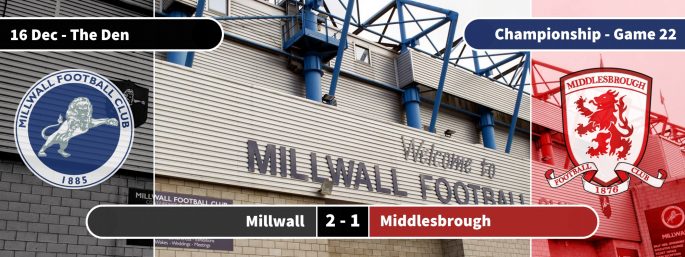
Boro 1 – 0 Sunderland

Middlesbrough Sunderland
Tavernier 6′
Possession
Shots
On target
Corners
Fouls
47%
 6
 4
 1
13
Possession
Shots
On target
Corners
Fouls
53%
10
 3
 5
17

Tav earns precious play-off points

Redcar Red reports on the Tees-Wear derby…

The dirties getting beat in West London last night saw us jump over them on GD as bar one or two results games largely went our way in the top half yesterday afternoon. A an almost perfect build up then to a game that as a consequence of those same set of results now saw the Mackem’s anchored rock bottom of the Championship and facing a localish “derby” or at least the only “derby” they will likely be having in the near future.

An odds on home win would see effigies of Ellis Short replacing Guy Fawkes on pyres 30 miles North of the Tees this evening. One of our own Robbie Stockdale and Billy McKinlay were sat in the away dug out and being fair they didn’t have an awful lot to play with. For them to consider anything other than a defensive masterclass with a few long hoofs would be seen as suicide tactics given their clubs current predicament. That said whilst getting a point would be seen as a great result, a win would lift them out of the bottom three on GD so with nothing to lose would they spring a surprise and try and get all three points?

Boro fans making their way from the Town centre towards the Riverside would have been greeted by the new Ali Brownlee wall graffiti or artwork depending on perspective adorning the Shepherdson Way Bridge. Whilst personally not to my taste in terms of presentation the sentiment is what counts and all that inspirational talk of the infant Hercules born from the river, the Iron ore from Eston Hills to a Parmo party could not possibly fail to inspire the spirit of even the most sceptical Boro fan pre KO.

Arriving inside the ground the air was pensive but exciting, almost unrecognisable from the previous few weeks were doom-laden clouds had descended over the Riverside before the travelling army witnessed GM’s damascene moment on the road to Reading then to Hull and back. Ten minutes before KO the atmosphere was building, hope was high and the away section filled with those whose predicament was the source of much merriment on the home concourses. TV Cameras in place being beamed live around the world, a building atmosphere the anxiousness of which you could almost inhale with adrenaline coursing around the ground.

Rather poignantly just as the atmosphere was building with the crowd taking over from MMP updated 90’s collection it all fell silent for one solemn, solitary minute. Petty rivalries and hostilities temporarily put aside with the common ground of respect and humility silently rippling in the flags above the East Stand momentarily perforated by one or two idiots immediately invited to shut it by both sets of fans as a bugler played the last post.

Sunderland adorned in a dull funereal charcoal and black ensemble looked the part for what was hopefully about to unfold as an unchanged Boro bar Friend for Fabio kicked off in their traditional Red with their half of the Riverside bathed in blinding winter sunshine. A few of us remarked how strong the sun was as we struggled to see through the glare, hands held across foreheads peering onto the proceedings. Surprisingly and not for the first time a Boro keeper had no cap to assist with his vision and Randolph clearly had the same problem as those in the East Stand Lower and North stands. After warm-ups like today I struggle to see how the Keepers and the Goalkeeping coaches cannot realise that a Cap is not a luxury or a fashion faux pas but an absolute necessity.

Randolph nearly paid the price for going capless in the second minute as Sunderland broke, Ndong fired in a long range shot, Grabban following up burst into the Boro box facing a blinded Randolph who squinted and squirmed Ndong’s shot only to pull off a blinding (literally) follow-up reflex save from Grabban. A standing ovation ensued but it could and should have been 0-1 to the Mackems.

That was an early wake-up call for Boro who responded by putting some pressure of their own on the packed Sunderland midfield and backline. In the 6th minute Downing fed Braithwaite who ran to the touchline cutting the ball back into the path of the onrushing Tavernier who shot slipped his shot into the net to put Boro one up. The celebrations began as we sat back expecting an avalanche. Now it is one thing for fans to sit back but unfortunately Boro did exactly that or at least they did until around fifty minutes or so later.

For whatever reason Boro looked disjointed struggling to find anything but a Sunderland player with their passing and clearances. Sunderland to their credit came back at deep-seated Boro and a McGeady free kick on 11 minutes saw a Jones header force Randolph into another world-class save. Just a minute earlier Ndong again cut in feeding Cattermole who let fly forcing Randolph into a another brilliant diving save. In all seriousness had the 12th minute ticked over with Sunderland 3-1 up there could have been no complaints.

The best Boro could muster apart from the goal in the opening quarter hour was a curling Howson attempt that went wide of the top corner sailing into the South Stand. For a Derby match the atmosphere in the Stadium was quietening down with both sets of fans unimpressed by what was on offer. My thoughts and sympathy was for those neutrals watching on in pubs around the world because it didn’t make for great viewing. A break for the previously booked and now hobbling Jones saw the arrival of Matthews coming on for Sunderland.

Just before the substitution Grant had unleashed a 40-yarder that went well wide and when I say well wide I mean 20 yards wide! McGeady then copied the former Sunderland star with a similar effort at the other end. That summed up the game, after a frantic opening ten minutes that saw three Sunderland chances and a Boro goal it was impossible to now tell which side was sitting in a play-off place and which were propping up the division. Inevitably Cattermole just had to add his name in the Referee’s book with a ridiculous two footed lunge at young Tavernier in front of the Technical area just as the half ended.

The second half commenced with Boro fans hoping a half-time GM team talk will have fired a rocket up them, unfortunately the malaise that saw shuffling, hurried, misplaced passes at the back continued and we looked distinctly edgy despite being a goal to the good. There was some appallingly bad examples of passing which inexplicably put us on the back foot on a number of occasions. Only Downing and Braithwaite seemed to be functioning on a higher level but were not without fault themselves.

An Oviedo cross found Grabban whose header went wide as he outfought Gibson not for the first time. A couple of minutes later Ndong went off injured which was a relief for Boro as he had been far more creative than anyone in a Red shirt. Just as a few mumbles of frustration were audible in the North Stand Cyrus Christie surged through to the edge of the box, played it across to Britt in a packed box whose effort (pass?) deflected to Braithwaite who hammered straight down the throat of Ruiter who got down to save. That was Boro’s sole serious effort of note in the entire second half.

Christie broke again a few minutes later trying to replicate his earlier cross but was scythed down by McGeady who earned a yellow for his troubles. The resulting free kick from Stewy ended up in the North Stand, woefully mishit summing up how dire Boro were on the day. Christie was next to go into the Ref’s book this time for getting to grips with the lively Grabban. That was the cue for GM to make his first Sub with Johnson coming on for Tavernier.

The cards continued as Sunderland’s Wilson collected his yellow for hauling down Braithwaite on the edge of the box with optimistic chants of “off, off, off” coming from the North Stand. Downing’s clever low shot was palmed away but there was nobody running in to follow up allowing Ruiter to regain the ball with ease. As Sunderland went for it the totally knackered McNair went off for Williams with Fletcher coming on for Britt to try and create an outlet with ten minutes to go. With five minutes of normal time remaining Grant left the field to applause from both sets of fans to be replaced by Forshaw who immediately upended an opponent giving away a careless free kick but his eagerness and passion at least was to be applauded.

Four more minutes of purgatory was signalled by the Fourth Official as Boro repelled without totally convincingly holding firm against statistically at least, the worst side in the division. I said before hand that I would settle for a 1-0 win but deep down it felt a little flat to be relieved at the result, even more so considering that this was a Derby of sorts that was more of a damp squib.

Tellingly my MOM was Randolph but Braithwaite is looking something special in a side that otherwise flattered to deceive on the day. Winning ugly is something we have been used to but regardless, my overall view is that if Boro want to seriously push for promotion then a lot of work needs to be done especially with careless unnecessary backline passing which created more problems than opportunities. Still three wins in three is reason enough to be cheerful.

Boro hope to add to Wearsiders woes

Werdermouth previews the visit of Sunderland to the Riverside…

It’s often said that a week is a long time in politics, but seven days in the Championship feels considerably longer. Last Saturday, as Garry Monk’s team pulled out of Hurworth on the coach to Reading, it was probably with slight trepidation as they started to glance over their shoulders like a nervous bus driver wondering if a late Adama Traore was about to overtake him. Boro had gone five games without a win and were beginning to ominously slide down the table, which had left many supporters doubting the manager’s ability to find the right blend of players and tactics. A good solid but scrappy away performance against The Royals gave Boro three much needed points, which was duly followed up three days later by a more convincing win at fellow relegated side Hull. All of a sudden Garry Monk’s men now find themselves back in touching distance of the play-off pack with a home game against a struggling Sunderland team there for the taking as they’ve hopelessly continued where they left off last season.

Football is often about the ‘ifs’ and the insecurity of those in charge, which could be described by slightly misquoting that lesser-known football pundit ‘Rudders’ “If you can keep your head while all about you others are losing theirs… then you’ll be a manager my son” – though keeping your job is another matter. Last week ahead of the visit of Boro, Jaap Stam contemplated whether it was possible that there was maybe a better man out there to take his under-performing Reading side forward. Then after losing to Monk’s men, Leonid Slutsky told the Hull board that they had a decision to make and almost implied they had every right to sack him for his failure. However, Sunderland were not going to wait around to see how their man fared against Boro and promptly dismissed Simon Grayson on Tuesday evening before he’s had a chance to raise the issue – presumably to avoid the indignation of their manager prompting them to show him the exit too. Sunderland didn’t get where they are today by allowing their managers to call the shots – though then again that might actually be the problem.

It may well be that the Sunderland chairman had become alarmed at the number of goals Grayson’s team were conceding – with 16 in their last six games it was approaching an average of 3 per game, which surely makes winning near on impossible. In addition, Sunderland have achieved the lowest points total after the first 15 games than any other club previously relegated from the Premier League. If that fact wasn’t grim enough, the club set a new record on Tuesday of 19 for the number of consecutive home games without a victory. What the Black Cats need now is a manager who can come in, organise the players and tighten up the defence – I believe there’s a certain out of work manager from Bilbao who may fit that description.

Middlesbrough Sunderland
Gary Monk Billy and Robbie Caretaker
P15 – W6 – D5 – L4 – F20 – A13 P15 – W1 – D7 – L7 – F20 – A30
Position
Points
Points per game
Projected points
8th
23
1.5
70
Position
Points
Points per game
Projected points
22nd
10
0.67
31
Last 6 Games
Hull (A)
Reading (A)
Cardiff (H)
Barnsley (A)
Brentford (H)
Norwich (H)
(H-T)
3:1 (2:0) W
2:0 (1:0) W
0:1 (0:0) L
2:2 (1:2) D
2:2 (0:1) D
0:1 (0:1) L
Last 6 Games
Bolton (H)
Bristol City (H)
Brentford (A)
QPR (H)
Preston (A)
Ipswich (A)
F-T (H-T)
3:3 (1:1) D
1:2 (1:1) L
3:3 (3:1) D
1:1 (0:1) D
2:2 (1:0) D
2:5 (1:2) L

Such has been the plight of Sunderland supporters that there’s almost a feeling of pity on Teesside rather than the usual schadenfreude. Whilst taking pleasure in others misfortune is not normally an attractive characteristic in a person, it’s pretty much the currency of local rivalry in football and if the roles had been reversed, I’m sure the sentiments would be quickly reciprocated from the banks of the Wear all the way down to Stockton. Though the sentiments uttered by many a relegation battle-weary Wearsider shortly after their fate was sealed last season was that they were actually looking forward to the Championship so that they could have a break from season after season of just escaping relegation. They’d seen neighbours Newcastle winning regularly last season and many quite fancied the idea of enjoying their weekends again and regrouping – I’m sure it wasn’t in their worst nightmares that they’d continue in the same vein in the second tier. From such sentiments complacency is born.

It’s been long since suspected that when they built the Stadium of Light they specified a requirement to install a panic room, though how it ended up being used as a boardroom is still unclear. However, reports that Ellis Short sits at meetings stroking a black cat on his knee like a bad footballing pastiche of a Bond villain in ‘You only win twice’, while the manager stands on a trapdoor above pool of red and white striped piranhas is probably just the product of an over-stimulated imagination.

Although, if ever you wanted to look for an example of impatience in football then you’d do well to find a better example than Sunderland. A manager’s tenure is often precarious but that particular position has become one of the least secure jobs on Wearside in recent years since Ellis Short arrived on the scene. The story of how he came to preside over Sunderland is perhaps one of unfulfilled ambition coupled with a group of over-ambitious businessmen used to making quick returns. Following 20 years at the helm, former owner Bob Murray and the man behind the move from Roker Park to the Stadium of Light, sold his stake to the Drumaville Consortium for the seemingly bargain price of just £10m in the summer of 2006. Named after a village in Donegal, this was a consortium of seven predominantly Irish businessmen plus former player Niall Quinn, who was the public face and fans favourite.

Each man in the consortium held an equal amount of shares except for Paddy Kelly (I’m guessing he’s probably one of the Irish members) who received a double portion. Some reports suggest that this extra share was on behalf silent partner Sean Mulryan, who had previously tried to take-over the club and is a wealthy property developer and CEO of the Ballymore Group – who for his sins is good friends with both Seb Coe and U2’s Bono, along with former-stadium fillers Blondie who dropped in to sing at his 50th Birthday party – though I suspect their iconic black and white striped cover on Parallel Lines prevented many a purchase among Sunderland fans. Incidentally, the consortium also included publican Charlie Chawkes who was once shot in the leg during an armed robbery at one of his pubs – at least they spared shooting him in the foot as no self-respecting Sunderland owner would want someone to take that particular pleasure away from them – though perhaps his loyalty to the cause was questionable as he also attempted an unsuccessful takeover of Newcastle in 2010.

So Murray reluctantly sold his stake for relatively small amount on the condition that the consortium invested in the club, however, in 2008 a 30 per cent stake in the group was bought by Irish-American businessman Ellis Short, who ran a private equity fund that focused on investments in European distressed property assets – which I’m sure is just a coincidence in him being attracted to the Stadium of Light, where distressed assets are normally the ones pulling on the red and white striped shirt.

Following the take-over, one group of Sunderland supporters were rumoured to have been asked by the local media how they felt that their club was now owned by someone who was brought up in Missouri – they apparently showed unexpected empathy and nodded in a knowing manner – it later transpired that they thought the reporter had said ‘misery’. A mistake easily made, though perhaps the long-suffering Mackem supporters could identify with Missouri as it’s also known as the ‘Show Me State’, which is a phrase that is purported to represent the sceptical nature of those born there since they are people not easily convinced – something that may help explain the managerial carnage at the club during the last decade.

The Wearside club have employed quite a comprehensive who’s who list of managers under Short and his first casualty was Roy Keane who was given an early Christmas present in December 2008. He was replaced by former Man Utd coach Ricky Sbragia who lasted until the end of the season in what was his only managerial role. Next up was Steve Bruce who enjoyed nearly two-and-a-half years in charge and completely reshaped the squad before a prolonged bad run saw his team slip to 16th which resulted in his exit that he then shamelessly blamed on being a Newcastle lad. Bruce was replaced in December 2011 by boyhood Sunderland supporter Martin O’Neill, who’s promising start faded as the season ended on an 8-game winless run, a repeat of which gained him the sack the following season with the club dropping to one place above the relegation zone with seven to play. Former Labour Party leading light David Milliband resigned as vice-chairman when the Mussolini-admiring self-confessed fascist Paolo Di Canio was brought in to save Sunderland from relegation, which he duly achieved. Then despite signing 14 players in the summer he was sacked after only 5 games when he managed just one point.

Short then turned to rising star Gus Poyet, who presided over a great escape at the end of the season despite being 7 points adrift of safety by accumulating 13 points from the last 15. Though he was sacked the following season as Sunderland dropped to 17th following a 4-0 home defeat to Villa that sparked a mass walk-out by fans. Short then appointed experienced Dutch coach and Steve McClaren sound-alike Dick Advocaat to save the club from relegation, which he did with one game to spare – he initially left but was persuaded to return and lasted until just early October before he resigned as Sunderland sat in second-bottom with only 3 points from 8 games. In came former Newcastle boss Sam Allardyce to rescue them from relegation, which he did with a few late end-of-season wins that had the added bonus of relegating the Magpies instead – he then resigned in the summer to take the England job for a game.

Big Sam was replaced by another high profile name in David Moyes, who was looking to restore his reputation after his failures at Man Utd and Real Sociedad, sadly his reputation suffered further as Sunderland ended up finally dropping out of the Premier League after ten years of flirting with relegation – Moyes resigned after deciding the funds for a promotion challenge were unlikely to be forthcoming as the club had accumulated debts of £130m. Simon Grayson was then appointed on a three-year contract to mastermind the return to the top-flight – although he started he did not finish after failing to get a pass as Short dismissed the former Preston boss stating “results have not been good enough for a club of this stature”. So ten managers in nine years and another relegation battle lined-up for the next man to be offered a three-year contract that on average probably won’t last one. What’s interesting is that this collective group of high profile managers perhaps had 15-20 years worth of contracts for them and their staff that needed paying off – a sum that could easily amount to at least a quarter of that massive debt.

All of which means Boro will be facing a Sunderland club in crisis for this televised north-east derby on Sunday. With Boro back to winning ways and Sunderland managerless and conceding two goals per game, the exponents of ‘typical Boro’ are already no doubt getting worried that the game has been set-up to deliver an unexpected defeat for the home side. They may have some legitimate causes for concern as Boro’s home displays have been much less convincing than their away form recently – you have to go back to that topsy-turvy game against QPR to find the last victory at the Riverside and since then Garry Monk’s men have struggled in front of their own crowd. However, Sunderland have only won 2 of their last 24 league visits to Middlesbrough, which depending on your state of mind either means nailed on home victory or the Black Cats are overdue a win. Though in temporary charge of Sunderland is a return to Boro for former player Robbie Stockdale to add to the occasion – with not to mention Lee Cattemole expected to put his foot into the Boro midfield to add further spice.

Garry Monk may be tempted to stick to a winning side, Fabio is apparently fit to play after he went off for an ankle knock early in the midweek victory – though natural left-footer George Friend appeared to bring out a better performance in young Marcus Tavernier. The Riverside faithful will be hoping Grant Leadbitter is fresh enough to continue running the midfield and it may well be Adam Clayton is once again overlooked in favour of the improving Howson. Britt Assombalonga has shown in recent games that if the team plays to his strengths he’ll likely bag you a goal – hopefully he’ll repeat his feat against the other clubs in the bottom three and score another brace. It would be a welcome relief if Boro make it three wins in a row to go into the international break full of confidence – though the final game before the previous two breaks saw Boro put in disappointing performances against Preston and Brentford as Monk made some odd team selections.

So will Boro’s luck be in as the Black Cats cross their path at the Riverside? Or will the cornered feline failures show their claws and leave Garry Monk’s men licking their wounds? As usual your predictions for score, scorers and team selection – plus will Aitor Karanka be at the Riverside to take a look at the players of his next employers?