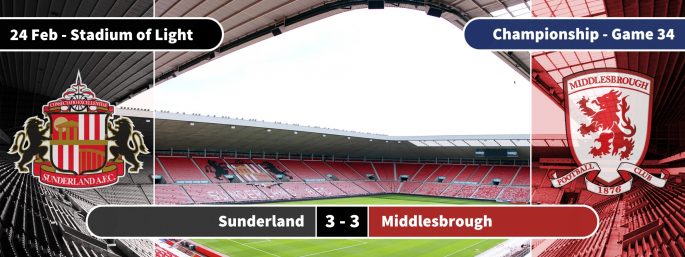
| Sunderland | Middlesbrough | ||
| Asoro Williams McManaman ▮ Clarke-Salter |
11′ 58′ 90’+6 24′ |
Bamford Leadbitter ▮ Traore |
49′, 68′ 53′ (pen) 37′ |
| Possession Shots On target Corners Fouls |
51% 17 7 4 14 |
Possession Shots On target Corners Fouls |
49% 11 4 2 10 |
Defensive Callumity costs Boro
Normally I begin these pieces with a bit of up to date background info on our opponents and how they are shaping up with specific regard to any problems, injuries, suspensions and possible team selection headaches etc. coming onto the game. This however is Sunderland and it’s very difficult to know where to start and where to finish. Allegedly Ellis Short is now so desperate that he is willing to give the club away if someone is willing to take on the supposed £170m debt.
I wonder if Chris Coleman knew when he took the job on that the depth of the clubs problems are even deeper than the former Wearmouth Colliery upon which it stands and that the monumental Davy Lamp outside was supposed to be a beacon of light for the clubs future. Either way it looks a complete shambles from the outside looking in with League 1 Football beckoning (or worse should Short pull the plug on his unbeloved sojourn in the world of Soccer). Ellis Short’s Wikipedia page describes him as “founder of Kildare Partners, a private equity fund investing in distressed European real estate assets”. Well they certainly don’t come any more distressed than SAFC!
On the actual footballing front defender Adam Matthews and midfielder Ovie Ejaria were hoping to be available to Chris Coleman in the Makem’s desperate struggle for survival against their “local rivals” as oppose to “a derby” of course, Middlesbrough. Matthews has been struggling with a hamstring injury while Ejaria was 50/50 with a thigh problem.
Boro were concerned about Ben Gibson and if he had recovered from his illness bug on Tuesday evening. After 85 consecutive games his absence should have been sorely missed but all credit to Dael Fry who slotted in seamlessly alongside Ayala and given today’s opponents many thought it would make sense to let Ben fully recover and give Dael another run out.
Of more concern was the doubt over our new found Goal Machine who seemed to somehow tweak his ankle in the dying seconds on Tuesday night? Rumours during the week had ranged from a slight twist and he will be fine to a broken metatarsal but the formal diagnosis was much worse with a fractured ankle and will now be out for the season. Other than that TP’s Friday pre match conference gave little away and as we now know what TP says in those conferences and what is actually going through his mind can be somewhat disingenuous.
Boro were looking to make it 6 wins on the trot against the Black Cats and with odds of 21/20 It was a game that looked almost impossible to lose especially with Sunderland letting in eleven goals in their last five league games with 10 of them coming in the first half. The hope for those of us travelling up the A19 was that the sea of pink plastic would have grown significantly by half time as is now the custom these days on Wearside. The Hull victory over Sheffield United last night piled huge additional pressure onto Sunderland but simultaneously provided Boro with a massive incentive as an away win today would put us in sixth spot with Bristol not playing until Sunday.
TP went with Assombalonga for Gestede and restored Gibson to CB in place of Fry who took a seat on the bench and thereby keeping disruption to the starting eleven to a minimum with everyone else in their usual positions or so we thought as Traore was on the left flank. Coleman had Matthews available and so went with wing backs or more likely five at the back. He gave starts to both Asoro and Maja up front as he realised with a solitary goal apiece all season between them the teenagers probably weren’t going to be a major concern for Boro’s back line on their own.
The teams entered the pitch in bright winter sunshine but with a distinct chill in the air caused by the proximity to the North Sea rather than the Home fans although that was subjective. Judging by the empty seats and lack of enthusiasm from the Makem fans the “derby” question had been answered as they kicked off. Early intent was seen from Asoro after a poor Shotton clearance led to the youngster blasting his effort well over the bar.
Cattermole gave away possession allowing Boro their first serious foray into the Sunderland half but he got back making amends for his error as the game started with plenty of energy. Sunderland were certainly attempting to have a go and those wing backs were endeavouring to create rather than defend surprisingly. The Swedish youngster Asoro got his head to the ball beating a Shotton/Ayala sandwich this time from a long throw in after a flick on beat Friend to open the scoring exploiting some sloppy defending on eleven minutes. Boro had been “outPulised”, beaten at their own game. Traore had been anonymous up to this point apart from one dribble which was perhaps no surprise considering he was ineffectively deployed on the left yet again.
Boro needed to clear their heads and get stuck in because the opening quarter of an hour was non-descript with Sunderland good value for their lead. McNair clattered into Paddy and looked to be in some pain for his efforts and not long after Matthews looked to have also hurt himself after a tackle on Friend. Twenty minutes gone and the most cause for Boro optimism at this point was that Sunderland may end up with a few players struggling through injury.
A Shotton throw in was launched for Ayala who had run forward into the Sunderland half but it went out aimlessly for a goal kick which summed up the lacklustre start from those in white shirts. A break from Asoro nearly doubled the lead for Sunderland as Boro contrived to try and find some shape with both Friend and and Shotton guilty of some defensive panics. Immediately afterwards Traore who by now had been switched to the right since going behind was scythed down by Clarke-Salter in a challenge that sent Adama literally flying into the air on the half way line and rightfully receiving a straight red for his horrendous assault. Why Traore was stationed on the left was bizarre as it is well known that Sunderland have struggled down their left flank all season so surely Adama on the right would have been a match made in heaven?
Now down to ten men after 28 minutes Coleman was forced into a reshuffle to try and defend his side’s slender lead. Traore meanwhile had become the target for abuse from the Home fans jeering and booing his every touch of the ball for his audacity in avoiding a broken leg. A couple of minutes later a ball in from Friend presented Traore with a half chance but he stabbed it over the crossbar. A Downing free kick was then poorly executed as Boro had begun to start to make the extra man count but still no breakthrough was forthcoming.
McNair looked crocked and was hobbling around as Coleman looked at his scant options and didn’t want to bring off one of his more experienced players so early in the game. His previous challenge on Bamford looked to have seriously left its mark on the Northern Ireland International rather than Paddy. A Grant corner then saw a Bamford effort cleared away for another Boro corner, immediately after/during Sunderland clearing the corner there was an “off the ball” incident involving Traore and Oviedo. Adama got his marching orders as a consequence reducing both sides to ten men but not before he threw several strops and fits on his way off the pitch including a verbal assault on the fourth official and even wrestling with a team mate trying to usher him away down the tunnel.
Less than ten minutes now to go to half time, a poor start, a failure to take advantage of ten men and Boro now found themselves down to ten men due to sheer petulance from Traore and in his absence now zero creativity. McNair eventually limped off with Welsh International Williams taking his place just before half time.
Maja picked up a yellow for a challenge on Leadbitter which saw Grant put in another of his infamously poor free kicks straight into Camp’s arms. I sometimes wonder if Stewy and Grant have a wager on who can take the worst corner or free kick so consistently poor are their deliveries of late. Eight minutes of additional time due to the injuries to McNair and Matthews and the two sendings off didn’t inspire Boro in what was a below par first half for the visitors.
The half time whistle went. Overall we had looked flat, lacking conviction and were second best to Sunderland’s fighters for survival. After the first sending off we had come back into it but with Traroe then seeing Red we just faded. My take on it was that Boro had started this game with the same mind-set they finished off with on Tuesday night and had struggled to shake that mentality off. TP not for the first time since his arrival had some major talking to do during the interval, like Downing and Leadbitter’s set pieces a pattern is emerging and not a good one.
The twenty players started the second half with Boro kicking off and Shotton then immediately hoofing a ball aimlessly. Our full backs pushed up with Shotton, Stewy and Friend linking up and feeding Bamford who controlled brilliantly from Friend’s header in a packed box turning, twisting and swivelling to equalise. The game then entered a manic few minutes as Boro wasted a quick free kick then Assombalonga was going wide past Camp who “brought” him down after a cleared ball deflected into the Sunderland box off Shotton and a penalty was awarded to Boro literally seconds after Paddy’s goal. Grant stepped up and despite his dire free kicks his spot kicks are calm, cool and collected and he stroked it home into the bottom right hand corner for Boro to take a 2-1 lead.
George Honeyman raced free into the Boro box from the KO and Shotton interrupted his flight just outside the box. Sunderland now had an opportunity to quickly draw back level but fortunately Cattermole hit it wide much to Randolph’s relief. Ten minutes of the second half gone and the match had erupted into life as Assombalonga now latched onto a ball down the other end only for the Lino’s flag to rule him offside. Oviedo then went past Downing on the left flank to put a ball into Sub Williams who had lost Grant and blasted it unmarked into the Boro net (just as the home fans had been getting onto the backs of the Black Cats) pulling it back to 2-2 and restoring hope once again to the beleaguered home fans.
Boro were once again rocking again as the Black Cats had their tails up sensing shell shocked Teessiders who had thought they had already done enough to seal the points. Heads once again needed to be cleared as silly balls were now being given away and Boro needed a spark. That spark came in the form of Harrison as Britt was taken off much to his disgust and my surprise. TP I suspect felt that we needed more energy and pace than Britt provided and almost instantly Paddy had a chance that he fluffed after being played in by Besic. Coleman then responded by bringing on McManaman in an effort to turn the game in his favour.
With Bamford now leading the line Besic once again put a clever ball through the split Sunderland defence that Paddy latched on to, went wide of Camp and cut back an acute left footed shot to send the away fans euphoric.
The game was by no means over as literally anything could happen and Sunderland still fighting as the Boro fans gave a rendition of “you’re going down”. McManaman meanwhile tested Randolph’s palms and Shotton fortunately cleared the danger then in the next phase managed to give a free kick away for a foul on Williams. Fortunately Shotton himself reacted first to the ball with McManaman closing in hitting a wild shot wide.
TP then made two changes with Grant and Stewy coming off for Clayts and Howson respectively. Grant received a warm ovation from both sets of fans as he made his way for Clayton with TP presumably wanting to add some fresh legs with a like for like swap. Coleman countered with George Honeyman coming off for Sunderland and Aidan McGeady coming on with a quarter of an hour to go. A well won corner won by Asoro hassling Ayala was flapped at by Randolph as Sunderland still had belief and no wonder considering the manic events of the afternoon in general.
Pulis was out instructing his players to keep their heads and remain calm rather than do anything rash. Howson was then wiped out by McGeady in a clash of the subs which ended in a Boro free kick from Howson himself but the ball was once again a poor one and this time neither Downing nor Grant were on the pitch to blame. Sunderland desperately needed something from the game and were pushing but also looked susceptible and the lively McManaman reminded Randolph once again to stay alert with Shotton coming to the Boro Keeper’s rescue once more who wasn’t having the best of afternoons. Cemented to the bottom of the table versus potentially sixth place meant that anxiety levels were high and rising as the Black Cats pushed forward with McManaman trying to entice Friend into a rash penalty but the Ref was having none of it.
Six minutes of added time was found from somewhere. Clayton played a ball through for Bamford and he was fouled by Oviedo. Bamford stood isolated supported only by Harrison arriving late and decided to take charge of the free kick. He fizzed the ball over the Sunderland wall forcing Camp into a save in what was by far the best set piece of the afternoon. In fairness to Paddy he made a strong claim this afternoon to be the man to fill Gestede’s central striker vacancy.
A foul on Williams saw the Ref wave play on and Asoro almost nicked an equaliser but Randolph got down this time making a good save. A corner in the last minute for Sunderland found McManaman ridiculously free running around the back of the Boro defence in another atrocious piece of defending to pull the sides level and with it Boro remained out of the top six after having briefly entered it and the game ended 3-3.
MOM for Boro was Besic but overall Boro were unconvincing throughout the afternoon. This game highlighted far too many avoidable deficiencies across the entire side from woeful set pieces, poor discipline again to defending that was pure comedy made worse by the fact that defending corners and poor concentration had done for us yet again.
Pulis hoping the Mackems continue
to make a habit of losing to Boro
Boro head to their charitable north-east neighbours Sunderland on Saturday in anticipation of collecting their usual donation of three points to help them with their worthy cause of closing the gap on the promotion pack. After play-off rivals Fulham and Bristol City shared a point in midweek, they now face tricky fixtures against Wolves and Cardiff respectively, which offers the tantalising prospect of Tony Pulis’ team actually breaking into the top six. Boro will be in confident mood of picking off another fellow relegated club after the midweek victory over Hull, especially with the Wearside outfit low on confidence after returning to the foot of the table following defeat at relegation threatened Bolton. Boro are usually lucky when the familiar opposition of the Black Cats cross their path and have enjoyed a spell of good results in recent times. Admittedly Tony Pulis said he didn’t possess a magic wand when he took over, but with the season fast heading towards its conclusion, many supporters are hoping his new broom will help Boro conjure up a winning run with some wizardry on the pitch.
As welcome as it was to beat Hull on Tuesday, Tony Pulis needs his Boro team to go on a winning run if they are to end up in the play-off zone come the end of the season. Not an easy task if you consider Boro have just once managed three wins in a row (Reading, Hull, Sunderland) and in addition only twice managed back-to-back victories (Games 2-3: Sheff Utd, Burton and Games 23-24: Sheff Wed, Bolton). After nine league games in charge since replacing Monk, the new Boro manager is still looking to win two successive league games and that was probably not why he was installed by Steve Gibson. The trip to Sunderland gives him his best opportunity so far of achieving this feat and only after that box has been ticked should we start talking about continuing the run against Leeds, Birmingham or Barnsely.
Sunderland are once again staring relegation in the face and even manager Chris Coleman is sounding resigned to the fate of the club as they continue where they left off last season. The former Welsh national manager has already seemingly placed the blame at the bullet-ridden feet of the Wearside club’s owner Ellis Short. The aloof American has abandoned the spurned supporters to leave them feeling like a humiliated jilted bride in a replica red and white striped wedding dress who has barricaded herself in a Stadium of Light executive box with just a congealed chocolate fountain and several crates of room-temperature Asti Spumante to see her through to the inevitable confirmed relegation. Coleman declared: “Obviously Ellis wants to sell the club and they [the fans] recognise that maybe his love for the club was yesterday… so until we get someone that wants to turn a corner with it and love it, care for it and look after it, you get the negativity.” All of which has seemingly left the club in search of a cat loving philanthropist who is somehow capable of grabbing the steering wheel off the absent owner to prevent him driving the club off the Seaburn Cliffs by proxy.
The accounts of the Black Cats are heavily in the red with a debt, which depending on reports, is estimated between £150-200m, with owner Ellis Short having investing less than £2m on new players this season despite £47m parachute payments and £30m received from the removal of former keeper Jordan Pickford to Everton. Coleman understands all the anger and frustration from everyone associated with the club but admits they have no choice but to accept the situation and said “We’ll take that on the chin. But until we have a new owner with new ideas, we are where we are.” – which appears to be somewhere between rock bottom and the hardest of hard places. However, after Coleman swapped Wales for the wails of Wearside his words at his unveiling were hardly ones that looked like rousing the supporters: “Someone’s going to turn this club around. Whether it’s me or whether it’s the next one, sooner or later this club will start climbing again, start playing in front of a full house again” – I suspect it may be later, very much later.
Short will have his work cut out to find a buyer for a club that so rarely delivers – though there is one possible American buyer seemingly fond of red and white stripes in the news recently that although may not have the faithful on Wearside licking their lips in anticipation, it will perhaps have them lickin’ their fingers instead. Whether these potential new owners have the secret recipe for success is another matter but a suitable owner for Sunderland could well be Colonel Sanders along with his recent infamous organisational ability. However, before any upstanding Mackem is tempted to reach for their phone and dial the police with evidence of fowl play, they should be warned that their local constabulary may be following the lead of Tower Hamlets Metropolitan Police Service on such matters. If you’re not aware, they urged the public to stop calling them to report that KFC has run out of chicken by tweeting: “Please do not contact us about the #KFCCrisis – it is not a police matter if your favourite eatery is not serving the menu that you desire.” Maybe so but try telling that to Chicken Runners on Teesside who have gone cold turkey and have been contemplating the possibility of deep frying foam hands to get through the crisis. Nevertheless, serving up a well battered boneless product that includes a moist tissue at the end is something Sunderland fans have got used to over the years.
| Sunderland | Middlesbrough | ||
| Chris Coleman | Tony Pulis | ||
| P33 – W5 – D11 – L17 – F34 – A58 | P33 – W15 – D6 – L12 – F43 – A31 | ||
| Position Points Points per game Projected points |
24th 26 0.8 36 |
Position Points Points per game Projected points |
8th 51 1.5 71 |
| Last 6 Games Bolton (A) Brentford (H) Bristol City (A) Ipswich (H) Birmingham (A) Hull (H) |
F-T (H-T) 0:1 (0:1) L 0:2 (0:2) L 3:3 (0:3) D 0:2 (0:2) L 1:3 (0:2) L 1:0 (1:0) W |
Last 6 Games Hull (H) Cardiff (A) Reading (H) Norwich (A) Sheff Wed (H) QPR (A) |
F-T (H-T) 3:1 (2:1) W 0:1 (0:1) L 2:1 (1:0) W 0:1 (0:1) L 0:0 (0:0) D 3:0 (2:0) W |
Along with Sunderland, Boro have been no stranger to defeats this season, though whilst they have not suffered as many they have nevertheless proved costly and the job of a manager is to deliver psychological messages that prevent defeats from undermining the team’s confidence. When a team loses, particularly narrowly, the manager will often focus on the key events that didn’t go in their favour – such as a refereeing decision or an individual error. The aim is to rationalise the defeat and try to find legitimate excuses for the failure to win so that the players remain convinced that they were capable of achieving victory under the manager’s methods. When this is not possible, an alternative tactic is often to say ‘we were simply not good enough on the day’ or ‘we must learn from our mistakes’ – this is instead creating a mood that the team had an off-day and can do much better. In both instances the manager wants to keep the players confident that the team is capable of winning games, both as individuals and under his game plan.
This ‘excuse’ strategy is geared towards getting a response from the players so that they will continue to play with the belief that they will perform better in the next game and hopefully win. Winning after losing a game will usually help negate the impact of the previous loss but much will depend on the overall mentality and ability of the team in deciding if this is sustained or not. Creating a winning mentality also needs the manager to instil the right attitude into the players and part of that is also learning to deal with the consequence of winning. It sometimes creates the trap of believing that you are better than you are, which can results in players thinking that they only have to turn up to win a game against perceived weaker opposition. This is why we often talk about needing leaders on the pitch, who like the name suggests, lead by example and will always give 100% regardless of the strength of the opposition – or even 110% if their manager is prone to hyperbole and an advocate of quantitative impossibilities. Without such players in the team there is a risk that some will play within themselves in the belief they will ultimately beat their opponents due to the perceived superiority.
Psychologists have shown that the emotional response to losing or making a mistake can manifest itself in one of two ways – engaging in risky behaviour to try and make up for the failure or becoming instead over-cautious out of fear of repeating the error. It’s something we may observe with strikers who have gone on barren runs or defenders who have made a costly error. If the player can follow up a bad performance with good one or even score a goal then the slate has been wiped clean in their mind – but it’s no fun to watch a player struggling on the pitch as their confidence has deserted them and suddenly the crowd are on their backs. More experienced players who have come through similar runs should have the resolve to get through it but sometimes it can stall the career of a younger player, who often finds themselves out of the team and feeling their chance has gone. That’s why good managers will view mistakes by players as an opportunity to learn and not try to openly blame or discard them from the team.
So what is it about winning that lifts those who experience it? Well when biologists are not busy on random projects like growing human ears on the back of mice, they sometimes turn their attention to other less tabloid-friendly matters. Studies have shown the testosterone levels of athletes who win races increase significantly and this in turn increases the chemical dopamine, which is the chemical messenger that hits the reward centre in our brains and makes us feel better. In the animal kingdom, the ‘winner effect’ is a term that describes how competing males first fight off weaker contenders to boost their dopamine hits to their brain as it then subsequently means they are far likelier to win a contest against a stronger contender.
It’s a bit like the scenario of a young male lion, possibly called Roary, who wants to boost his confidence ahead of a pending battle against a big bad wolf from the Birmingham area, he would first perhaps test himself against a toothless lame Tiger from a nearby circus run by clowns before attempting to savage the beaten-up neighbourhood black cat from up the road. So when Boro fans start singing to the Sunderland supporters “can we play you every week” it’s not intended as an unkind bout of gloating but is simply their inner evolutionary biologist wanting to get their team up for the next big game against stronger opposition. All this valuable work helps us understand the biochemical consequences of sport – though researchers are still awaiting funding to discover how much the testosterone levels would increase if you were to shout ‘Boo’ behind a mouse with a huge ear on its back while it wasn’t looking.
Anyway, the task of a manager who wants to tap into this ‘winner effect’ phenomenon should be to try and extend the concept of winning from merely just the actual result and instead make it into a more fluid concept – though some will already be familiar with the fluid nature of what constitutes success in the eyes of Boro managers from listening to post-match interviews over the years. Though rather than talking about attempts after the game to rationalise the failure to win, it is important for a manager to set individual and group goals ahead of the game, which can then be used to gain positives when they are achieved. It is not possible that simply setting the target of winning a game can be used to help a group of players progress, so other measures need to be used to build the confidence and a sense of achievement. For example, keeping a clean sheet is often used as one such goal – though under some recent Boro managers it sometimes seemed that was indeed the only goal witnessed!
How the club ultimately performs over the current season tends to be judged in the context of what the expectations were. Whilst we all may have our own ideas of what we are expecting from our team (with some supporters less easily pleased than others) its normally from the owner where the real expectations are driven. If we look at Boro, it was clear from Steve Gibson that he had indicated that automatic promotion was the target – with his infamously misquoted sentiment of wanting to ‘Smash the League’ seemingly engraved on the baseball bat that was used to beat the manager and players with every dropped point and position below the top. Whilst ambition is admirable, being measured against over-ambitious targets has a similar effect of being on a losing run – both are held up as failure and anything below automatic promotion was perceived as thus from both inside and outside the Boro camp. It probably also didn’t help to suggest that before a ball was hardly kicked in anger, it was boasted that we had the best squad in the league – possibly the biggest budget but that is never a measure of quality unless it is wisely spent.
Did some of the players suffer from loss of confidence as a result of not sitting at the top of the table? Or were the players who were brought in not mentally tough enough to fight for the right to sit at the top of the table? Perhaps the continued pressure of needing to try and win each game in order to play catch-up with expectations has ultimately prevented the team from building a good run of results. If you also add into the equation that a significant number of players in the squad were still feeling bruised and fragile from their Premier League experience, then it may have been better in hindsight to have set the target of making the play-offs as the only target and then less people will have viewed the season in the context of under-achievement.
The idea of setting manageable goals in sport is a crucial aspect of the psychology of ensuring achievement – If expectations are placed beyond what can realistically be achieved, then without a well defined improvement plan, the mental pain response will kick in and leave sportsmen feeling miserable – which is certainly true in the case of Boro followers, who have generally felt miserable all season as most expected a lot more. Too many people were perhaps caught up in the hype that spending big money equated to a guarantee of success rather than just the price of failure being more costly.
Despite Tony Pulis having a less than auspicious start to his tenure, there are some signs that he has a good understanding of how to get the best from his players. His transformation of Adama Traore from a bit-part player with potential to probably now our most effective player has been to his credit. He has done this by focusing on what the player can do well and giving him some slack on other aspects – it has improved his confidence and made him feel an important member of the team, which has added belief in himself and belief from others too. The problem of giving a player too many tasks to carry out will lead to them failing at some and distract from what they do best, which contributes to undermining their confidence. Pulis was also not afraid to drop players who weren’t performing in their roles and with Assombalonga it appears it’s going to be a hard road ahead. Two goals for Gestede will have given him a boost that he can be a Pulis target man that also scores goals and with Bamford showing he still has the scoring touch it leaves Britt with a lot to prove. Whether he will get the pitch time to show it is another matter and at some point he may mentally start to shut down if he no longer believes he can offer something that his manager wants.
Overall there are perhaps signs that Tony Pulis has enough players at his disposal who are maybe capable of showing the form needed to reach the top six goal that many were starting to think was just beyond reach. Mo Besic has shown in his last two outings that he offers the drive that was missing in central midfield with the hope that Jack Harrison will also soon be match fit to add a little extra guile to the team. If some of the strikers also rediscover their scoring touch then it will mean Boro could be finally ready to go as the business end of the season arrives. However, failure to pick up the points against a poor Sunderland side at the weekend will leave the concept of forming a ‘winning mentality’ back on the drawing board as Boro miss out on yet another opportunity to prove their critics wrong.
So will Boro be the alpha male that get the much needed dopamine hit after defeating the neighbourhood pretenders? Or will the Black Cats reveal our beta-release team is just not up to scratch? As usual your predictions on score, scorers and team selection – plus will the KFC chickens finally come home to roost at the Stadium of Light?